


Is “ecology and cash flow” the answer to AI investment? Apple (AAPL.US)'s market capitalization broke 5 trillion dollars for the first time and wants to invade global homes with Siri AI
The Zhitong Finance App learned that Apple product whistleblower Mark Gurman (Mark Gurman), who has revealed the details of iPhone updates accurately and in advance several times, published an article on Tuesday saying that Apple is preparing to use Siri AI as the core to greatly penetrate the global smart home market. This also means that Apple (AAPL.US), after falling behind other consumer electronics companies in the smart home market for many years, is preparing to enter the field in a big way with a new end-side device and AI software ecosystem. Apple, which recently bucked the trend when the AI computing power theme plummeted, wants to launch a spectacular new offensive.
Quoting information revealed by people familiar with the matter, Gulman wrote that the company plans to soon launch this smart home product offensive with a smart home hub device built around the new Siri AI assistant. People familiar with the matter said that Apple is also preparing to release a new TV set-top box and an upgraded HomePod mini smart speaker. Since the relevant plans have not been disclosed, these people familiar with the matter requested anonymity.
All three devices are close to launch. Apple plans to launch the new Apple TV and HomePod mini in the fall of this year, and release home hub devices between October this year and the beginning of next year.
According to Gulman, Apple plans to launch a Siri AI home hub with a 7-inch display and simultaneously update Apple TV and HomePod mini, which will be further extended to home security cameras and robotic terminals equipped with robotic arms in the future. Its strategic value far exceeds that of a new smart speaker: facial recognition, personal schedule and information call, FaceTime, door lock and home appliance control, multi-room communication, and security monitoring, which can upgrade Siri AI to an always-on home operating system and environmental computing portal.
This move will enable the iPhone smartphone product line owner to compete more directly and fiercely with Amazon and Alphabet's Google in a market that is being updated and iteratively reshaped by artificial intelligence technology. Apple's new home hub will go head-to-head with Amazon's Echo Show and Google's Nest Hub product line.
As of the July 28 intraday market, Apple's stock price once rose to about 340 US dollars, reaching the market capitalization milestone of 5 trillion US dollars for the first time; Nvidia's market capitalization fell back to about 4.74 trillion US dollars. The “AI computing power beta strategy weather vane” of the US stock market, iShares Semiconductor ETF, once fell by about 4.6% on the same day. This strong contrast shows that Apple's smart home plan hits the current market's most willing to pay a premium: as the AI infrastructure sector is being re-examined due to capital expenditure, financing arrangements, and final return, Apple is showing investors a path to commercialize AI based on strong cash flow based on existing terminals, user data, and ecological distribution capabilities.
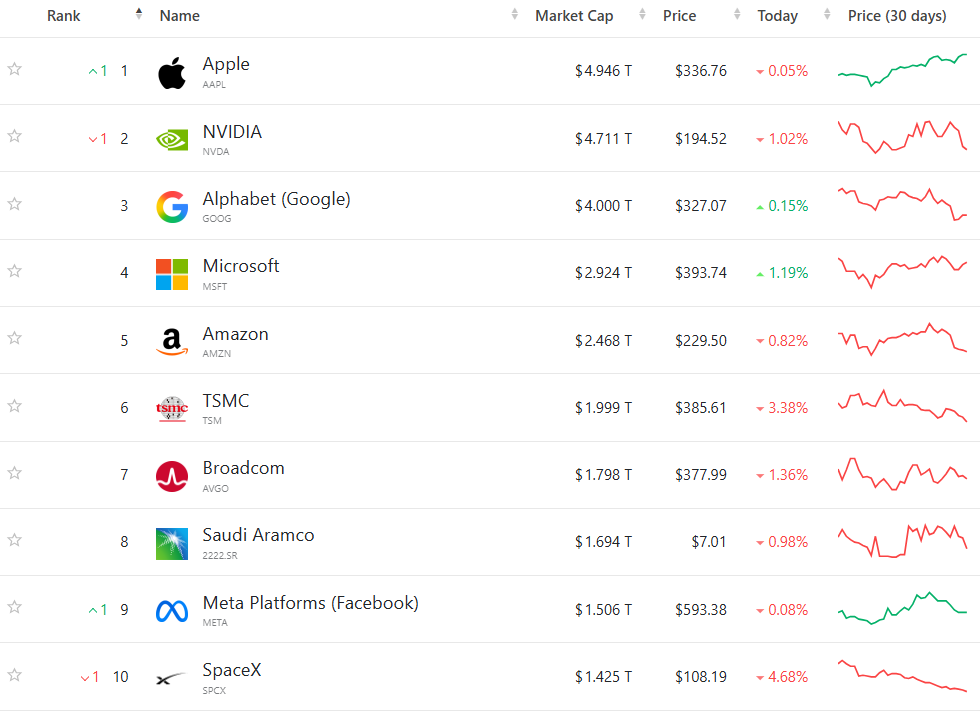
In other words, the Siri AI home hub added a new long-term growth opportunity to Apple, which recently bucked the trend and reached new highs, strengthening the market belief that “not only did Apple not miss the AI superwave, but it could reap AI dividends at the end-side AI application layer.”
The semiconductor sector faced concentrated sell-off due to AI infrastructure financing risks, return on capital expenditure, and competitive pressure from China, while Apple regained the top position in global market capitalization with a relatively asset-light AI path, stable profits, and terminal ecology, highlighting the shift in market investment trends from “AI computing power frenzy” to “cash flow and so-called ecological rent” — the market is beginning to shift from rewarding capital investment scale to examining free cash flow, user entry, service revenue, and AI commercialization efficiency, as well as the ability to continuously monetize based on hardware installation infrastructure, service systems, and user stickiness.
Siri AI wants to seize the center of the home
Apple is by no means simply updating product lines such as Apple TV and HomePod mini, but is trying to redefine the human-computer interaction portal in the home scene using Siri AI as the operating core and the smart home hub as the hardware carrier.
Approximately 7-inch displays, facial recognition, distance sensing, personalized calendars and memos, FaceTime, home security, device control, and multi-room intercom will transform the new device from a traditional smart speaker to an “environmental AI terminal” that can recognize family members, call personal information, and actively adapt the interface. The wall-mounted version of the J491, the desktop version of the J490, and the future 9-inch robot version equipped with a robotic arm show that Apple is not a single popular device, but a home AI node network covering multiple rooms and connecting different terminals.
Strategically, Apple is upgrading Siri AI from iPhone functionality to a unified intelligence layer across iOS, tvOS, watchOS, and home hardware: user data, device control, security, and content services all operate around the same identity system. Its real competitors are not only Amazon Echo Show and Google Nest Hub, but also the home security portal represented by Amazon Ring, as well as control platforms for future robots and artificial intelligence. Apple officially announced the software framework for next-generation Siri AI and Apple Intelligence (that is, Apple Intelligence) in June 2026. This provides the software foundation for the reported home hardware route, but the specific product plans still come from anonymous sources and have not been officially confirmed by Apple.
From selling hardware to running household data: Apple's search for a second ecological closed loop in the post-iPhone era
Until now, Apple has failed to develop household products into an important source of profit. Its HomePod smart speaker was first launched in 2018, while the Apple TV set-top box debuted almost 20 years ago, and both have relatively limited sales. Most of the revenue from Apple's wearables, home, and accessories business comes from AirPods and Apple Watch.
Apple's smart home hub will be equipped with a 7-inch square display, which aims to be the core of the company's restart of the smart home offensive. The device runs a new operating system based on Apple TV's operating system, tvOS. The interface looks like a fusion of tvOS, watchOS, and iOS, with an icon grid, widgets, and apps.
The device supports FaceTime video conferencing, home security monitoring, and an internal communication system for families with multiple Apple home devices. Users can manage and control smart appliances such as speakers and door locks, as well as view photos, access calendars, and play music. According to people familiar with the matter, the device also comes with a variety of customizable dials similar to the Apple Watch.
Its signature feature is facial recognition, which enables the home center to recognize the person viewing the display, determine the distance between them and the device, and personalize the interface in real time. The device can adjust the size and type of information to make it easier for users to view content, while displaying that user's calendar, notes, and other personalized content based on who is standing in front of the device.
In the article, Gulman stressed that Apple representatives, headquartered in Cupertino, California, declined to comment on all the information revealed by people familiar with the matter.
This product is designed to take full advantage of Siri AI. Siri AI is an upgrade to this voice assistant. It can call the user's personal information and allow the user to accurately control the application through voice. Apple also plans to launch a supporting interface for the iPhone to help users set up and manage this home hub.
Apple will launch two versions. The first version, internally codenamed J490, had a display mounted on a half-dome-shaped base and looked like a HomePod mini cut in half. The other version, codenamed J491, is designed to be fixed to the wall through a new magnetic system. Apple envisions users being able to deploy multiple devices at home.
The new Apple TV and HomePod Mini are internally codenamed J265 and B525, respectively. They look similar to the current version, but will be equipped with a faster processor to support Siri AI. Apple has recently raised the prices of these two devices to $199 and $129, respectively.
Since 2024, Apple has been promoting the release of these three new home devices. At the time, Apple originally planned to launch a completely revamped version of Siri. Due to engineering and quality issues, the assistant was delayed and eventually renamed Siri AI, and is scheduled to be released along with iOS 27 and other new operating systems this fall.
After the first extension in 2024, Apple sought to release these new hardware in the spring of 2025. After that, the planned release was postponed to fall 2025, and then to spring 2026. The main challenge is that these devices can't be released without the software and AI features that surround them. Although less likely, it is theoretically possible that these products will be extended again.
The first three Siri AI-powered home products are a prelude to at least two other new devices. The first one is a higher-end home hub with robotic features. The robotic robotic arm allows the display to move and interact with humans. For instance, it can capture more people or objects during FaceTime calls. This more advanced device has a 9-inch display.
Apple is also planning to launch an advanced indoor security camera codenamed J450 and a related system to compete with Amazon's Ring.
Behind the chip crash and Apple's record high: the market is shifting from an “AI computing power frenzy” to “cash flow and ecological rent”
Apple is preparing to use Siri AI as the core to massively penetrate the global smart home market, which can be described as adding fire to Apple's recent record high against the trend. This latest plan has indeed added fuel to Apple's stock price, but whether Apple can continue to outperform Nvidia and the semiconductor sector ultimately depends on whether it can prove — in the AI era, the most valuable thing is not only to manufacture computing power, but to control the entry that billion-level users use computing power every day.
The core revealed by “Nvidia was sold off miserably, and Apple regained first place” is not that the market denies demand for AI computing power, but rather that it is beginning to differentiate between the capital risk of AI infrastructure and the monetization quality of AI application entrances. Nvidia is reported to be considering providing financing guarantees of up to US$250 billion for 10 gigawatt data centers participating in OpenAI, and is separately discussing GPU procurement financing of up to US$350 billion; related news drove its stock price down about 4% to 5% due to market concerns that chip suppliers are moving from high-margin equipment sales to customer financing, rental guarantees, and potential credit risk.
Apple, on the other hand, does not need to replicate the balance sheet expansion of hyperscale cloud vendors: its latest disclosed quarterly revenue reached $111.2 billion, up 17% year over year, earnings per share increased 22%, operating cash flow exceeded 28 billion US dollars, and service revenue reached another record high. As a result, capital is shifting from “who invests the most GPUs and data centers” to “who owns the end users, distribution channels, and verifiable cash flow.”
However, Apple's belief does not mean that valuation can be separated from the infinite expansion of the ability to cash out. Currently, Apple's price-earnings ratio is about 41 times, and the $5 trillion valuation has taken into account the high expectations of the smooth implementation of Siri AI, the continuation of the hardware switching cycle, and the continued growth of the service business in advance. The smart home plan will only be upgraded from a “narrative catalyst” to a “profit catalyst” once Siri AI is stably launched, devices are released on schedule, users are willing to deploy terminals in multiple rooms, and further converted into iCloud, security, media, and other subscription revenue.