


A classic that never fades! Coca Cola (KO.US) eats up World Cup dividends, performance outlook overcomes turbulence in AI computing power
The Zhitong Finance App learned that the latest performance data released by Coca Cola (KO.US), the most iconic market capitalization giant in the US stock market, shows that the company raised its full-year performance forecast, benefiting from a strong boost in demand in the last quarter during its period as the main sponsor of the FIFA World Cup. Coca Cola's strong long-term cash flow and raised performance expectations can be said to have directly “added a spark” to the company's contrarian rise at a time when the AI computing power theme plummeted, highlighting the recent shift in global capital to high-quality, low-momentum, and abundant cash flow with alpha potential, and this year's strong fundamental cycle sector and defensive stocks far below that of technology stocks.
Atlanta-headquartered Coca Cola currently expects at least 5% growth in endogenous sales throughout the year, after forecasting a 4% to 5% increase. The company also raised its earnings per share increase forecast to a maximum of 8%, which is a full 1 percentage point higher than before.
As the South Korean stock market, which has the title of “AI computing power weather vane,” falls into a bear market, and the Philadelphia Semiconductor Index of the US stock market falls into a bear market, and global AI computing power-themed momentum transactions such as AI semiconductors cool down, capital is shifting from high-leverage computing power beta to low-pressure quality stocks, and the market's leading forces are expected to spread from semiconductors to consumption/cycle/medical/big finance defense assets with abundant cash flow for the next round of alpha potential.
A more optimistic performance outlook shows that as consumers move away from traditional full-sugar soft drinks, Coca Cola continues to win the favor of global consumers with its expanding beverage product portfolio — including an array of sugar-free soda products, sports drinks, and drinking water. It also helped the beverage giant's smooth transition to CEO Henrique Braun; he succeeded James Quincey in that role earlier this year.
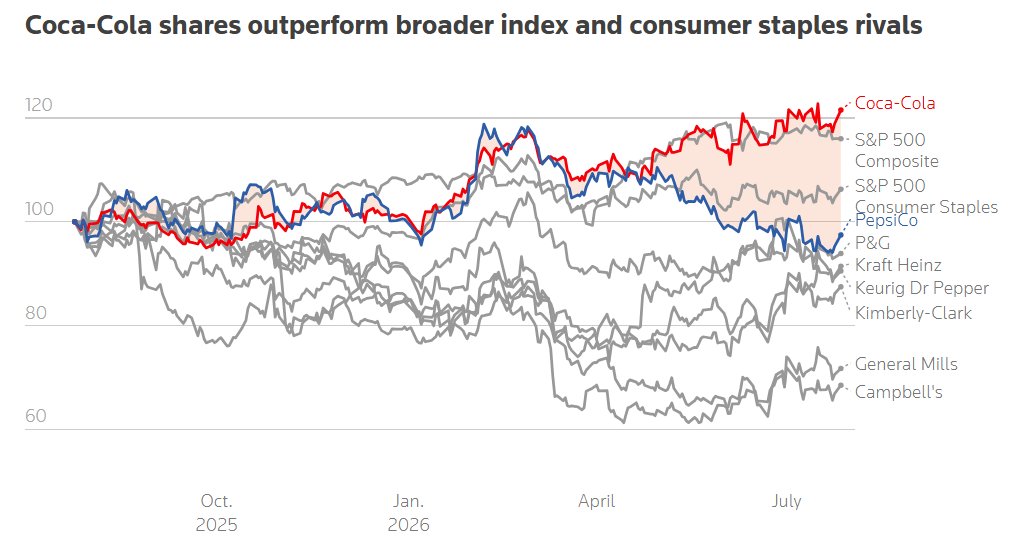
Thanks to the market's continued embrace of the “cash flow alpha” theme and future performance and future prospects, Coca Cola's stock price once rose sharply by nearly 5% during pre-market trading in US stocks. By Monday's close, the stock had risen 20% this year. In contrast, the S&P 500 index had only increased by about 8% over the same period. The total market value of Coca Cola is hovering around 360 billion US dollars.
Zero Sugar resonates with the classic Coca Cola brand! Coca Cola overcomes technological shocks with profit improvements
Coca-Cola's profit and sales also surpassed expectations for the last quarter, which covered about half of the five-week World Cup tournament schedule.
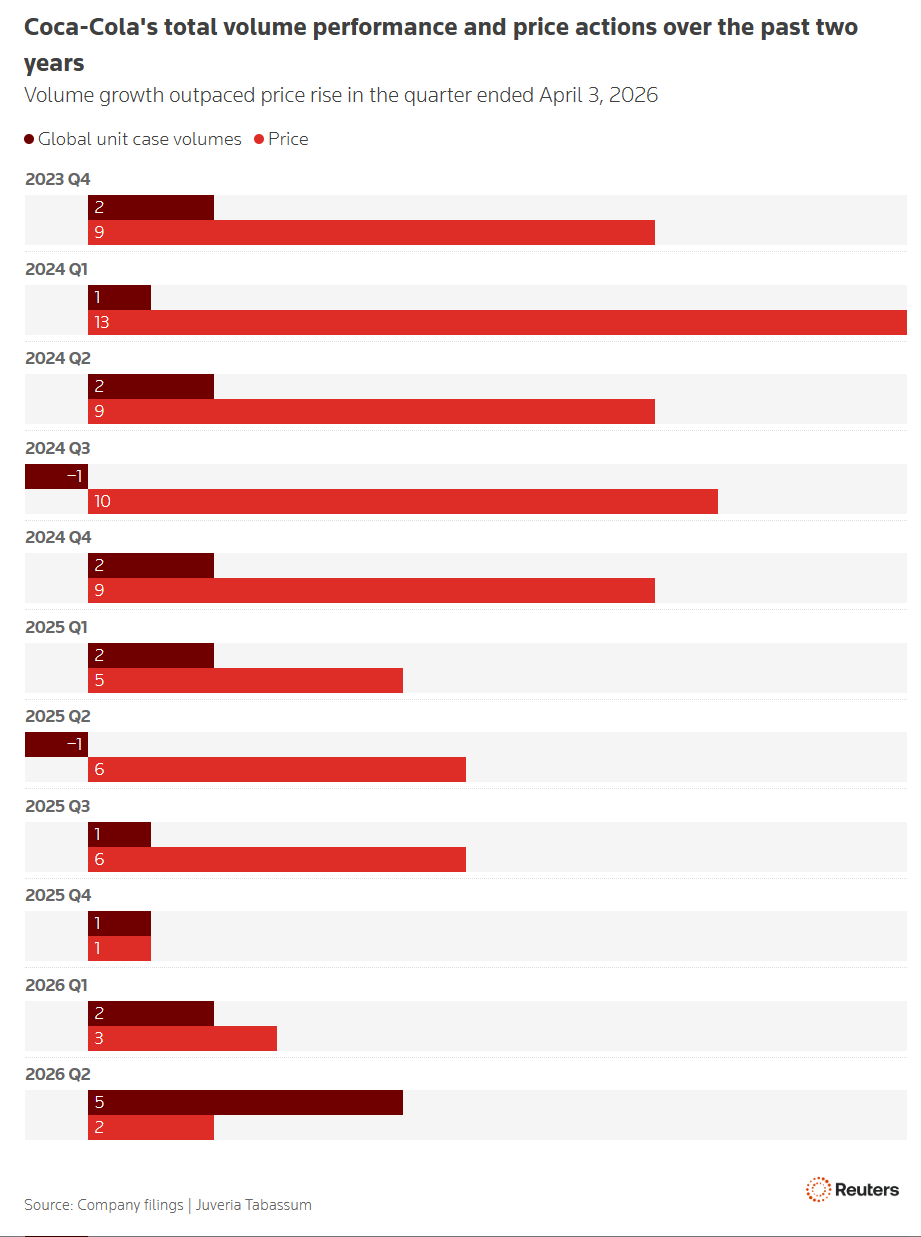
In North America, where the World Cup was hosted, Coca Cola's endogenous sales rose sharply by 7% in the second quarter, exceeding the expectations of the most optimistic Wall Street analysts compiled by the agency. North America contributed about 40% of the company's total sales in the last quarter, the highest share of all regions.
According to the performance and forward-looking guidance statement, the company's intensive media marketing campaign around this world soccer event brought 9 billion views to its brands on social media and received support from more than 2,500 Big V content creators.
Driven by significant improvements in sales performance, Coca Cola's second-quarter earnings per share increased sharply by 11%. Compared to the already resilient increase of about 4% in the same period last year. This is the second quarter in a row that the company has achieved double-digit year-on-year growth in profit, and it is also the first time since 2021 that it has achieved this result.
Earlier this month, Coca Cola suspended the Fairlife milk brand's operations in the US after a cyber attack. The company said on Monday that much of the business's production has resumed.
Coca Cola's second-quarter results exceeded expectations, mainly driven by strong demand in the US market for its sugar-free drinks and the Fairlife milk brand after production resumed, as well as sales related to the FIFA World Cup.
Increased consumption during the World Cup further strengthened the growth momentum of Coca Cola's classic brand drinks and sugar-free sodas. Although US consumers' spending on non-essential goods is generally weakening, particularly among low-income consumers, the “essential consumption type Coca Cola product line” shopping demand for North American consumers remains resilient.
Coca Cola has long been FIFA's official drink sponsor. The company said its marketing activities around the 2026 World Cup boosted sales of Coca-Cola's classic carbonated drink brand product line Coca-Cola and Powerade sports drink for the quarter ending July 3.
The beverage giant's second-quarter comparable revenue surpassed expectations by about 6%, reaching US$13.37 billion, significantly higher than Wall Street analysts' unanimous expectations of US$13.16 billion.
Taking price increases for some popular products that have been in high demand for a long time, and providing smaller packages of soft drinks to more cost-conscious consumers have further boosted Coca Cola's overall sales and future performance growth prospects. The company also invests in other cutting-edge beverages in its product portfolio, including ready-to-drink teas and Fairlife branded dairy products, which also contributed to revenue.
The company expects endogenous sales to grow by about 5% in 2026, and the previous target was a growth range of 4% to 5%. Coca Cola expects comparable earnings per share to increase by 9% to 10% throughout the year, higher than the previous target of 8% to 9% growth.
A classic that never fades! When the AI super bull market was tested by stress, Coca Cola took over the market with sales volume, profit, and cash flow
The Coca Cola Company can be described as a cash flow anchor for global asset rebalancing. According to a team of strategists from top Wall Street banks such as Citibank, Morgan Stanley, and Jefferies, the market surrounding AI computing power-related technology stocks will continue to fluctuate sharply in the future. It is time for investors to rebalance their portfolios that have become excessively focused on AI-related high-valuation technology stocks — that is, “the main AI line has not yet stopped, and the bull market is beginning to spread and rotate towards non-AI technology.”
That is, as AI semiconductor-themed momentum transactions cool down, capital will shift from high-leverage computing power beta to low-pressure quality stocks, and the market's leading forces are expected to spread from semiconductors to consumption/cyclic/medical/big finance defense assets with abundant cash flow with the next round of alpha potential.
Beata Mantai, head of European stock strategy from Wall Street financial giant Citigroup, said in an interview with the media recently that the bullish outlook for the global stock market in the next six months is still optimistic, but as the rise in the global stock market spreads beyond the AI-related technology sector, intense stock position rotation is indispensable.
The so-called “alpha” is defined as the actual return on investment far exceeding the “beta return” — that is, the simultaneous return on investment data that far exceeds that achieved by tracking the benchmark stock index. The simultaneous return achieved by tracking the benchmark index is also known as “beta return” (beta).
According to the mid-July fund manager survey report released by Bank of America, some institutional investors have begun to increase their exposure through blue-chip stocks such as healthcare, industrial, and non-essential consumer goods that have outperformed technology stocks since this year, with long-term low volatility and high quality, and long-term stable cash flow, while reducing their holdings in energy, communications, and essential consumer goods, and technology stocks.
As of July 27, Coca Cola's stock price has accumulated a cumulative increase of about 20% since 2026, clearly outperforming the S&P 500 index, which rose 8.3% during the same period; on July 7, it hit an all-time high of 85.68 US dollars during the intraday period, and hit an all-time high closing price with 84.92 US dollars on July 16. After the latest earnings report was released, it rose about 1.8% before the market, once again approaching its historical peak. Meanwhile, the Philadelphia Semiconductor Index had previously fallen by more than 11% from its June high, and the monthly decline widened to about 18% in mid-July; on July 28, Samsung Electronics and SK Hynix plummeted 13.4% and 14.7% respectively, while Nvidia also fell about 5% before the market. Therefore, this is not a simple “casual rise in consumer stocks,” but rather a typical rebalancing transaction where capital shifts to profit visibility and certainty in cash flow when highly valued, highly leveraged, and highly capital expenditure sensitive AI assets are tested under stress tests.
Judging from the factor attributes, Coca Cola fully complies with the screening logic of high quality, low beta, strong brand moat, stable cash flow, and defensive growth. Consumer necessities ETFs in the US stock market rose 1.6% on July 27, becoming the best performer in the S&P 500 11 sector, further proving that capital is reducing the long-term risk of AI capital expenditure and increasing assets with immediate profit, dividends, and cash returns. Coca Cola is essentially not a strong cyclical stock, but rather a qualitative compound interest defensive asset that can maintain pricing power in an environment of economic slowdown, inflation, and market fluctuations.
The strong long-term cash flow that Coca Cola is proud of and the increase in performance expectations can be said to have directly “added fuel” to the company's contrarian upward market when the AI computing power theme plummeted.
The company's operating cash flow reached 7.5 billion US dollars and free cash flow reached 6.9 billion US dollars in the first half of the year. Coca Cola management has now raised its annual endogenous sales growth forecast from 4% — 5% to about 5%, the comparable earnings per share growth forecast from 8% to 9% to 10%, and the annual free cash flow forecast from $12.2 billion to $12.4 billion. Coca Cola management said that the World Cup was not a one-off “advertising gimmick”: the campaign covered more than 180 markets, more than 20 million retail outlets, generated more than 60 billion impressions and 9 billion views, and obtained more than 25 million pieces of first-party data, leaving reusable assets for subsequent accurate marketing and brand monetization. Seen from this perspective, financial reports and future guidance not only reinforce Coca Cola's defensive attributes at a time when technology stocks are weak, but also prove that Coca Cola can build new growth curves such as zero sugar, dairy products, sports drinks, and data-driven marketing on top of traditional brands.
While the AI computing power sector still needs to answer questions about return on capital, financing costs, depreciation pressure, and final demand fulfillment, Coca Cola has transformed brand traffic into current sales, profit margins, and free cash flow, highlighting Buffett's dominant so-called “classic never fades” investmentalism — that is, always focusing on cash flow. What really has continuous investment value is that classic brands, supported by improved growth structures and strong cash flow, can cross all technology transaction cycles, rather than simply rely on long-term profit and valuation expansion driven by capital hedging.