


An important sign of a recovery in market risk appetite! As oil prices cooled, US debt ushered in three consecutive rises to the longest continuous rise in a month
The Zhitong Finance App learned that due to market optimism that peace negotiations between the US and Iran will lead to the resumption of tanker transportation around the Arabian Peninsula, the international oil price benchmark, Brent crude oil prices, and WTI crude oil prices have declined sharply recently, and US bond trading prices have also been significantly boosted by the cooling of oil prices and inflation expectations, which is expected to set the longest continuous rise record in a month. As far as the outlook for the stock market is concerned, the short-term market may see a correction in technical risk appetite driven by falling oil prices and falling 10-year US bond yields, but this is not enough to confirm the return of global stocks to an undifferentiated bull market.
The yield on US 10-year Treasury bonds, which have the title of “the anchor of global asset pricing,” fell for 3 consecutive days, continuing its downward trend before the US stock market on Tuesday, falling 3 basis points to 4.62%; its premium compared to two-year US Treasury yields, which are most sensitive to the Federal Reserve's monetary policy, also narrowed to its lowest level in nearly four weeks.
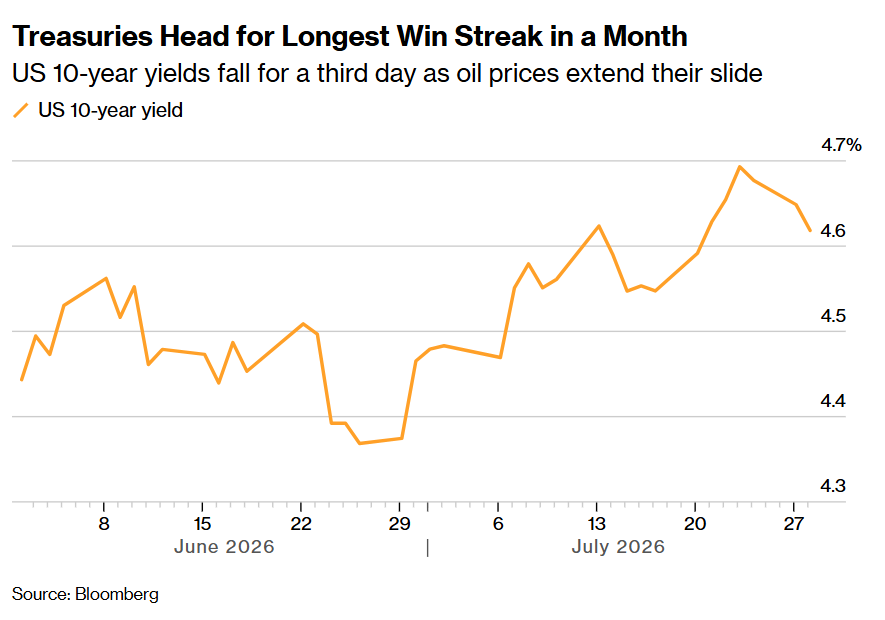
As shown in the chart above, US bonds have reached their longest continuous rise in a month — US 10-year Treasury yields fell for the third day in a row as international oil prices continued to decline.
Improved negotiations between the US and Iran are rapidly reducing the geopolitical risk premium on crude oil and driving the continuous rise in US debt prices by lowering expectations of energy inflation. Brent crude oil fell from more than $100 to about $86 per barrel last week, and the US 10-year Treasury yield fell to about 4.62%, but the 10-year yield narrowed at the same time as the two-year premium, indicating that this is closer to a “flat bull market” driven by a combination of falling long-term inflation premiums and safe-haven demand in the financial market, rather than the market fully betting on the Federal Reserve returning to the monetary policy easing cycle.
In particular, the probability that the Fed will raise interest rates by 25 basis points in the futures market this week is still close to 40%. Economists' benchmark expectations generally point to the Fed keeping the benchmark interest rate on hold this year, further showing that the bond market is only withdrawing part of the “oil price out of control” pricing, and it has not been confirmed that the risk of monetary tightening has been completely lifted.
As the denominator of the DCF stock valuation model, 10-year US bonds are the risk-free yield anchor. Once they continue to rise, the super bull market surrounding AI will not necessarily end, but they will face a brief downward pressure, and may further shift from an “expansionary valuation bull market” to a “profit-proven bull market.” The increase in yield will drastically reduce the valuation of long-term assets such as high-PE semiconductors, AI software, unprofitable AI infrastructure, power fuel cells, quantum computing, and space technology; however, for leading technology assets that already have order locking, pricing power, repurchase ability, and cash flow, the impact is more reflected in phased fluctuations rather than a collapse in industrial logic.
Low oil prices supported long-term debt, and US bonds welcomed the best one-month winning streak
According to the latest trading data, the improving prospects for US-Iran negotiations is rapidly reducing the geopolitical risk premium on crude oil prices and driving the price of long-term US bonds of 10 years or more to rise continuously by lowering expectations of energy inflation. Brent crude oil has fallen from over $100 per barrel last week to about $86, and the yield on US 10-year Treasury bonds has fallen to about 4.62%.
“This optimistic trend of US bonds with a long-term term of 10 years or more shows that investors are still unwilling to completely eliminate the risk premiums associated with another rise in inflationary pressure, nor are they willing to rule out the possibility that global central banks may eventually still have to maintain restrictive monetary policies for a longer period of time.” Evelyn Gomez-Lehti, a multi-asset strategist from Mizuho International, said.
The forward interest rate swap agreement linked to the date of the Federal Reserve's FOMC monetary policy meeting shows that the probability that the Fed will choose to raise interest rates by 25 basis points on Wednesday EST is more than one-third and close to 40%.
“This is very extraordinary,” said Laura Cooper, a senior macro credit director from Nuveen Administration Ltd in an interview with the media. “Looking back over the past decade or so, the FOMC members of the Federal Reserve usually fully communicate their possible monetary policy actions in advance, so investors now have to deal with the new monetary policy system under Walsh where the Fed no longer provides forward-looking guidance.”
She said that the Federal Reserve may currently “stand still for the time being,” but she still “tends to think that there is no need to take the position of returning to raising interest rates this year.”
The US ADP employment data released later may provide a clearer clue about employment prospects. There are currently no economists' forecasts for the four-week data ending July 11, which unexpectedly increased 16,500 people in the previous cycle. Consumer confidence data from the American Federation of World Large Businesses is expected to show that the consumer confidence index rose to 92.4 in July from 91.2 in June. The US Treasury will issue a new seven-year treasury bond of 44 billion US dollars. The degree of market acceptance of treasury bonds and indicators of strong demand are also worthy of investors' attention.
During the pre-market trading session of US stocks on Tuesday, the price of Brent crude oil fell 2.3% to $86.28 per barrel; the oil price benchmark rose above $100 per barrel last week, reaching a two-month high.
Global stock markets have entered the “discount rate repair+profit quality verification” stage
At the level of financial market transactions and pricing, the 10-year US Treasury yield is a well-deserved “anchor for global asset pricing.” If the yield index continues to rise for some time to come, driven by stronger inflation expectations and a “term premium” factor driven by larger fiscal stimulus, and the yield moves towards 5%, which has significant psychological significance, it will undoubtedly directly raise the risk-free yield index in the DCF quantitative valuation model for risky assets. Furthermore, it is possible that the overall valuation of popular technology stocks and growth stocks that are not yet profitable, momentum stocks closely linked to the AI computing power theme, high-yield corporate bonds, and cryptocurrency assets will shrink or even collapse. Furthermore, if 10-year US bond yields continue to rise along with inflation rather than growth improvement, then corporate profit margins will also be impacted by multiple impacts caused by energy, wages, and financing costs.
From a theoretical perspective, the 10-year US Treasury yield is equivalent to the risk-free yield index r on the denominator side of the DCF valuation model, an important valuation model in the stock market. Other indicators (especially the molecular side's cash flow expectations) have not changed significantly — for example, during the earnings season, the molecular side is in a vacuum due to lack of active catalysts. At this time, if the denominator level is higher or continues to operate at a historically high level, the valuations of risky assets such as technology stocks, high-yield corporate bonds, and cryptocurrencies closely linked to AI are facing a collapse.
As far as the global stock market is concerned, the simultaneous decline in oil prices and long-term treasury bond yields is beneficial to highly valued technology stocks that have been valued for a long period of time and rely on discounts from forward cash flows. Against the backdrop of a continued decline in oil prices, relatively low energy prices can also significantly reduce the pressure on corporate costs and residents' actual income, while lower risk-free interest rates increase the present value of future corporate cash flows. As a result, short-term market conditions may see an accelerated recovery in technical risk appetite driven by falling oil prices and falling US bond yields, but this is not enough to confirm the return of global stocks to an indiscriminate bull market.
Technology leaders with sufficient free cash flow, high AI revenue generation and no need to rely on external financing will be superior to computing power projects that rely on forward demand, high leverage, or customer financing to maintain growth; non-essential consumption, industry, transportation, and some interest-sensitive assets may benefit from falling energy costs, while oil producers and high-beta semiconductors are still under downward pressure on profit expectations. Furthermore, what really determines whether the market can escalate from a rebound to a new upward trend is not whether oil oil falls below a certain price level, but whether the Federal Reserve suspends interest rate hikes, and whether AI capital spenders such as Microsoft, Meta, and Amazon can simultaneously prove revenue growth, capital efficiency, and free cash flow restoration.