


IDC: China's AI game cloud market will reach 1.86 billion yuan in 2025
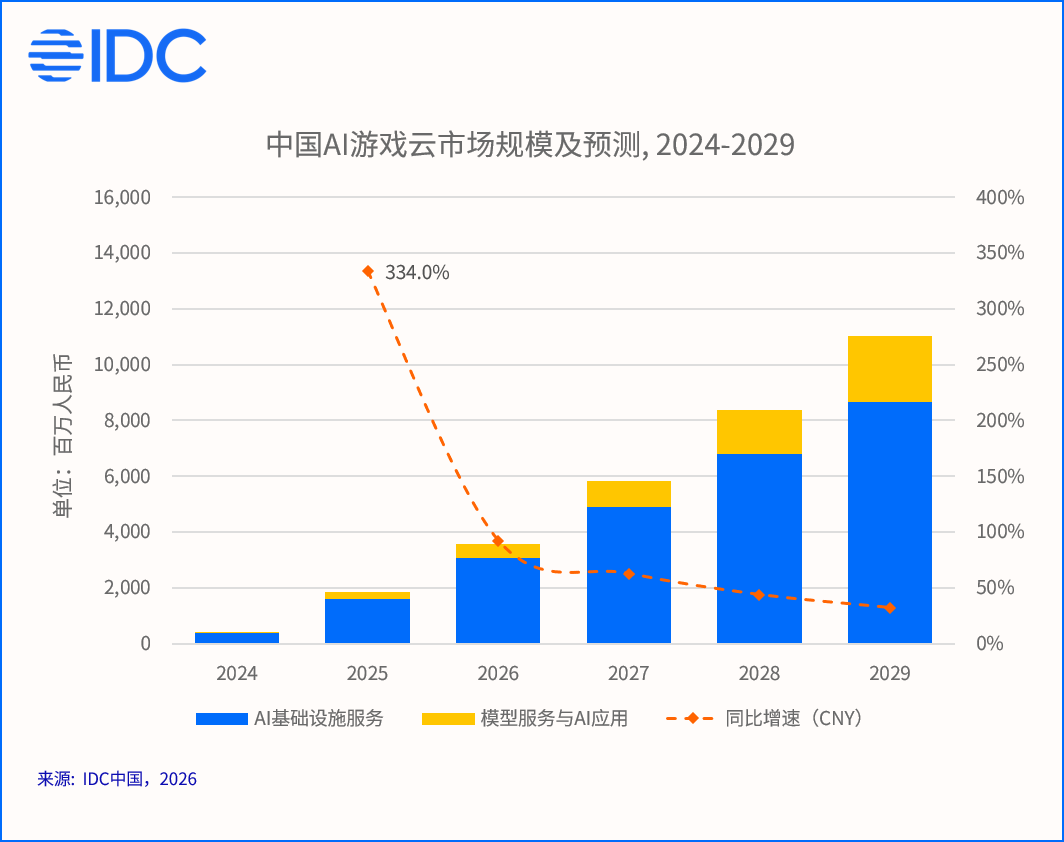
Zhitong Finance App learned that according to data from the International Data Corporation (IDC), China's AI game cloud market reached 1.86 billion yuan in 2025. Among them, the AI infrastructure services, model services, and AI application markets reached 1.61 billion and 250 million respectively. The market is in the early stages of an explosion, and both major markets have achieved three-digit growth. In the face of rapid growth, AI game clouds are reshaping the technical foundation of game industrialization at a deeper level and driving a fundamental shift in the spending logic of industry customers for AI technology products.
1. The AI game cloud is becoming the cornerstone of the next stop in game industrialization
Over the past five years, “game industrialization” has evolved from the vision of a few pioneers to collective consensus and common practice in the Chinese game industry. From standardization of art pipelines and modularization of program frameworks to the establishment of automated testing and continuous integration systems, the entire industry has completed the construction of industrial infrastructure at an unprecedented speed, and has witnessed the stable industrial output capabilities of Chinese game companies and publishers on various tracks such as open world and boutique MOBAs.
Entering the AIGC era, products and services based on LLM, multi-modal models, and agents are advancing game industrialization to a new stage. Leading manufacturers are starting to build AI native pipelines, expanding the object of game production from “preset assets and rules” to “generable logic and emerging intelligence”. When AI participates in worldview architectures, dynamic plot generation, and player behavior prediction, what industrialization delivers is no longer “playable software”, but a “sensible digital civilization” that continues to grow on the AI game cloud.
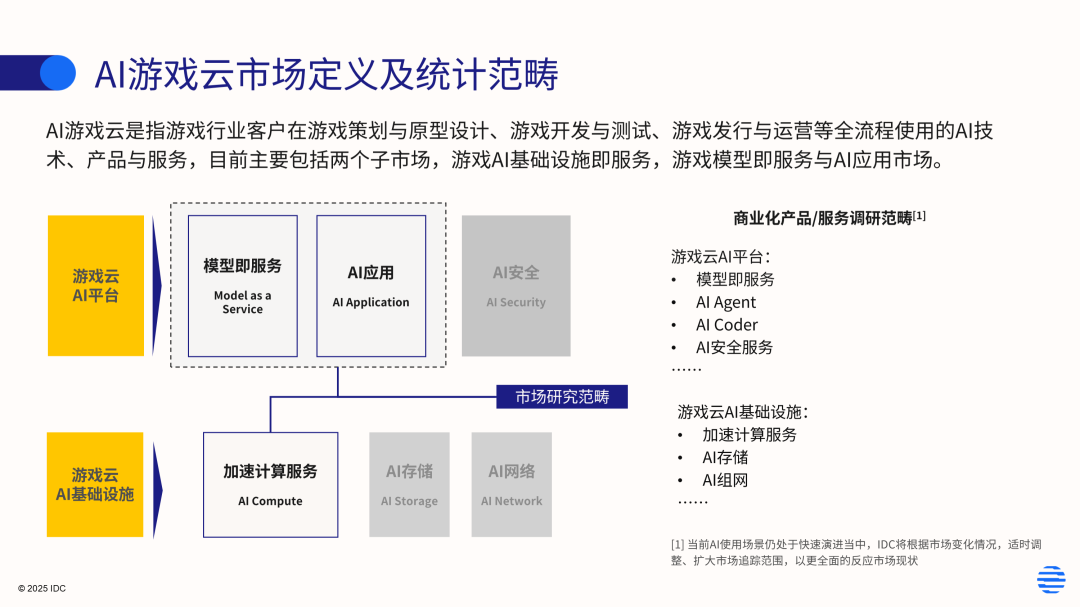
Based on the above requirements, IDC believes that AI game clouds should include AI technology, products, and services used by game industry customers in the entire process of game planning and prototyping, game development and testing, and game distribution and operation. According to the type of product and service, it can currently be divided into two categories: game AI infrastructure as a service, and game model as a service and AI application.
2. The AI game cloud market is the core growth engine of the game cloud market and the entire game IT market
In 2025, China's AI game cloud market reached 1.86 billion yuan, of which the AI infrastructure service market reached 1.61 billion, and the model service and AI application market reached 250 million yuan. Although its share is still limited compared to China's 10 billion game cloud market, the market growth rate is expected to remain at a three-digit level in the short term, and is expected to reach 11 billion in 2029, contributing more than 50% of the game cloud market space.
Market growth is mainly due to the following factors:
1. Game AI scenarios are being replicated and promoted at an accelerated pace in the industry: AI application scenarios that have proven ROI are moving from early single-point trials to large-scale replication across enterprises and categories. Automated production of purchased materials is typical. When a product uses this to significantly reduce the material iteration cycle and reduce customer acquisition costs, its methodology will quickly spread and be imitated among manufacturers in the same category.
2. Leading manufacturers continue to increase AI infrastructure construction and technology iteration based on strategic goals: Unlike the careful decisions of midstream and downstream publishers and game companies, some leading game customers do not only make decisions based on short-term ROI in single-point scenarios, but view AI as a strategic foundation to support long-term competitiveness, and make continuous and heavy strategic investments around infrastructure such as self-built computing power clusters, model training platforms, and data asset management.
3. Rising purchasing costs are forcing customers to adopt more aggressive AI strategies: after the version number is normalized, the number of new products is being released centrally, the superimposed traffic dividends have subsided, and the cost of individual product purchases in the game industry continues to rise, fundamentally changing the logic of customer investment in AI. Cost pressure has changed from “optional” to “mandatory”, forcing manufacturers to adopt more aggressive AI strategies: industrialize material production to hedge production capacity bottlenecks with automated pipelines; use models to replace experience to drive real-time tuning; and refined user insight, shifting from broad customer acquisition to deep crowd modeling.
3. Industry customers have formed clear procurement decision ideas
In the current market environment, industry customers generally adopt a pragmatic AI product and service procurement style, pay attention to various scenarios in the entire game development and operation process, and enhance the speed of integration of existing production pipelines with AI.
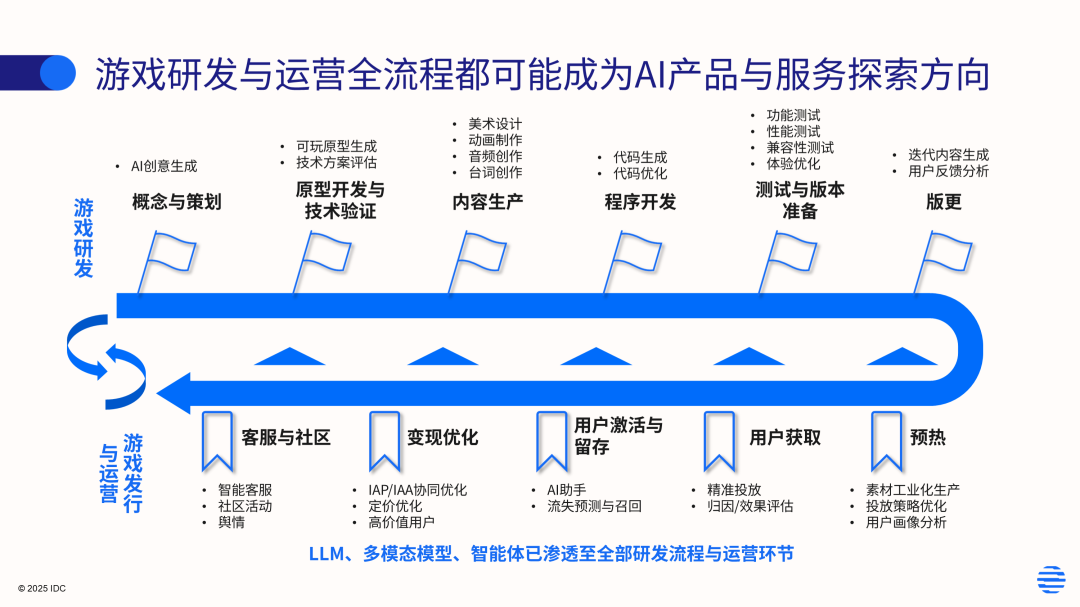
1. Short-term procurement logic: pragmatic and fast output orientation, AI infrastructure dominates the bill: AI procurement for game customers is still guided by clear output, and decisions show the characteristics of “pragmatism, prudence, and speed.” With the exception of very few leading publishers, customers generally choose single-point embedding in discrete scenarios such as material production, code assistance, and customer service response, and use AI infrastructure to deploy self-developed products or integrate third-party MaaS and standardized AI applications. The overall AI bill is still dominated by infrastructure such as GPU computing power leasing, model training platforms, and inference clusters, and the overall market is still in the “pipeline building” stage for core scenarios.
2. Deployment strategy and value verification: Simultaneous online and offline construction, taking into account launch speed and sensitive assets: Game customers generally choose a hybrid method of “offline polishing of AI R&D pipelines and online access to public cloud resources and APIs” to keep sensitive art assets and self-developed model tuning in private environments. High-frequency purchase material generation and online reasoning widely use public cloud products and services to form a steady state architecture that balances security and elasticity.
3. Long-term cognitive shift: From IT costs to strategic growth investments: As AI shows growth potential in scenarios such as content generation and personalized operation, compounding the impact of rising purchasing volume costs, the budget logic of some leading customers is fundamentally changing. Expenses related to AI game clouds are no longer viewed as pure IT costs. The budget approval framework will break out of the traditional calculation method of “IT spending/turnover ratio” in the past and be redefined as a strategic growth investment that drives user life cycle value and market differentiation.
Wei Yunfeng, IDC China Industry Cloud Service Research Manager, said that AI cloud services are reshaping the Chinese gaming industry. Using AI in discrete scenarios of R&D pipelines, game distribution, and game operations is just the beginning. Game studios and publishers have begun experimenting with using AI technology products to break static narratives, shift the worldview from established design to infinite generation, or try to release projects entirely created by AI and intelligent entities, and this has also brought more room for imagination to the AI game cloud market.