


Johnson And Johnson Talc Settlement Puts Colgate And Kimberly Clark Stock In Focus
Legal shockwaves from Johnson & Johnson’s proposed $5.5b talc settlement are rippling through the baby care and personal health space, reshaping how investors think about litigation risk, consumer trust, and competitive positioning. With up to $3b potentially paid out in the next year and no further payments scheduled before 2028, this attempt to resolve around 69,000 talc-related lawsuits could mark a turning point for Johnson & Johnson and its peers. Below, you will see 3 stocks exposed to this news, each offering a different way to assess potential opportunity or caution around this legal reset.
Colgate-Palmolive (CL)
Overview: Colgate-Palmolive is a global consumer products company best known for everyday essentials like toothpaste, soap, household cleaners, and pet food, sold through supermarkets, eCommerce platforms, and professionals such as dentists and veterinarians. Its brands span oral care, personal and home care, and pet nutrition, including Colgate, Palmolive, Softsoap, Fabuloso, and Hill’s.
Operations: Colgate-Palmolive generates most of its revenue from Oral, Personal and Home Care across Latin America (US$4.9b), North America (US$4.0b), and Asia Pacific (US$2.9b), alongside Pet Nutrition at US$4.7b and a Segment Adjustment of US$4.3b.
Market Cap: US$72.6b
Colgate-Palmolive gives you exposure to everyday consumer staples and pet nutrition at a time when Johnson & Johnson’s talc settlement is reshaping the baby and personal care category and potentially opening room for competitors that already focus on non talc products. The company couples long established global brands and a 64 year dividend growth streak with solid free cash flow and ongoing buybacks. However, recent margin pressure, one off losses of about US$1.1b and high leverage mean earnings quality is a key area to watch. With analysts expecting faster earnings growth than revenue and options markets signaling heightened volatility, investors who look closer may find a mix of defensive cash flows and real balance sheet questions that the headlines do not fully capture.
Colgate-Palmolive’s mix of resilient staples, a 64 year dividend growth streak and buybacks could be masking a far more complex story around leverage and earnings quality, so it is worth reading the 3 key rewards and 3 important warning signs

Kimberly-Clark (KMB)
Overview: Kimberly-Clark is a global personal care company behind everyday hygiene staples such as Huggies diapers, Pull-Ups, Kotex, Depend, Kleenex tissues, and Cottonelle bathroom tissue, serving households and professional customers through supermarkets, clubs, drugstores, mass retailers, and eCommerce, as well as institutions like offices, hotels, and public facilities.
Operations: Kimberly-Clark generates about US$10.7b of revenue from North America and US$5.8b from International Personal Care, with both segments focused on baby, feminine, adult incontinence, and tissue products.
Market Cap: US$36.4b
Kimberly-Clark sits right in the middle of the talc story because it sells baby and family care products that compete with Johnson & Johnson, yet it is not tied to talc litigation and is leaning into higher margin personal care after the Arbex joint venture reshaped its tissue footprint. That position comes with real trade offs, including high debt, dividend coverage concerns and slower growth than the broader US market. For investors, the key question is whether a focused, brand heavy business with cost savings momentum and a 4.6% yield justifies the current P/E premium despite past earnings softness and intense competition in diapers and tissue.
Kimberly-Clark’s 4.6% yield and its brand-heavy shift toward higher margin personal care could be masking a far bigger story, so review the 2 key rewards and 2 important warning signs (1 is major!)

Bausch Health Companies (BHC)
Overview: Bausch Health Companies is a diversified healthcare group that develops, manufactures, and sells specialty pharmaceuticals and medical devices across areas like gastroenterology, neurology, dermatology, aesthetics, and eye health in the United States and internationally.
Operations: Bausch Health Companies generates most of its revenue from Bausch + Lomb at US$5.2b and Salix at US$2.7b, with additional contributions from International at US$1.2b, Diversified at US$917m, and Solta Medical at US$576m.
Market Cap: US$1.7b
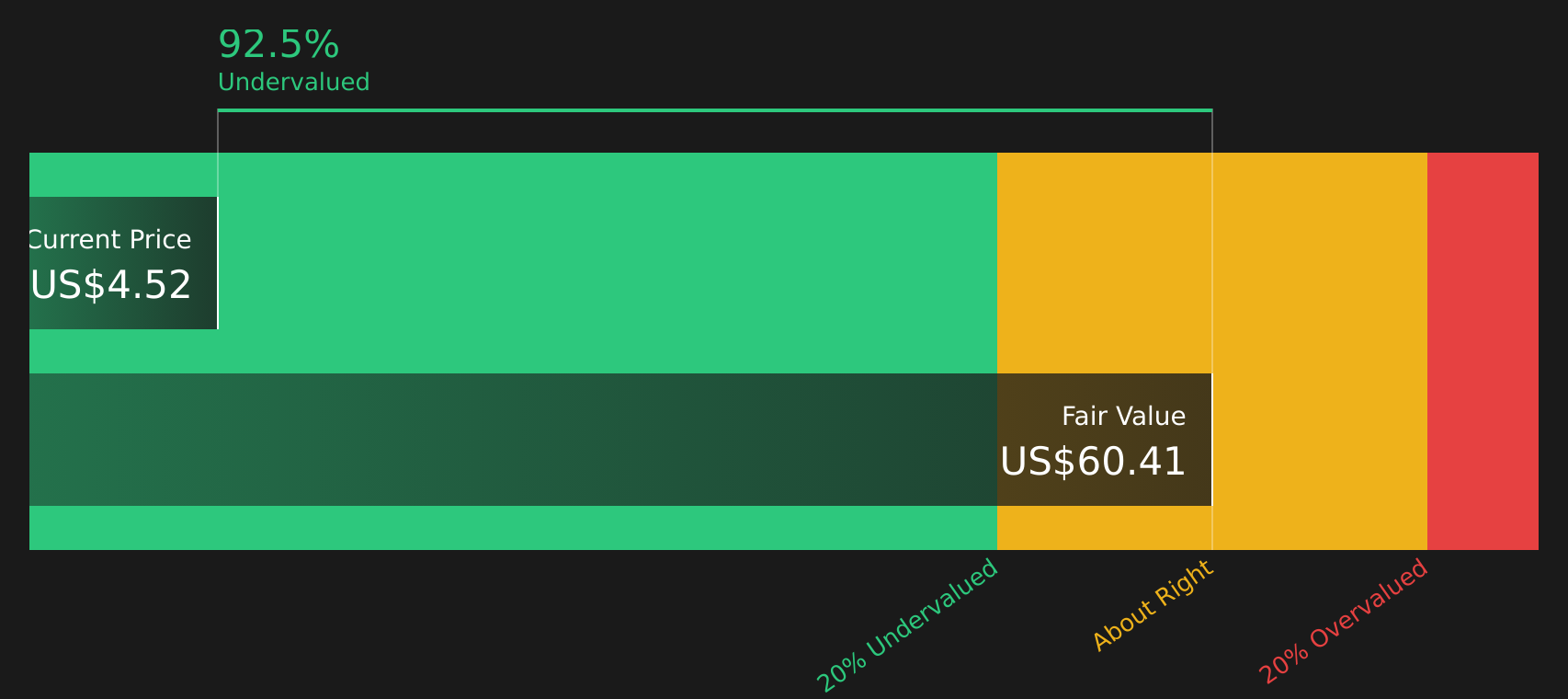
Bausch Health Companies operates at the intersection of affordable medicines and medical devices, with large franchises like Bausch + Lomb and Salix supporting efforts to improve profitability. The stock trades at a deep discount to some fair value estimates and a very low P/S multiple, yet carries meaningful risks including reliance on key drugs such as Xifaxan, regulatory price pressure, ongoing losses, and complex legal and tax settlements that management says should not materially affect cash flows. For investors watching how Johnson & Johnson’s talc settlement could shift trust toward alternative healthcare providers, Bausch Health represents a higher-risk way to gain exposure to that potential shift without relying on baby care products alone.
Bausch Health’s combination of discounted valuation and major franchises such as Bausch + Lomb and Salix suggests that the story may not be fully reflected in the current market view, so walk through the 3 key rewards and 1 important major warning sign
Take Control of Your Investment Journey
If Kimberly-Clark or any of these companies sound like a great opportunity, register for FREE with Simply Wall St and add your companies to a Watchlist to monitor the share price against the fair value the ideal entry point. Once you've made your move, manage your holdings with our Portfolio Command Center that filters out the noise to deliver only the most critical, actionable updates. Throughout your journey, our Community allows you to filter the best ideas from thousands of investor perspectives. By uncovering hidden catalysts and risks early, you'll accelerate your decision-making and stay one step ahead of the market.
Seeking Alternatives Before Opportunities Fly Past?
Fresh ideas can move from under the radar to full breakout faster than most investors expect. Scan these curated shortlists before the momentum is fully caught and consider your options promptly.
- Spot emerging income machines by reviewing a curated mix of high-yield companies in the 8 dividend fortresses while payouts and balance sheets still look compelling, not stretched.
- Track potential compounding stories early by scanning the 51 high quality undervalued stocks before quality businesses gain wider attention and the most attractive entry points start dropping away.
- Get ahead of the crowd by checking the 84 resilient stocks with low risk scores and focus on companies where measured risk scores may help you stay invested when others get caught off guard.
This article by Simply Wall St is general in nature. We provide commentary based on historical data and analyst forecasts only using an unbiased methodology and our articles are not intended to be financial advice. It does not constitute a recommendation to buy or sell any stock, and does not take account of your objectives, or your financial situation. We aim to bring you long-term focused analysis driven by fundamental data. Note that our analysis may not factor in the latest price-sensitive company announcements or qualitative material. Simply Wall St has no position in any stocks mentioned.
Have feedback on this article? Concerned about the content? Get in touch with us directly. Alternatively, email editorial-team@simplywallst.com