


Global chip stocks hit by “Black Tuesday”: South Korea's sharp decline in Kospi triggered a meltdown, and Nvidia's “$750 billion deal” triggered an AI bubble panic
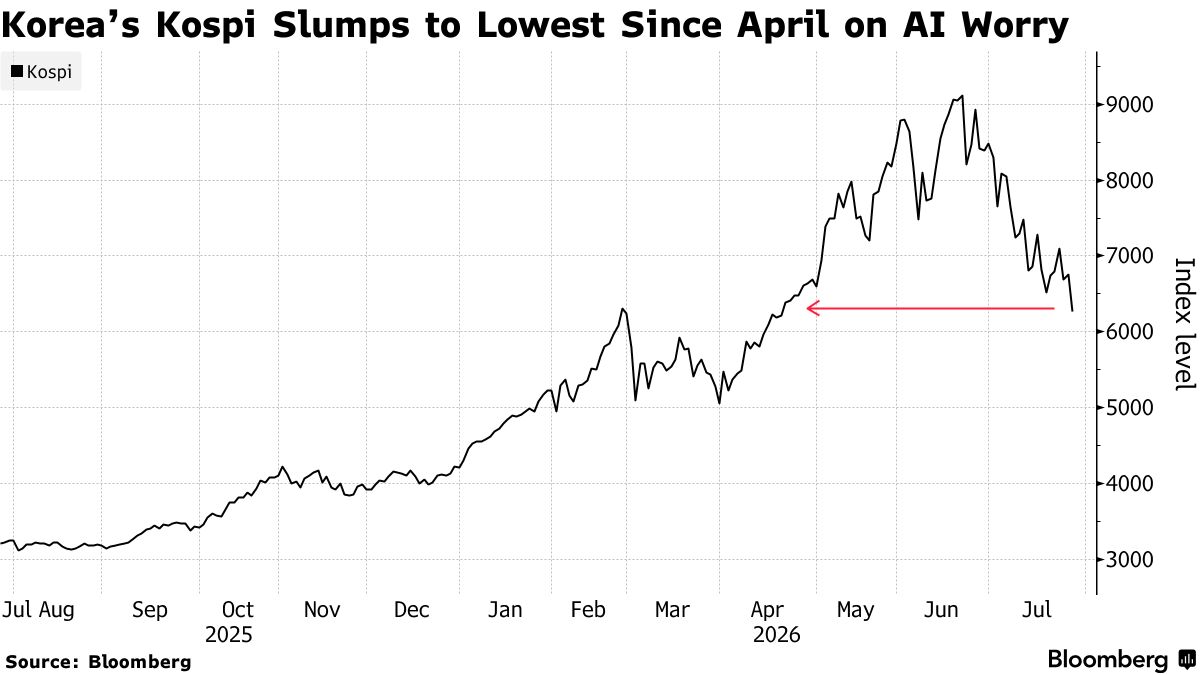
The Zhitong Finance App learned that as investors' concerns about whether the artificial intelligence (AI) boom continued to heat up and market sentiment continued to deteriorate, global chip stocks experienced a further sell-off on Tuesday. Korea's benchmark stock index, the Korea Composite Index (Kospi), once fell 9.6%, triggering a 20-minute trading suspension mechanism on the Korea Exchange. Shares of memory chip giants Samsung Electronics and SK Hynix both fell by at least 11%. The Nikkei 225 Index, which has a high weight on Japanese chips, and the Taiwan Weighted Index (Taiex) both fell by more than 4%.
This decline reflects growing market concerns about overcrowded stock positions and rising corporate debt levels during the AI construction cycle. Nvidia (NVDA.US)'s new round of transactions involving more than 750 billion US dollars has further raised market concerns about whether AI demand is being artificially boosted. At the same time, the progress made by Chinese competitors in the field of technology is putting additional pressure on an already overvalued market.
“Greed has turned into fear of AI-related semiconductor stocks,” said Vey—Sern Ling, managing director of AIA Bank. “Investors are now interpreting every piece of news in a negative way and using it as a reason to sell, rather than seriously analyzing the real impact of the news on the fundamentals of the company.”
China's competitive pressure intensifies, and chip makers are under pressure
This week, increased competitive pressure from China put pressure on chipmakers' stock prices. Changxin Technology went public on Monday. This initial public offering (IPO) will help the company fund plans to expand production capacity. Furthermore, there are reports that a Chinese company has begun large-scale production of immersive deep ultraviolet (DUV) lithography machines, which has become a new source of concern in the market.
Hiroshi Namioka, chief strategist at T&D Asset Management, said that China is improving advanced chip production capacity, which poses a negative factor for Japanese chipmakers. Shares of semiconductor equipment manufacturers, including Nikon and Tokyo Electronics, all fell more than 9% on Tuesday. At the same time, the stock prices of semiconductor equipment manufacturers listed in mainland China, including Zhongwei and Xinyuanwei, rose.
Meanwhile, the broader stock decline indicates that market confidence is weakening as the world's major technology companies begin a critical week when they are about to release financial reports. The future capital expenditure plans of companies such as Meta Platforms (META.US) and Amazon (AMZN.US) will be an important factor in determining future market trends.
Hebe Chen, senior market analyst at Vantage Global Prime, said, “The recent sell-off in chip stocks shows that market concerns about spending, return on investment, and valuation are deepening rather than fading away.” She added: “With a number of important catalysts on the horizon, investors are reluctant to buy on dips, indicating they are waiting for stronger evidence before increasing their investment exposure again.”
Memory chip stocks led the decline, and the AI trading boom faced a reassessment
Since this year, memory chip stocks have played an important role in the AI trading market, as soaring chip prices have driven storage makers' profits to record. However, as market doubts about the long-term outlook grow, the sharp gains that these stocks had previously accumulated are rapidly reversing.
Kioxia fell 18% on Tuesday, further reversing previous gains; last month, the company's stock price briefly rose to the list of companies with the highest market capitalization in Japan. Since SK Hynix's stock price hit a record high in June, the company's market value has shrunk by about 570 billion US dollars.
The relevant comments when Samsung Electronics and SK Hynix announced their results this week may provide more clues to investors experiencing significant fluctuations. Recently, however, the market doesn't seem to be easily moved by record profit levels. Dilin Wu, research strategist at Pepperstone Group Ltd., said: “The current market requirements are extremely high.” “Exceeding market expectations is no longer a guarantee that stock prices will rise — we've seen this over and over again over the past few weeks. Therefore, some of today's market trends may be traders cutting positions before earnings reports are announced, rather than waiting for results to come out before making decisions.”