


After more than 30 years, Hoisington rarely turned to warn that the US long-term bond bull market may end
The Zhitong Finance App learned that Hoisington Investment Management Co., which has long been adamant about US Treasury bonds, has now rarely changed its position. The company said in its newly released quarterly investment report that due to structural factors such as the continued expansion of the US fiscal deficit and rising capital demand, US inflation and long-term US bond yields may continue to rise in the future, which means that the US bond bull market environment that has continued for more than 30 years may have fundamentally changed.
According to the latest report of Hoisington Investment Management, headquartered in Austin, Texas, USA, and co-authored by founder Van R. Hoisington and chief economist Lacy Hunt, larger fiscal deficits and increasing demand for financing are reshaping the bond market pattern, and future inflation and long-term US Treasury yields are expected to rise.
This view marks a major shift in the agency's investment philosophy over a long period of time. Over the past 30 years, Hoisington has been one of the strongest US debt bulls on Wall Street. It continues to bet that the yield on US long-term treasury bonds will decline, and has received widespread attention in the market as a result.
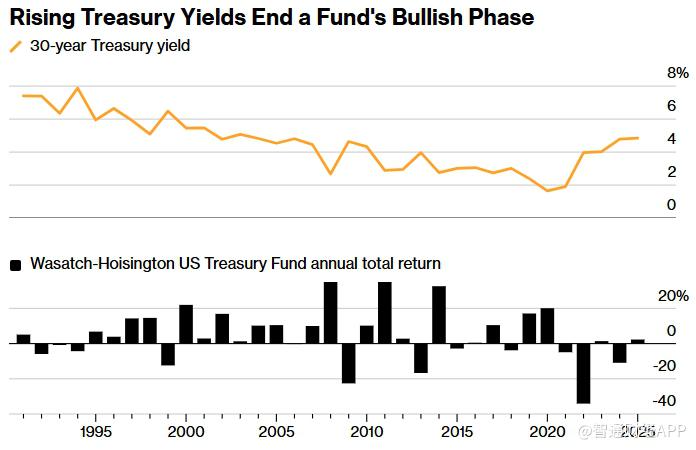
The report points out that the size of US debt continues to expand, prompting investors to demand higher risk premiums to hold US Treasury bonds. This means that the US interest rate environment is different from the era where yields continued to decline and long-term bonds continued to be bullish from 1990 to 2020.
Meanwhile, Hoisington predicts that the long-term equilibrium inflation level in the US is moving up the 3.5% to 4.5% range, and warns that there is still a risk of inflation exceeding 5% in the future.
This judgment is also reflected in its portfolio adjustments. According to regulatory documents, as of the end of September last year, the validity period of the fund's investment portfolio was as high as 20.88 years; by the end of March this year, this indicator had dropped sharply to 4.7 years, and to less than 1 year as of June 30. In contrast, the Bloomberg US Composite Bond Index currently has an average tenure of about 6 years.
The effective period is an important indicator for measuring the sensitivity of bond prices to changes in interest rates. The shorter the term, the lower the risk exposure of the portfolio to rising interest rates.
Hoisington began adjusting its strategy in the first quarter of this year. At the time, after the US launched a military attack on Iran at the end of February, international oil prices rose sharply, and market expectations for inflation and the Federal Reserve's further tightening of monetary policy heated up rapidly, and US Treasury yields rose accordingly.
According to the data, the yield on US 30-year Treasury bonds once approached 5.2% in May this year, the highest level since 2007. As of Thursday, the yield remained around 5.12%.
In fact, since the 30-year US Treasury yield fell below a historic low of 2% during the 2020 pandemic, the overall yield on US long-term treasury bonds showed a volatile upward trend, with only a brief decline in some stages. Over the same period, the global government bond index was still down about 19% from its 2020 high.
Over the past few years, Hoisington has concentrated clients' funds on long-term treasury bonds and zero-coupon bonds, betting that yields will continue to decline. This strategy was prominent in the rising bond market, but it was greatly impacted during the period when interest rates rose rapidly.
As of June 30 this year, the fund's annualized return has reached 5.38% since its establishment, but the annualized loss over the past five years has reached 8.7%. At the same time, the size of the company's assets under management also fell from about $5 billion in 2020 to less than $2 billion last year.
Hoisington believes that America's ever-expanding capital-spending boom will still put upward pressure on long-term interest rates. On the one hand, artificial intelligence (AI) investment is driving rapid growth in corporate financing needs; on the other hand, the US government's fiscal deficit continues to expand, and it is also necessary to issue more treasury bond financing to jointly boost bond supply.
Jeffrey Gundlach, CEO of DoubleLine Capital and the “King of New Debt,” also recently stated that the yield on US 30-year Treasury bonds continues to approach the key resistance level of 5%, and this level “seems difficult to maintain for a long time.” At the same time, he pointed out that even Lacy Hunt, who has long been adamant about US debt, is now turning bearish, which shows that the market environment has changed markedly.