


Despite Falling Oil Prices, There's Now a 73% Chance of an Interest Rate Hike by September -- Here Are the 2 Culprits to Blame
Key Points
The probability of the Federal Reserve raising interest rates by the Sept. 16 meeting jumped from 26% to 73% over the last month, according to the CME Group's FedWatch Tool.
Evidence is mounting that the effects of the Iran war have spilled over into the broader economy.
Furthermore, Wall Street's No. 1 catalyst is now adding to its inflationary woes.
Although the Dow Jones Industrial Average (DJINDICES: ^DJI), S&P 500 (SNPINDEX: ^GSPC), and Nasdaq Composite (NASDAQINDEX: ^IXIC) have all notched record-closing highs since early June, trouble is brewing on Wall Street.
In May, trailing 12-month U.S. inflation surged to a three-year high of 4.2%, spurred by the inflationary effects of the Iran war. While the stock market has thus far been able to climb this wall of worry, the probability of the Federal Reserve raising interest rates has risen sharply.
Missed Nvidia in 2009? This Rare Signal Is Flashing Again. In 2009, a "Double Down" signal flashed for a little-known chipmaker called Nvidia. For the first time in years, that same "Total Conviction" signal is flashing for a company 1/100th the size of Nvidia. Continue »
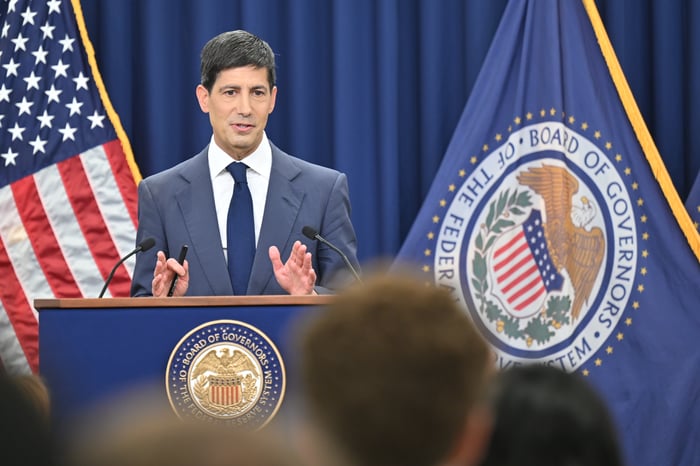
Fed Chair Kevin Warsh delivering remarks. Image source: Official Federal Reserve Photo.
On June 12, there was just a 26% chance that the Fed would hike the federal funds target rate by the Federal Open Market Committee's (FOMC) Sept. 16 meeting. As of July 12, this probability has risen to 73%, according to the CME Group's FedWatch Tool.
On the surface, this probably doesn't make much sense. West Texas Intermediate crude oil has plummeted from an Iran-war high of nearly $118 per barrel on April 7 to $74 per barrel in the late evening of July 12. With energy commodities driving inflation higher in the first place, the expectation would be for lower crude oil prices to drag down inflation and ease rate-hike concerns.
But thanks to two culprits beyond higher oil prices, the probability of a rate hike has soared over the last month.
The Iran war is no longer just an energy supply issue
While the closure of the Strait of Hormuz by Iran continues to be a choke point for a fifth of the world's petroleum liquids, Trumpflation (inflation driven by President Donald Trump's policies or decisions) has entered a new phase.
The Fed's preferred measure of inflation (Core PCE) moved up to 3.4% in May, the highest level since October 2023.
-- Charlie Bilello (@charliebilello) June 25, 2026
This was the 63rd consecutive reading above the Fed's 2% target level.
"We've missed for 5 years. And we're gonna fix that."-Kevin Warsh last week pic.twitter.com/Wtayfgt8sq
The steady rise observed in Core Personal Consumption Expenditures (PCE), which excludes volatile food and energy costs, suggests the inflationary effects of this conflict are spilling over into the broader economy. Even though crude oil prices are falling and providing partial relief at the fuel pump for consumers, ripple effects in other areas of the economy are getting worse.
For example, the impact of energy supply chain disruptions on businesses is often delayed by a few months. We're likely starting to see the effects of rerouted supply channels, higher transportation and production costs, and higher prices for petroleum-based products in corporate America. Companies that use plastics and synthetic polymers can expect to pay higher prices, which in turn are eventually passed on to consumers.

Image source: Getty Images.
Artificial intelligence is a double-edged sword for the U.S. economy
Additionally, the Fed minutes from the FOMC's June 16-17 meeting point to a new source of inflationary pressure: the artificial intelligence (AI) infrastructure build-out.
On the one hand, the AI revolution has been exceptionally profitable for investors who had the foresight to put their money to work in graphics processing unit (GPU) developers, chip fabricators, and memory/storage solutions providers. However, the overwhelming demand for these products, coupled with persistent supply shortages, has sent GPU and memory/storage prices into the stratosphere.
Higher price points for AI infrastructure impact businesses and consumers. While some policymakers, including Fed Chair Kevin Warsh, expect AI to improve economic output and ultimately lower inflation, this technology is likely years away from being optimized by businesses.
If Wall Street's No. 1 catalyst does prompt the FOMC to raise interest rates, the Fed could quickly put an end to the stock market's historic AI-driven rally.
Sean Williams has no position in any of the stocks mentioned. The Motley Fool has positions in and recommends CME Group. The Motley Fool has a disclosure policy.