


The AI “money printer” is roaring with all its might! ASML.US (ASML.US) Q2 performance exceeded expectations and raised annual guidance again. Intel took the lead in using next-generation lithographers
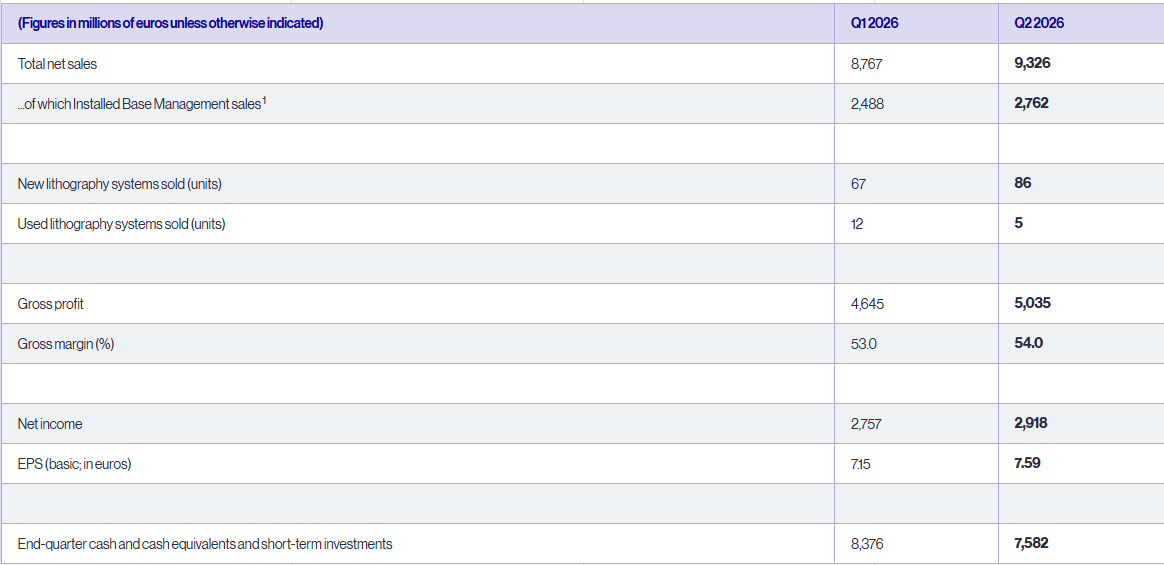
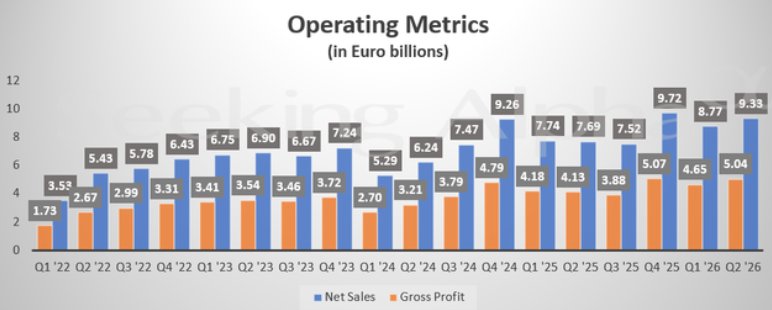
The Zhitong Finance App learned that on July 15, global lithography giant ASML.US (ASML.US) announced financial results for the second quarter of 2026 and announced a second increase in annual results guidance during the year. Net sales for the quarter reached 9.33 billion euros, far exceeding analysts' average expectations of 8.85 billion euros; net profit was 2.92 billion euros, also higher than market expectations of 2.64 billion euros; gross margin recorded 54.0%, better than 52% of expectations. Based on strong performance momentum, Asmack raised its net sales forecast for the full year 2026 to 43 billion to 45 billion euros, and the gross margin forecast to 54% to 56%. This is the second increase in the year after the company raised its full-year forecast from 34 billion to 39 billion euros to 36 billion to 40 billion euros in April.
AI demand is “extremely strong”: orders maintained a high growth rate in the first half of the year
“Our order volume remained extremely strong in the first half of the year,” Asmack CEO Christophe Fukai said in an earnings statement. He clearly stated, “Continued investment in artificial intelligence and the continuous advancement of AI technology are driving demand for advanced logic and memory chips, further strengthening the growth prospects of the semiconductor industry. ”
Asmack is the only manufacturer in the world that can produce extreme ultraviolet lithography (EUV) equipment, and these precision devices are essential for manufacturing Nvidia's AI training chips and advanced process chips from giants such as TSMC, Samsung, and Intel. As tech giants such as Microsoft and Google invest hundreds of billions of dollars to build AI infrastructure, chip makers are racing to expand production capacity, directly boosting demand for Asmack lithography machines.
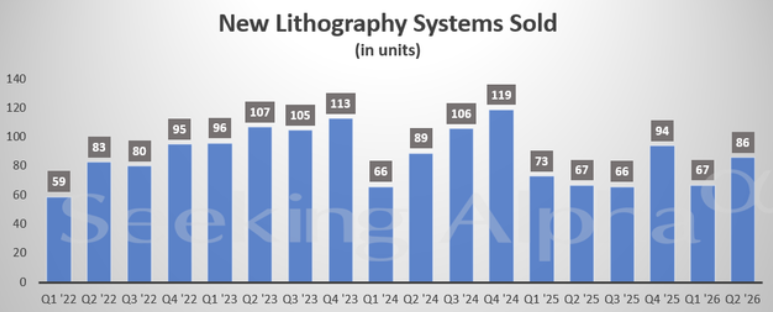
Shipments of new lithographs jumped sharply this quarter from 67 units in the first quarter to 86 units, and used lithography machines dropped from 12 to 5 units. Revenue from the installation management business (equipment maintenance and upgrade services) reached 2,762 billion euros, up from 2,488 billion euros in the previous quarter — this business has the characteristics of high profit margins and stable revenue, and is an important component of Asmack's “shaver+blade” business model.
Accelerated capacity expansion: another 30% increase in 2027
Based on the strong momentum of the first half of the year, Asmat announced an aggressive production capacity expansion plan: based on a production capacity of about 65 low-numerical aperture EUV units in 2026, increasing production capacity by 30% in 2027, and studying a further 30% increase in 2028; the DUV immersion lithography machine also plans to increase production capacity by 30% in 2027. Fukai said, “Our customers continue to accelerate capacity expansion plans... This translates into customer commitments covering our entire product portfolio, enabling Asmack to see longer-term needs more clearly.”
For the third quarter, Asmack's guidance was net sales of 11 billion to 12 billion euros, and gross margin of about 55% to 57%, far exceeding market expectations of 10.27 billion euros. This means that sales of around €25.9 billion will need to be completed in the second half of the year alone, showing management's strong confidence in the acceleration of demand.
Intel pioneered mass production of High NA EUV: a key victory
On the same day the earnings report was released, Asmack announced a key technological breakthrough — Intel Foundry has mass-produced some Intel Core Ultra Series 3 (codenamed Panther Lake) processors using Asmack's high numerical aperture extreme ultraviolet (High NA EUV) lithography technology on its Intel 18A process node, becoming the first company in the world to achieve high-volume shipments of High NA EUV logic chips.
Using Asmack's EXE High NA EUV technology at the Oregon plant, Intel mass-produced some Core Ultra Series 3 (codename Panther Lake) processors on Intel 18A process nodes. The two sides stated that part of the Intel 18A process layer has completed High NA EUV dual certification, and the product yield has reached the level of the existing NXE EUV platform.
High NA EUV is Asmack's most advanced lithography technology, which can provide more accurate patterning to create more advanced chips. Naga Chandrasekaran, executive vice president and general manager of Intel's factory division, said: “This milestone reflects the close technical cooperation between Intel and Asmack and shows how high numerical aperture EUV can be integrated into advanced semiconductor manufacturing on a large scale.”
This was a critical victory for Asmer. High NA EUV devices have always been criticized for being too expensive and difficult to be accepted by the mainstream market. Earlier, TSMC made it clear that the new generation of machines is too expensive to be suitable for large-scale production, and will not require HIGH NA EUV until the 1.4nm process. Intel's pioneering adoption will help reverse market doubts about this technology.
Asmack CEO Fukai said, “The launch of High NA EUV marks a major development in semiconductor lithography technology, and we are proud to play a role in achieving smaller, more intensive patterning, which will accelerate the advancement of AI and other emerging technologies.”
The “water seller” of the AI cycle
The explosion of Asmack's performance is essentially an inevitable transmission of the wave of AI infrastructure investment to the upstream equipment sector. As an indispensable “money printer” supplier for semiconductor manufacturing, Asmack is one of the most definite beneficiaries of the AI cycle.
The main line of AI is clear and strong - customers accelerate production expansion, orders continue to be strong, capacity expansion plans are increasing, and High NA EUV has achieved a breakthrough in mass production. Asmack is extracting “taxes” from every dollar spent on AI infrastructure construction. As Fukai said, “Our customers continue to accelerate capacity expansion plans.” From Nvidia to TSMC, from Samsung to SK Hynix, the expansion of the entire AI chip industry chain cannot bypass Asmack's lithography machine.
In the short term, Q3 revenue guidance was 11 billion to 12 billion euros, and the full-year forecast was raised to 43 billion to 45 billion euros, all pointing to continued strong demand side growth. Intel's breakthrough in mass production of High NA EUV has opened up space for the penetration of higher-value products. In the medium term, plans to increase production capacity by another 30% in 2027 indicate that Asmack has a long-term optimistic judgment on the AI-driven semiconductor production expansion cycle. However, there is still a time lag between the pace of capacity expansion and the actual execution of customer orders.
At the risk level, export restrictions to China are the biggest policy uncertainty. If the “MATCH Act” is passed, it could directly impact the Chinese market, which accounts for about 20% of revenue. Furthermore, if AI capital expenditure slows down in stages, the cyclical pullback in equipment orders may also put pressure on stock prices.
The analysis points out that AI is “generating demand for more systems.” In this AI-driven semiconductor “arms race,” Asmack, as the only supplier that can provide advanced lithography machines, is playing an indispensable role as a “water seller.”
Wall Street's bullish view on Asmer strengthens
Wall Street's bullish consensus on the stock was further strengthened after the results were announced. According to S&P Global's survey of 44 analysts, Asmack received a “Strong Buy” (Strong Buy) consensus rating, with an average target price of $1,902. According to LSEG data, all 19 analysts covering the stock gave a “buy” or “strong buy” rating.
Bernstein (Bernstein) gave Wall Street's most aggressive forecast. On July 6, the target price of Asma US stock was raised sharply from 1,971 US dollars to 2,623 US dollars (the target price of the euro was raised from 1,700 euros to 2,300 euros), maintaining the “outperforming the market” rating. The core logic of the upgrade is an “unprecedented” expansion of AI-driven advanced logic chips and DRAM production capacity. Bernstein raised the 2027 EUV shipment forecast from 86 units to 91 units, and from 87 units to 113 units in 2028; EUV revenue is expected to grow at a 30% CAGR to reach 42.7 billion euros by 2030; Asmack expects to receive 80 billion euros in 2030, with earnings per share of 97 euros. The target valuation multiplier was raised from 35 times to 40 times.
RBC Capital raised its target price from $1,700 to $2,000 on July 14, maintaining an “outperforming market” rating. RBC pointed out that strong investment in generative AI, tight supply in the DRAM market, and increased competition in advanced process foundry are the core driving forces driving EUV demand to continue to heat up. The bank expects shipments of low-numerical aperture EUV units to be close to 90 units in 2027, higher than the previous forecast of more than 80 units. RBC believes that EUV is gradually becoming an industrial bottleneck, and the tight supply situation will be difficult to ease within the next two to three years.
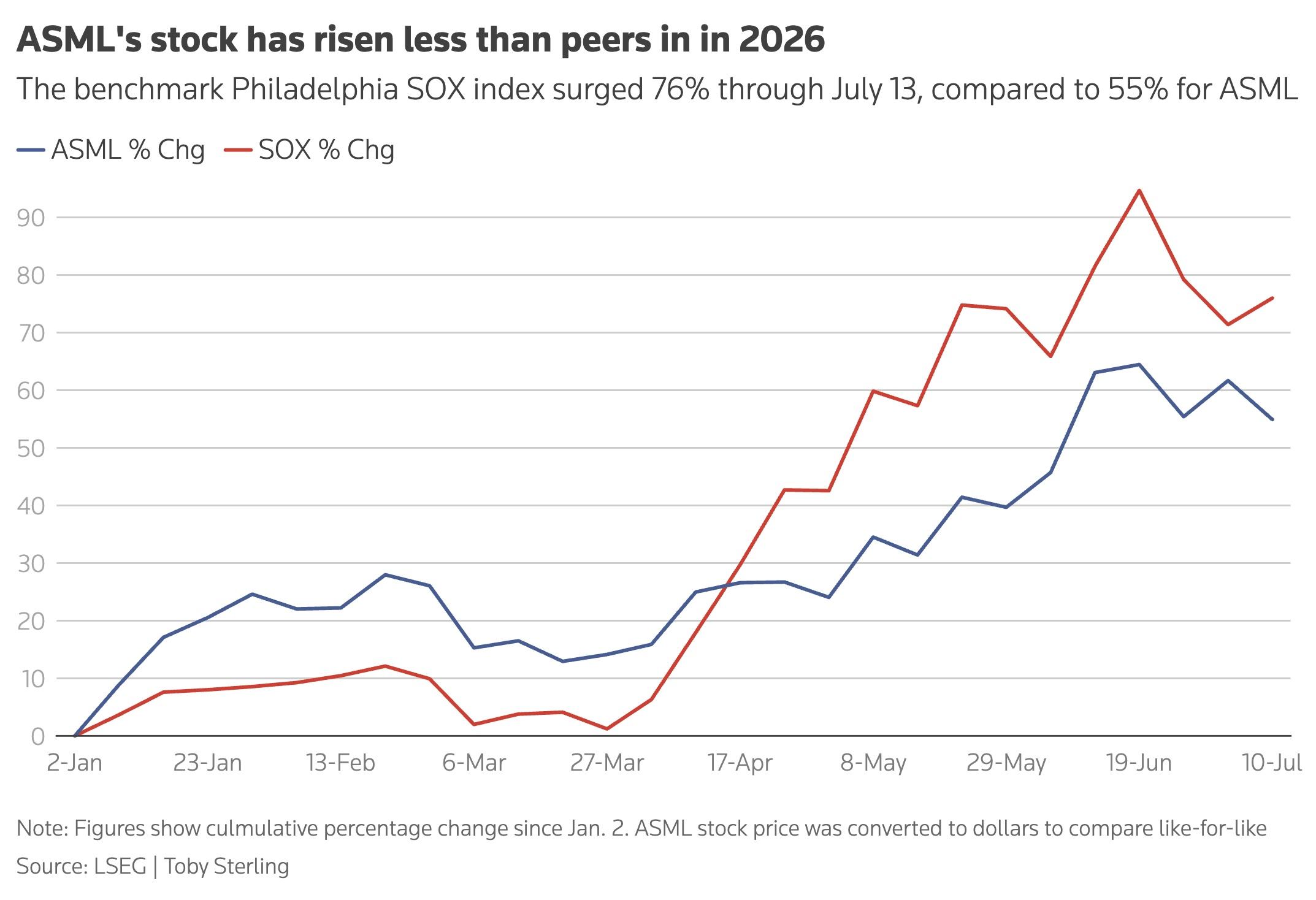
Asmack's stock price has risen by about 69% this year, and its market capitalization has steadily ranked first in Europe. The market is confident of AI-driven demand growth, but it is also wary of the impact on the Chinese market.
Recently, a number of top investment banks raised their target prices simultaneously: Bank of America Securities raised the target price from $2,268 to $2,345, reaffirming the “buy” rating, focusing on the sales range of 44 billion to 60 billion euros in the company's 2030 guidelines; J.P. Morgan raised the target price from $1,813 to $2,200 to give it an “extra hold” rating; Wells Fargo raised the target price from 1,750 US dollars to 2,200 US dollars; Goldman Sachs raised the target price from 1,770 euros to 2,000 euros; UBS Technology maintained its target price for Europe Preferred stocks in the hardware sector , the target price was 2,100 euros, and the forecast for fabs equipment expenditure was raised to US$147 billion in 2026 and US$198 billion in 2027; Morgan Stanley raised the target price to 1,830 euros.
The core logic that Wall Street favors is highly consistent: the AI-driven semiconductor capital expenditure “supercycle” is in full swing. TSMC's 2026 capital expenditure guidelines are as high as 52 billion to 56 billion US dollars, and DRAM manufacturers are actively expanding production of AI storage products such as HBM. As the only supplier of EUV lithography equipment in the world, Asmack is in an irreplaceable industrial position.
However, two major risks cannot be ignored: one is high valuation — Asmack's current price-earnings ratio is about 63.3 times. InvestingPro analysis shows that the stock's relatively fair value is overestimated; the second is geopolitical risk — if the “MATCH Act” currently under consideration by the US Congress passes, it may include an immersive DUV lithography machine on the Chinese restriction list, while Asmack's 2026 guidelines assume that the Chinese market will contribute about 20% of revenue. Furthermore, Nikon is entering the lithography equipment market with more competitive pricing, with the intention of challenging Asmat's dominant position.