


AI “steals” chips and raised costs, Ericsson (ERIC.US) Q2 net profit fell 12%, and the new CEO took over and faced the double test of cost and demand
The Zhitong Finance App learned that Swedish telecom equipment giant Ericsson (ERIC.US) announced financial results for the second quarter of 2026 on Tuesday. Driven by a decline in patent licensing revenue, net sales for the quarter fell 6.1% year on year to 52.69 billion SEK (approximately US$5.61 billion), lower than market expectations of 53.61 billion kroner. However, the adjusted gross margin bucked the trend and rose to 48.4%, exceeding the market estimate of 47.9%; the adjusted EBITA was 6.9 billion kroner, higher than the consensus estimate of 6.71 billion kroner, and the adjusted EBITA profit margin of 13.1% was also higher than the forecast of 12.5%. Net profit fell 12% year over year to SEK 4.1 billion. Outgoing CEO Börje Ekholm said in a statement: “The second-quarter results fully reflect the strength and strict execution of our product portfolio.”
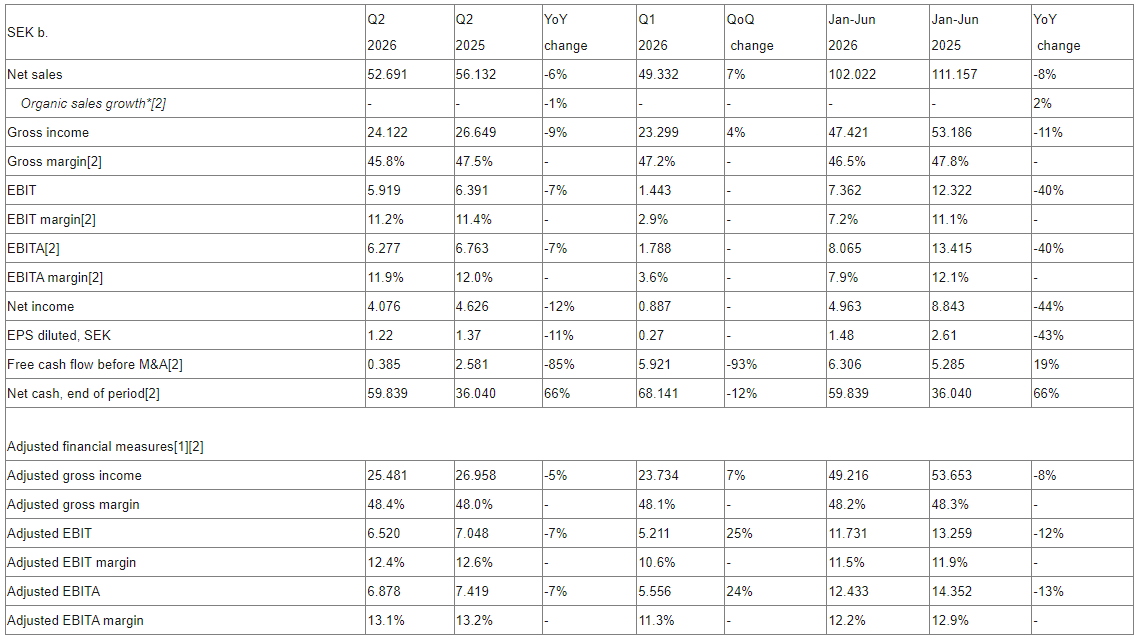
Revenue fell short of expectations, net profit fell 12%, and profit margins unexpectedly exceeded expectations
According to financial reports, Ericsson's net sales for the second quarter fell 6% year on year to 52.69 billion SEK (about US$5.4 billion), lower than analysts' expectations of 53.61 billion. Organic sales declined by 1%, mainly reflecting a decrease in patent licensing revenue — a one-time return was recorded in the same period last year due to partial settlement of intellectual property rights, which did not contribute this quarter.
However, the profit side showed resilience beyond expectations. Adjusted gross margin rose to 48.4% from 48% in the same period last year, surpassing analysts' highest forecast of 48.2%. Adjusted EBITA was 6.9 billion kroner (approximately US$710 million), higher than the market consensus estimate of 6.71 billion kroner. The adjusted EBITA margin was 13.1%, higher than the consensus estimate of 12.5%.
However, net profit declined 12% year over year to 4.1 billion kroner (approximately US$420 million). Free cash flow also plummeted from 2.6 billion kroner in the same period last year to 400 million kroner, a drop of 85% — although the profit side kept the bottom line, the sharp decline in cash generation capacity raised a question mark on the sustainability of capital return policies.
AI “steals” chips: memory shortage is driving up communication equipment costs
The most noteworthy signal in financial reports is the “unexpected transmission” of the AI boom to the cost structure of telecom equipment. Ekholm said in a statement that the company has taken steps to deal with the pressure of rising parts costs this season. Chief Financial Officer Lars Sandström also confirmed in an interview that parts costs “have been reduced through measures throughout the supply chain” — but this statement just confirms that the pressure exists.
The booming development of AI data center construction has driven demand for memory chips, leading to limited supply and rising costs. Omdia analyst Ronan de Renesse warned earlier this year: “The telecom industry is facing a serious shortage of memory chips and copper, affecting network deployment, decommissioning costs, and smartphone pricing.” Industry media Light Reading also reported in June that both Nokia and Ericsson had warned that AI was driving up parts prices and extending delivery times.
The pressure to increase the price of memory chips is being transmitted to the entire industry chain. According to storage giant SK Hynix, the global storage industry will face the worst supply shortage in history in 2027. According to a report by semiconductor research institute SemiAnalysis, the overall memory+flash memory+HBM storage category will account for 30% of the capital expenditure of global hyperscale cloud data centers in 2026. This means that the chip cost pressure on telecom equipment vendors is far from over.
Jefferies analysts have previously made it clear that “as memory prices continue to strengthen, gross margin may still be under pressure in the fourth quarter of 2026.” J.P. Morgan also judged in its earnings forecast that the rising cost of AI-driven chips is squeezing profits, and the pressure in the second half of the year may be even more obvious.
The company has taken steps to mitigate component cost inflation this season. As cost pressure continues to build up over the next few quarters, the company will continue to offset the impact through internal measures and pricing actions.
The decline in North America and global differentiation: a “two-sided narrative” of business prospects
Ericsson's business outlook shows clear regional differentiation. The North American market — a market that was greatly boosted by winning contracts with carriers such as AT&T and Verizon during his tenure — declined slightly this quarter. Analysts at J.P. Morgan Chase pointed out that the decline in 5G investment in North America is the biggest drag. With most 5G deployments completed, US investment is slowing down.
However, the European and Indian markets are expected to grow. Of Ericsson's four market regions, three of Ericsson's four market regions recorded organic sales growth. The North American market continued to be sluggish after the peak 5G construction period, and the US business declined slightly in the second quarter. The European and Indian markets became major growth engines.
However, improvements in growth expectations are accompanied by warnings of pressure on profit margins. Ekholm made it clear that due to the increase in the number of network deployment projects, gross margin after the network business adjustment in the third quarter will face some pressure. The adjusted gross margin forecast range for the third quarter of the network business given by the company is 48% to 50%, compared with the market's previous forecast of 49.5%.
This forecast means that while demand prospects have improved, pressure on the cost side is shrinking profit margins. J.P. Morgan Chase pointed out in its financial outlook that there is still uncertainty about when the European and Indian markets will expand.
Strategic area: Ericsson adheres to the “pure equipment vendor” route, Nokia bets on AI data centers
Against the backdrop of cost pressure and demand differentiation, Ericsson and Finnish competitor Nokia are moving on a different strategic path.
Nokia has restructured its business to prioritize the development of network equipment for AI data centers. According to reports, Nokia has fully embraced Nvidia's GPU solution and launched the AIAerial platform, which has enabled AI-driven 5G calls. Ericsson, on the other hand, remains a pure supplier of mobile network equipment for telecom operators. In terms of technology, Ericsson chose the self-developed ASIC route and collaborated with Intel to develop a CPU+AI accelerator solution, which emphasized the advantages of cost, power consumption, and supply chain security.
The differences in the two strategic paths reflect the different ways in which the telecom equipment industry responds to the AI wave. Nokia chose to actively embrace the incremental market of AI data centers, while Ericsson is more inclined to expand into the existing mobile network infrastructure — the former is likely to gain new growth poles, while the latter faces the challenge of finding new engines after the North American market is saturated.
Ekholm's “Last Season”: New CEO's Challenges After Taking Over
This financial report is also Ekholm's last quarterly report during his tenure. He will officially step down as CEO on September 30, 2026, and will be replaced by Per Narvinger, the current executive vice president and head of the network business. Eckholme will continue to act as Executive Advisor until June 15, 2027 to assist in the handover.
Jefferies analysts do not expect a major change in strategic direction after Narvinger takes office. But the challenges facing the new CEO should not be underestimated: how to find a new growth engine after the decline in 5G investment in North America, how to cope with the continued rise in AI-driven chip costs, and how to find a sustainable balance between profit margins and cash flow — these will all become top topics after Nalwenger takes office.
Ålandsbanken analyst Lars Söderfjell described Ekholm's last earnings report as “unusually calm” — but that is probably the problem. During his 9-year term, Eckholme raised Ericsson's gross margin from 29% to 48% of its online business, but now, new challenges are coming from outside.
As the hungry demand for memory chips in AI data centers continued to drive up component prices, Ericsson handed over a mixed questionnaire that “profits exceeded expectations and revenue fell short of expectations.” The 13.1% EBITA margin remained at the bottom line, but the collapse of 85% free cash flow and the reduction in gross margin guidance for the third quarter revealed deeper structural pressure. The double impact of declining 5G in North America and rising AI costs is pushing the Swedish telecom giant into a more complex business environment. And for Narvinger, who is about to take over, how to find a new growth story on the “pure equipment vendor” route will be a more severe test than any financial report.
Shareholder returns and performance outlook
Ericsson gave back 8.2 billion kroner to shareholders this quarter, including 3.2 billion kroner returned through share repurchases. The company's net cash position remains strong.
Looking ahead to the third quarter, Ericsson expects online business sales growth to be higher than the average seasonal pattern of the past three years, and the adjusted gross margin forecast range is 48% to 50%. Free cash flow before mergers and acquisitions plummeted 85% year-on-year to 400 million kroner this quarter, and the cash flow situation still requires attention.
The market is divided over Ericsson's ratings. Currently analysts' recommendations include 6 buys, 13 holdings, and 8 sales, with an average target price of approximately SEK 101.52. Handelsbanken reiterated the “buy” rating before the earnings report, but lowered the target price from 132 kroner to 123 kroner. J.P. Morgan previously expected an EBITA profit margin of 13.3% this quarter, which is higher than the consensus estimate.
Ericsson stands at a critical turning point: the end of the Ekholm era and the beginning of the Narvinger era, compounding AI-driven component cost pressure with the shift in the 5G investment cycle. Whether gross margin can maintain the 48%-50% guideline range in the third quarter will be a key litmus test for the Swedish telecom giant's ability to control costs and pricing power.