


The Federal Reserve maintains a $10 billion debt purchase scale to cope with the risk of future decline in reserves
The Zhitong Finance App learned that the Federal Reserve announced on Monday that during the current operating cycle ending August 13, it will continue to buy about 10 billion US Treasury bonds. The scale is the same as the previous two cycles to maintain the banking system's sufficient reserve level and prepare ahead of time for the tightening of liquidity that may result from an increase in the Treasury's cash balance in the coming months.
According to the arrangement announced on the New York Federal Reserve's open market trading desk, the Federal Reserve will also reinvest about 17.6 billion US dollars in maturing securities during the same period.
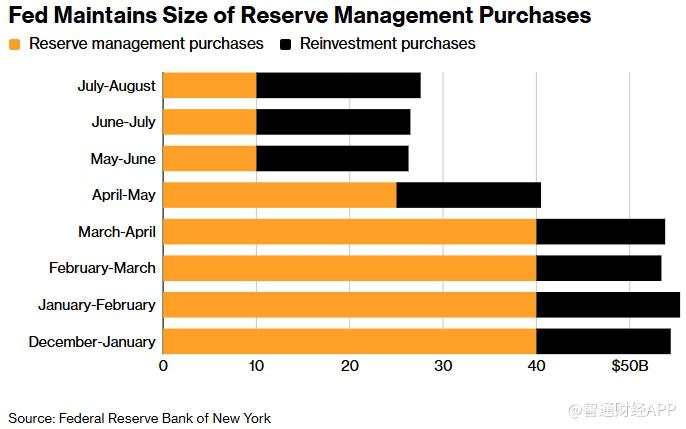
Although the Federal Reserve believes that the current money market is generally running smoothly, decision makers remain cautious about future liquidity conditions. The market generally anticipates that the US Treasury will increase the scale of issuing short-term treasury notes in the future and raise the cash balance to more than 1 trillion US dollars. As the Ministry of Finance absorbs market capital, this process may reduce banking system reserves and drive up short-term financing costs.
To address this risk, the Federal Reserve Open Market Committee (FOMC) revised the policy implementation instructions at the June meeting. The bank clearly stated that if the money market conditions change, reserve management purchases can be temporarily suspended or adjusted as needed to enhance the flexibility of policy operations.
The Federal Reserve ended balance-sheet contraction at the end of 2025, then switched to reinvesting reserves into the financial system by purchasing short-term US Treasury bonds maturing within one year.
In December 2025, the Federal Reserve raised the monthly treasury bill purchase scale to about 40 billion US dollars to ease the pressure on the short-term financing market. At the time, then-Federal Reserve Chairman Powell said that the move was aimed at supplementing liquidity in advance and ensuring that the banking system had sufficient reserves during the April tax season.
However, as market liquidity has improved, the Federal Reserve has gradually reduced the scale of purchases since this year. In April, monthly purchases fell to 25 billion US dollars; in May, it fell further to 10 billion US dollars. Both declines exceeded market expectations.
Roberto Perli, the New York Federal Reserve's open market account manager, emphasized once again last week that there is no pre-set path for reserve management purchases, and the Federal Reserve will flexibly adjust the monthly purchase size according to money market conditions to ensure that bank reserves remain at an “adequate” level at all times.
Recently, the overall liquidity of the US money market is still sufficient. Large amounts of capital continued to flow into money market funds, while increasing repurchase market allocation before the Federal Reserve's interest rate meeting at the end of July, causing the supply of capital to exceed market demand for collateral.
According to the data, the guaranteed overnight financing rate, which measures the cost of financing using US Treasury bonds as collateral, was lower than the bank reserve interest rate for most of the past month, and fell to its lowest level in about six weeks last week, reflecting that the short-term financing market is still relatively relaxed.
As of July 8, the US banking system's reserves were about $3.14 trillion, up from $2.85 trillion at the end of 2025.