


The cease-fire agreement has been reduced to waste paper! Trump reversed the war situation in the Middle East with one sentence, and top strategists shouted that “all research was done in vain”
The Zhitong Finance App noticed that just one day after making investment decisions in response to the easing of the situation in the Middle East, BCA Research's chief investment strategist Jianmarko Papik had to cut down his position and withdraw his recommendation. US President Trump said earlier that the war with Iran has resumed.
Last Tuesday, Papique advised clients to short US stocks and buy European and Japanese stocks instead. He said that US stocks, which provided relative safe haven characteristics during the peak of maritime political tension, have lost some of their appeal since then.
However, in just a few days, Trump suddenly announced the “end” of the US-Iran cease-fire, forcing Papique to quit his recommendations and bear a loss of 1.1%.
Less than a month after the US and Iran signed an interim peace agreement to suspend hostilities, the two countries have once again returned to the brink of all-out war. This has caused market watchers who are betting that the worst period of the Middle East conflict is over completely ruined investment strategies.
“You took the time to unearth an interesting argument, back it up with clear evidence, and then 'snapped' and you were asked to throw it all in the trash,” he said in an email.
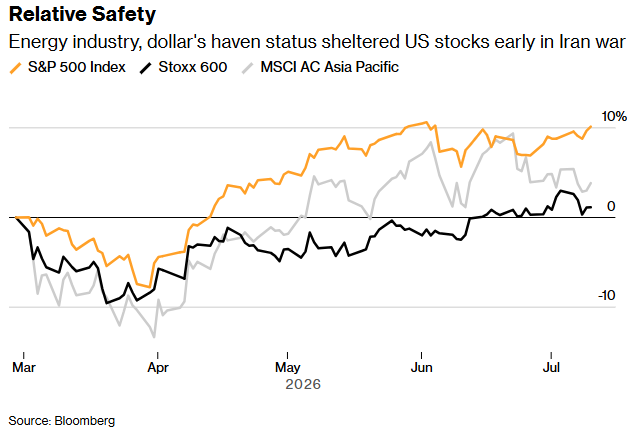
The energy industry and the dollar's safe-haven status protected the US stock market in the early days of the Iran war
When the Middle East war broke out this spring, US stocks outperformed the rest of the world because the US dollar re-emerged as a major safe-haven asset during the conflict, and the US achieved energy independence when crude oil prices soared. Strategists and fund managers at the Royal Bank of Canada, Clark Capital, and Moellencamp Fund say that if hostilities continue, US stocks are likely to outperform their European peers once again.
Mike Bell, a London-based strategist at the Royal Bank of Canada's asset management department, believes that if tension between the US and Iran causes the Strait of Hormuz to close again for a long time, US cyclical stocks are likely to be better able to withstand this kind of pressure compared to their European peers.
“It's important to remember that given that the Strait of Hormuz hasn't been open long enough to fill oil stocks, the long-term closure that begins now will be more serious than the initial one.”
Iran said over the weekend that the strait, which is a key channel for global oil flow, will be closed “until further notice.” The US Central Command raised objections to this, and the global monitoring agency Joint Maritime Information Center reported on Sunday that it is still possible to cross the waterway's southern route.
Brent crude oil futures rose more than 3% on Monday as traders were evaluating recent events (during which the US and Iran also exchanged new attacks). S&P 500 futures fell 0.3% as semiconductor stocks weakened again.
According to Dominique Papalado, chief multi-asset strategist at Morningstar Wealth, its investment team is considering increasing positions in deals made in the early days of the Iran war.
Latin American stocks are one of them. He said that although a stronger dollar has weakened the attractiveness of emerging market stocks, many energy exporters in the region are benefiting from more expensive oil. He added that the fundamentals of the US tech giants are strong, and if these stocks retreat, the team will consider increasing the allocation to them.
Although the rise in big tech stocks drove the broader stock market higher, renewed hostilities severely shook the travel and leisure-related sector last week.
The S&P 1500 airline index fell 5% last week. The S&P 500 Hotel, Resort and Cruise Index fell 1.7%, with cruise operator Carnival Cruises and online travel agency Booking leading the decline.
Elsewhere in the US market, if the strait remains closed, traders should expect a familiar set of winners and losers to re-emerge, said Phil Wool, chief research officer of Rui Lien. Energy companies like ExxonMobil will benefit from higher crude oil prices, while investors will seek refuge in defensive consumer staple stocks such as market openers. Non-consumer necessities stocks, including airlines, will be particularly vulnerable.
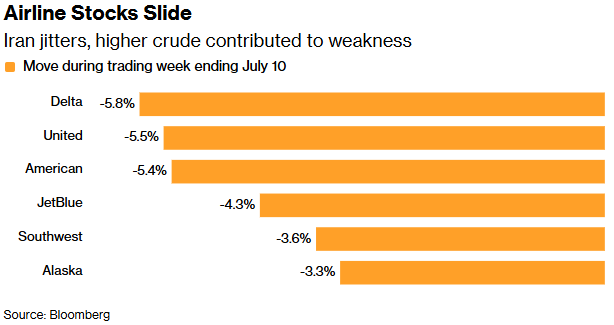
Airline stocks fall
It remains to be seen whether renewed tension in the Middle East will disrupt the broader upward momentum of US stocks. The S&P 500 surged nearly 20% between its low in late March and its recent record high in early June. The Chicago Board Options Exchange (Cboe) Volatility Index (VIX) has always been below 16, and uncertainty surrounding artificial intelligence trading has become the main engine of stock market volatility.
Wool said Wall Street would be “awakened” if the conflict exacerbates continued inflation. “Higher prices are not good for the kind of growth investors are expecting.”
Just like the trading model, the issues investors face are becoming familiar at this point. Will the attacks continue or even escalate? If oil soars and the stock market falls, will Trump try to save it?
Jeff Mullenkamp, fund manager, said, “I would be wise to keep ignoring it because it actually doesn't matter; or would it be wise to keep a close eye on it and get more exposure to oil risk than I have now? That's the kind of question I'm trying to sort out, but I haven't had much success so far.”