


US stock outlook | Futures of the three major stock indexes fell sharply, SK Hynix (SKHY.US) was lowered by Korean brokerage firms, profit expectations were lowered, and chip stocks generally fell before the market
Pre-market market trends
1. On July 13 (Monday), the futures of the three major US stock indexes fell sharply before the US stock market. As of press release, Dow futures were down 0.10%, S&P 500 futures were down 0.37%, and NASDAQ futures were down 1.14%.

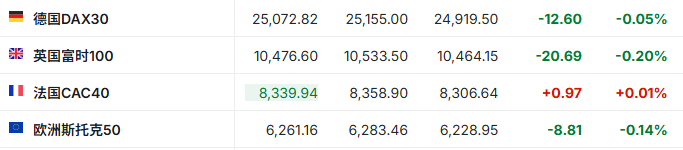
2. As of press release, the German DAX index fell 0.05%, the UK FTSE 100 index fell 0.20%, the French CAC40 index rose 0.01%, and the European Stoxx 50 index fell 0.14%.
3. As of press release, WTI crude oil rose 4.09% to $74.33 per barrel. Brent crude rose 4.18% to $79.19 per barrel. Iranian Foreign Ministry spokesman Bagae said earlier that the memorandum of understanding with the US “has undoubtedly entered a crisis phase.” Bagae said Iran will not abide by the memorandum of understanding as long as the US continues to break its commitments.

Market news
The “Super Week” of US stocks is here: the earnings season meets inflation data, the war in the Middle East stirs up the market again, and Walsh will break through Capitol Hill for the first time. After a relatively calm last week, the US stock market will have a busy week: the second-quarter earnings season has officially begun, and several key economic data have been released one after another; at the same time, the US military launched a new round of attacks on Iran, and geopolitical uncertainty continues to disrupt the market; new Federal Reserve Chairman Kevin Wash is also about to welcome his first trip to Capitol Hill this week since taking office. In terms of financial reports, J.P. Morgan Chase (JPM.US), Goldman Sachs (GS.US), Bank of America (BAC.US), Wells Fargo (WFC.US), and Citibank (C.US) all released earnings reports on Tuesday, while Morgan Stanley (MS.US) and another financial services giant BlackRock (BLK.US) released earnings on Wednesday. Additionally, Johnson & Johnson (JNJ.US), Kindle Morgan (KMI.US), and aviation industry leader United Airlines (UAL.US) Earnings will be announced on Wednesday, leading global artificial intelligence (AI) chip foundry TSM.US (TSM.US), streaming giant Netflix (NFLX.US), and healthcare industry leader UnitedHealth (UNH.US) will announce results on Thursday. In terms of economic data, the consumer price index released on Tuesday and the producer price index released on Wednesday will provide investors with the latest data on the US inflation situation. The University of Michigan consumer confidence survey report will be released on Friday. Meanwhile, on Tuesday and Wednesday, Walsh will attend the National Assembly's semi-annual monetary policy hearings.
The Q2 earnings season for US stocks is approaching: profit expectations soared to the strongest in the post-pandemic era, and the market is about to face “the most severe test in history.” With Wall Street banks taking the lead in handing over report cards this week, the US stock market is about to enter the second quarter earnings season. However, unlike previous years, this earnings season is facing extremely high performance expectations — S&P 500 companies are expected to record a profit increase of more than 23%, the strongest level since the post-pandemic recovery. In a context where stock indexes are approaching historic highs, an abnormally steep profit “pass line” means that the room for fault tolerance is shrinking sharply, and any wind and wind may trigger sharp fluctuations. According to LSEG IBES aggregated analysts' forecast data, the overall profit of the Q2 S&P 500 index is expected to increase by 23.4% year-on-year, a sharp increase from the 15.2% forecast at the beginning of the year.
New Federal Reserve Chairman Walsh faces congressional tests for the first time: Can “talk less and do more” work? Inflation and independence are the focus of the question. During Kevin Walsh's first month as chairman of the Federal Reserve, he made his point clear: less is more when explaining his views on the economy. In fact, Walsh has remained largely silent on related market issues. But this week, as Walsh testifies in Congress for the first time as Chairman of the Federal Reserve, he will face a group of lawmakers who want answers. This hearing is a law requiring the Chairman of the Federal Reserve to attend the semi-annual monetary policy report hearing twice a year. Meanwhile, the Federal Reserve submitted this official report to Congress in advance last Friday (July 10). In the report, policymakers clearly reiterated the Fed's iron-fisted position — “the committee will achieve price stability” and vowed to push the inflation rate back to the target level of 2%.
The rumor about Japan's pension “booming” has been refuted by people familiar with the matter. According to people familiar with discussions within the Japanese government, Japan currently has no plans to immediately adjust the target asset allocation of the National Pension Fund, but it may direct more capital to domestic assets within the scope currently permitted. Japan's Finance Minister Katayama Satsuki said on Friday that the government will explore ways to encourage various pension funds, including the world's largest pension fund, the Japanese Government Pension Investment Fund (GPIF), to “significantly increase investment in Japanese financial assets.” This statement triggered a rise in yen and Japanese treasury bonds at the time, and the market anticipated that trillions of dollars of capital might flow into the Japanese market through GPIF. However, two government sources revealed that although the government is studying how to increase such investment to the extent permitted by the current benchmark portfolio, this move will not immediately trigger revisions to GPIF's mid-term goals. A source said, “The market response far exceeded our expectations,” while admitting that Katayama Satsuki's statement did not mean that the asset allocation structure would change.
Will the explosion of the bond market trigger the next financial tsunami? Wall Street bear Peter Schiff warns that the pressure on US debt will escalate, and the stock market and coin industry will be “bloodwashed.” As global investors keep an eye on drastic fluctuations in risky assets, well-known pessimistic economist Peter Schiff (Peter Schiff) recently issued a stern warning: the next financial tsunami that will sweep the world will not be turbulent, but rather the seemingly uneventful US Treasury bond market. This well-known investor, who has long been bullish on gold, said bluntly in his latest podcast that the collapse of the US Treasury bond market could trigger a chain reaction, affecting the stock market, real estate, and even cryptocurrencies. He expects that with the simultaneous correction of various types of risk assets, investors will eventually withdraw from these fields and switch to gold for safe haven.
AI giants are starting to roll up prices! OpenAI, Meta (META.US), and SpaceXAI collectively launched a low-cost model. Over the past week, the global AI industry ushered in a rare “price war” climax. OpenAI, Elon Musk's SpaceXAI, and Meta Platforms have successively released next-generation AI models — their common selling point is not how powerful they are, but how cheap they are. From GPT-5.6 to GroK 4.5 to Meta Muse Spark 1.1, the three major players all shared “cost efficiency” as the core narrative.
OPEC maintained its global economic growth forecast for this year and next two years, and lowered its forecast for oil demand growth in 2026. On July 13, the Organization of Petroleum Exporting Countries (OPEC) maintained the 2026 and 2027 global economic growth forecasts unchanged at 3.1% and 3.2%, respectively, in its latest monthly crude oil market report. Meanwhile, OPEC slightly lowered its forecast for global oil demand growth in 2026 to 800,000 b/d, saying this is a slight reduction from last month's forecast; global oil demand is expected to grow 1.9 million b/d in 2027, up from last month's forecast.
Individual stock news
Did you find the reason why SK Hynix (SKHY.US) plummeted 15%? South Korean brokerage firms said Q2 earnings or “fell short of expectations.” On Monday, the stock price of South Korean memory chip giant SK Hynix plummeted by more than 15%, dragging down the South Korean stock market to another collapse, leading to the collapse of Asian storage stocks. A report released today by Korea Investment Securities (KIS), a local Korean brokerage firm, is seen as the trigger for SK Hynix's stock price to plummet. In its latest report, KIS predicts that SK Hynix's operating profit for the second quarter of this year will be slightly lower than market expectations. Although KIS's forecast for SK Hynix's second-quarter results is quite impressive, the bank's operating profit forecast is about 8% lower than the market consensus forecast of 65 trillion won. This has inflamed investors' concerns. KIS explained in the report that since SK Hynix's HBM's share of revenue was higher than that of competitors, the increase in average selling price (ASP) was lower than the market average. The reason behind this is that HBM usually locks in prices with long-term supply agreements, so there will be no significant changes in the short term according to market prices. In contrast, when the overall price of the market rises, the average sales price of traditional DRAM and NAND products increases even more.
US chip stocks generally fell before the market. Before the US stock market on Monday, SK Hynix fell by about 9%, while the stock made a spectacular debut in the US market last Friday, surging 13%. Another memory chip giant, Micron Technology (MU.US), fell 5%, while flash memory product supplier SNDK.US (SNDK.US) fell nearly 6%. In addition, individual stocks closely related to the AI industry chain, such as AMD (AMD.US), Intel (INTC.US), Lumentum (LITE.US), Maywell Technology (MRVL.US), and Western Digital (WDC.US), also generally declined in pre-market trading on Monday.
Intel is investing $5.7 billion to expand its manufacturing facility in Ireland. Intel plans to invest $5.7 billion to significantly increase production capacity at its Leixlip, Ireland plant. The plant is located approximately 12 miles west of Dublin. The investment will enable the plant to scale up production of Intel Xeon 6 server processors and future generations of processors designed for high-density cloud and networking, artificial intelligence, and enterprise workloads.
Escape the AI arms race storm! Wall Street capital flocked to the “king of cash,” and Apple (AAPL.US) soared to a market capitalization of 600 billion US dollars in 20 days. Investors are turning back to Apple as concerns about AI spending are dragging down the stocks of chipmakers and cloud computing giants. The iPhone maker's stock price plummeted last month due to a disappointing demonstration of future AI features, but since bottoming out on June 25, it has rebounded 15%, increased its market capitalization by nearly $600 billion, and pushed the stock price back to a record high. Over the same period, the Philadelphia Semiconductor Index fell 7%, the S&P 500 rose 3%, while the tech-heavy Nasdaq 100 Index only rose 1.3%. The stock's reversal reflects the market's growing unease about whether high AI spending will pay off, and Apple's decision not to participate in the data center arms race is increasingly being viewed as an asset rather than a liability, even though its AI products have repeatedly frustrated investors.
Meta's total investment in its Louisiana data center will exceed $250 billion. Meta Platforms promised to invest an additional $40 billion in its large data center campus in Louisiana, USA. As the company continues to expand its AI computing layout, the project's total investment is expected to exceed $250 billion. Meta announced Monday that it will expand its data center project in rural Louisiana to at least 5 gigawatts (GW) of computing capacity, with a total investment of 50 billion US dollars. Earlier, the company had announced that it would invest $10 billion to build the data center and surrounding communities. In May of this year, it was reported that Meta plans to invest another 200 billion US dollars into the project, mainly to purchase high-cost computing chips to be installed in this nearly 4,000-acre park. According to a source familiar with the matter, this will bring the estimated total investment of the project to at least 250 billion US dollars. As of now, Meta has not announced any specific expenses for the project other than this $50 billion.
AI orders continue to be strong! TSM.US's June revenue surged 67.9% year-on-year, and advanced packaging production was further expanded. According to data released by TSMC on Monday, its June sales increased 67.9% year over year, and the company will release its second-quarter earnings report later this week. In the first half of 2026, TSMC's total revenue reached NT$2.4 trillion (US$74.99 billion), an increase of 35.6% compared with the same period in 2025. TSMC reported revenue of NT$442.68 billion in June, up 6.2% from the previous month. Additionally, TSMC will add three new advanced packaging plants to the second phase of the Chiayi Science Park construction plan in southern Taiwan. The source said that the park, which covers an area of about 90 hectares, will develop into an advanced packaging industrial settlement led by TSMC. The report said that the two advanced packaging plants in the first phase of the plan began mass production last month. He said that after all four factories are put into operation, the Chiayi Science Park is expected to generate an output value of more than 300 billion NTD (about 9.35 billion US dollars) and create more than 9,000 jobs every year.
Demand for AI has spread to mature manufacturing processes, and TSMC plans to raise the price, which is expected to take effect in January next year. According to reports, TSMC plans to raise mature process quotes. A number of IC designers have revealed that they have received notifications from TSMC one after another. As for the increase, depending on the manufacturer and product line, it will be finalized in the fourth quarter and is expected to take effect in January next year. The increase is currently estimated to be around a single-digit percentage. This is the first time in more than three years that TSMC has raised prices for mature manufacturing processes. Previously, due to a rush of orders for advanced processes, many of its advanced process nodes (covering cutting-edge nodes such as 3nm and 5nm) had already raised prices by up to 15%, and may rise further by 5% to 10% next year.
The stock price of SpaceX (SPCX.US) fell nearly 30% from its peak. Senior investors commented: Hong Feng is about to be lifted, and it is only worth $30 per share. SpaceX's stock price has fallen about 28% from the closing peak of more than $200 after the IPO. Veteran investor George Noble once again voiced a bearish voice and warned that the stock will face concentrated pressure from insiders to reduce its holdings in the coming months. Noble, who participated in the establishment of the Fidelity Overseas Fund, pointed out that SpaceX's valuation is seriously out of touch with fundamentals. He also believes that the initial rise in the stock's listing was not driven by fundamentals, but rather stemmed from what he called “artificial emptying.” However, Noble judged that this pattern was about to be reversed. He pointed out that the lockdown schedule already announced by the company shows that the ban on insider shares will be lifted in batches — starting after the release of the second-quarter earnings report and continuing until the end of the year. The final batch is scheduled to be unblocked in June 2027. He believes that the main catalyst for stock prices in the coming months is not company fundamentals, but rather the disclosed schedule for lifting the ban. Noble said that Starlink is SpaceX's only continuously profitable business, but this business alone is insufficient to support the company's current market value. He estimated SpaceX's reasonable valuation at around $30 per share and called the company “the worst large-cap valuation bubble I've ever seen.”
Key economic data and event forecasts
23:00 Beijing time: The US New York Federal Reserve's 1-year inflation forecast for June.
The next day at 00:30 Beijing time: Federal Reserve Governor Waller delivered a speech.
Performance Forecast
Tuesday pre-market: Ericsson (ERIC.US), J.P. Morgan Chase, Bank of America, Goldman Sachs, Wells Fargo, Citibank.