


Cui Dongshu: The average price of passenger cars was 174,000 yuan in June, the year-on-year increase of 40,000 yuan, the volume of new energy fell, and the structural characteristics of the increase were obvious
The Zhitong Finance App learned that on July 13, Cui Dongshu published an article stating that the main influence on price changes was structural changes and sales volume changes. While sales growth is slow, the average price in the car market continues to rise. The average price of passenger cars in 2025 was 168,000 yuan, down 16,000 yuan from the average price in 2024. The average price of passenger cars in June 2026 was 174,000 yuan, an increase of 40,000 yuan over the same period. In 2025, with the rapid contraction of high-end fuel vehicles, the average price in 2025 dropped to 177,000 yuan. The average price of conventional fuel vehicles was 178,000 yuan in June 2026, and fuel vehicle buyers gradually stabilized. The average price of new energy vehicles in 2025 is 160,000 yuan, and the price has dropped significantly. June 2026 was 171,000 yuan, with a price increase of 10,000 yuan, volume decline and price increase, reflecting structural changes in NEV consumption.
The average price of luxury cars in 2026 was 330,000 yuan, down 30,000 yuan from 2025; in June 2026, the average price of luxury cars was 329,000 yuan, down 50,000 yuan from the same period. In 2026, the joint venture brand was 172,000 yuan, an increase of 10,000 yuan over 2025; the average price of 171,000 yuan in June 2026 decreased by 20,000 yuan over the same period. In 2026, the new forces were 238,000 yuan, down 30,000 yuan from 2025; the average price in June 2026 was 232,000 yuan, down 16,000 yuan from the same period. In 2026, the average price of independent brands was 128,000 yuan, an increase of 60,000 yuan over the same period; in June 2026, the average price of independent brands was 131,000 yuan, an increase of 70,000 yuan over the same period.
The popularity of automobiles in China is only 254 units/1,000 people, and the popularity of automobile consumption is the most important trend in the future. The trend is that car prices continue to fall due to the low cost of electrification. Currently, with the withdrawal of the vehicle purchase tax exemption policy and the upgrading of duty-free technical indicators for new energy vehicles, some models with short battery life and high electricity consumption are under pressure to be remodeled. The sharp contraction of A00 class electric vehicles in June brought about an increase in average prices, and there is a lot of pressure to increase sales in 2026.
1. Passenger car prices have risen sharply
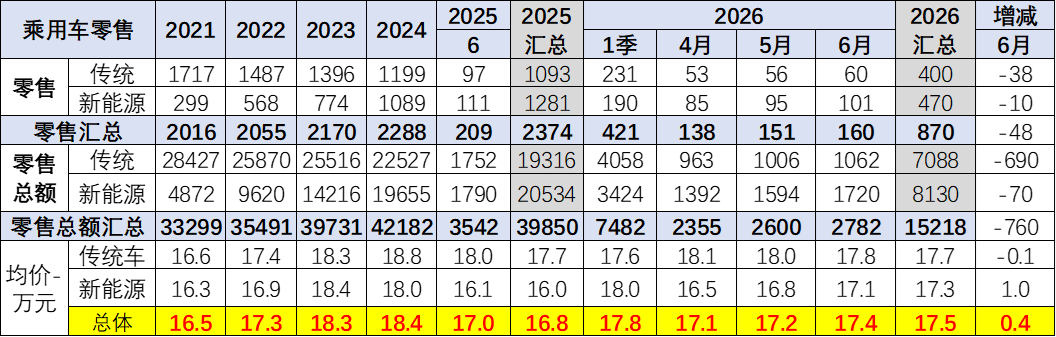
The main factors affecting price changes are structural changes and sales volume changes. While sales growth is slow, the average price in the car market continues to rise. The average retail price of passenger cars was 165,000 yuan in 2021, rising all the way up to 184,000 yuan in 2024. The average price of a passenger car in 2025 was 168,000 yuan, down 16,000 yuan from the average price in 2024. The average price of passenger cars in June 2026 was 174,000 yuan, an increase of 40,000 yuan over the same period.
The price of conventional fuel vehicles continues to rise. The market contraction is obvious in the middle and low end, while the high-end shrinks slowly, so it has risen from 166,000 yuan in 2021 to 188,000 yuan in 2024. In 2025, with the rapid contraction of high-end fuel vehicles, the average price in 2025 dropped to 177,000 yuan. The average price of conventional fuel vehicles was 178,000 yuan in June 2026, and fuel vehicle buyers gradually stabilized.
Recently, the average price of new energy vehicles has gradually declined, from the average price of 184,000 yuan in 2023 to 180,000 yuan in 2024, and the average price of new energy vehicles is 160,000 yuan in 2025. The price drop is significant. June 2026 was 171,000 yuan, with a price increase of 10,000 yuan, volume decline and price increase, reflecting structural changes in NEV consumption.
2024-2025 was promoted by end-of-life renewal and trade-in subsidy policies, and sales in the middle and lower end increased significantly, so average prices declined and the market picked up. Since the popularity of private cars in China is relatively backward, the reduction in average prices promotes all-round development of the market, which is conducive to the popularization and increase in the scale of the car market.
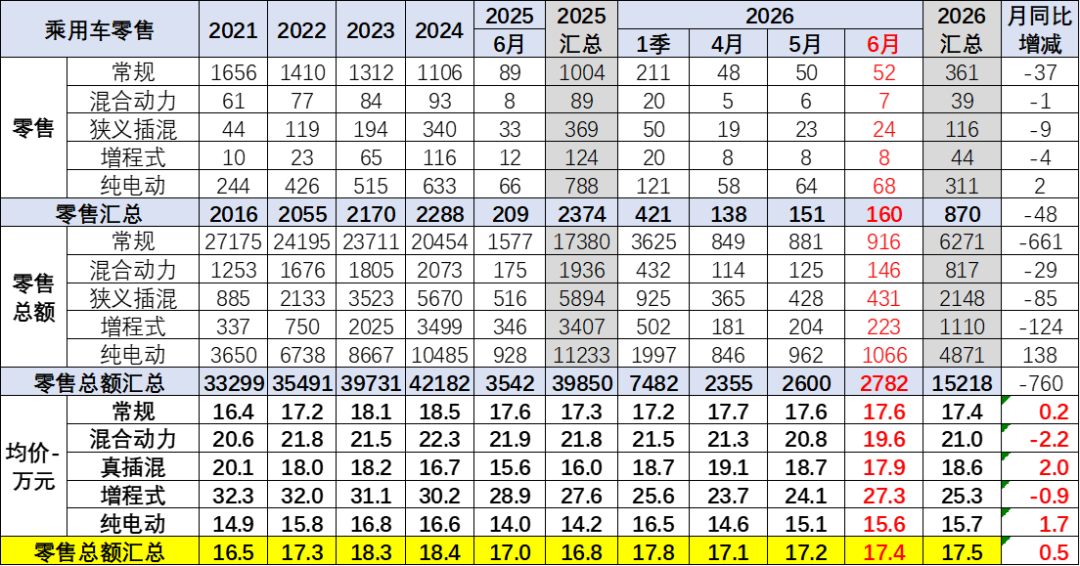
The highest average price in the car market is for extended-range and hybrid vehicles, and the lowest is for pure electric vehicles. The structural reason for the recent decline in average price is the increase in the share of entry-level pure electric power, and the decline in the share of higher-cost extensions and hybrid power, creating structural impetus. The growth rate of new energy sources declined in June 2026, and the low end contraction led to a huge increase in the price of plug-in hybrid and pure electric vehicles. As a result, the overall average price in June was 174,000 yuan, a relative increase of 50,000 yuan.
In an objective reality where the popularity of the Chinese car market is low, the decline in the average price in the car market reflects an increase in purchases by middle- and low-end people. It should be a good thing to have an increase. Retail sales declined in June 2026, the lower end fell even more, the average price increased, and the market pressure was high.
2. Low-end contraction of the passenger car market price segment sales structure
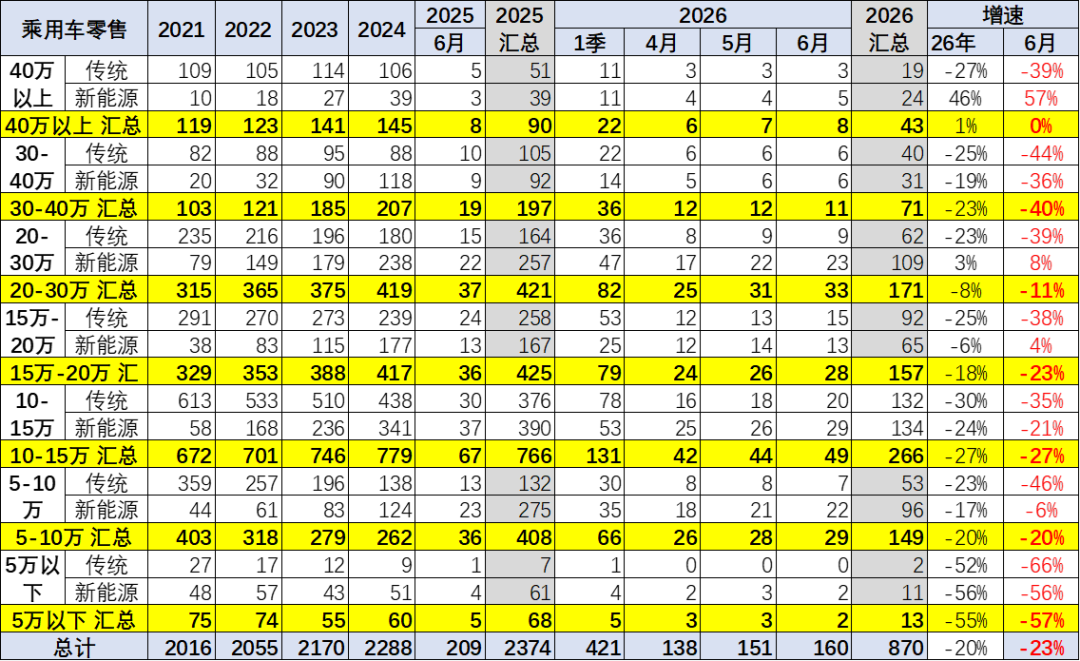
According to Passenger Link data, the price segment structure trend in the national retail market continued to rise in previous years. Sales of high-end new energy models increased markedly, while sales of medium- and low-priced models declined. In 2025, with the promotion of the end-of-life renewal policy, the middle- and low-end car market picked up, and medium- to low-end consumption rebounded. In 2026, with the high-quality development of policies, there was a sharp decline in the middle and low end. Among them, less than 50,000 fell by 55%, which was quite drastic, and sales of the 10-150,000 traditional flagship models also fell sharply, putting poor pressure on entry-level consumption and inhibiting the growth of the car market.
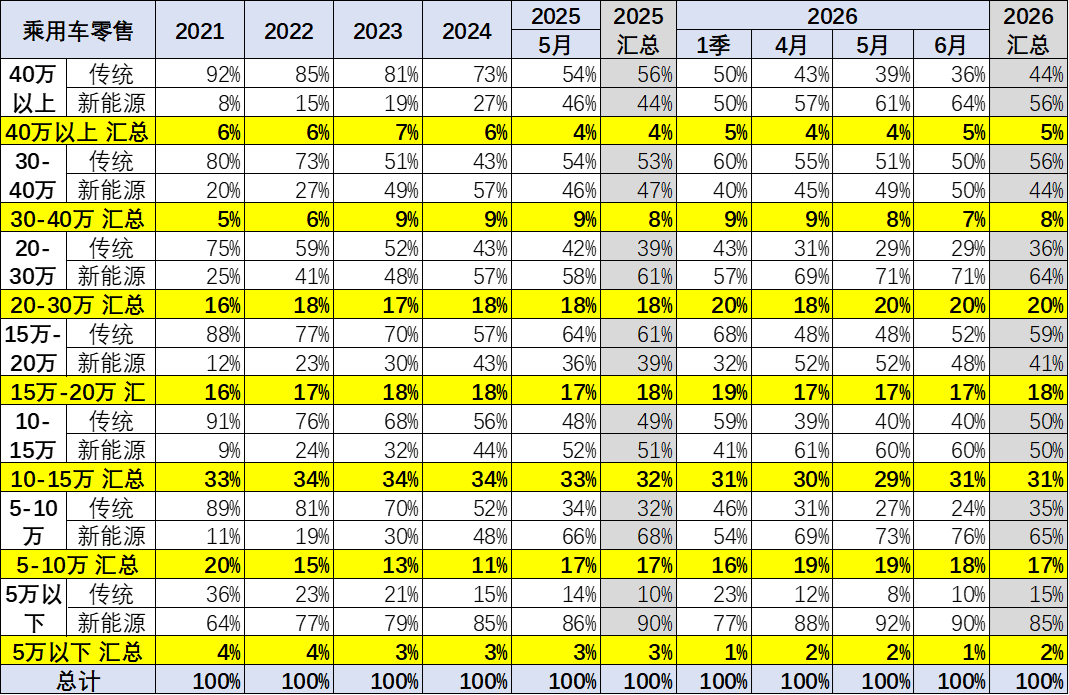
Autonomous high-end breakthroughs reflect the obvious trend of high-end development brought about by the growth of new energy sources for passenger cars, but the breakthrough was based on stability at the low end. Currently, the downward trend in entry-level new energy sources is quite severe. High-end consumption is reflected in the fact that ordinary consumption is not strong. People's consumption is fundamental. Although high-end consumption is strong, it actually shows that the car market is generally weak.
3. Passenger car grade market sales structure
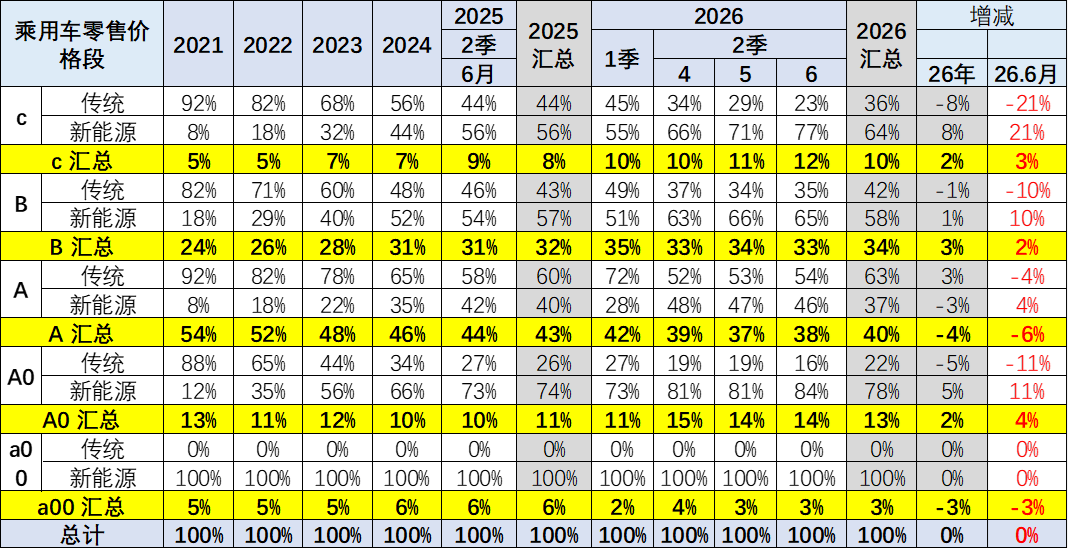
Recently, the highest penetration rate of new energy vehicles was small cars. In June, the penetration rate of mini cars was 100%, A0 class small cars reached 84%, and Class A new energy increased relatively well, with a penetration rate of 46%.
The new energy penetration rate of B-class cars continues to increase, and the performance of extended-range models has improved. The new energy penetration rate of C-class cars has increased dramatically, reflecting the obvious advantages of high-end electrification.
4. New energy line structure for passenger cars
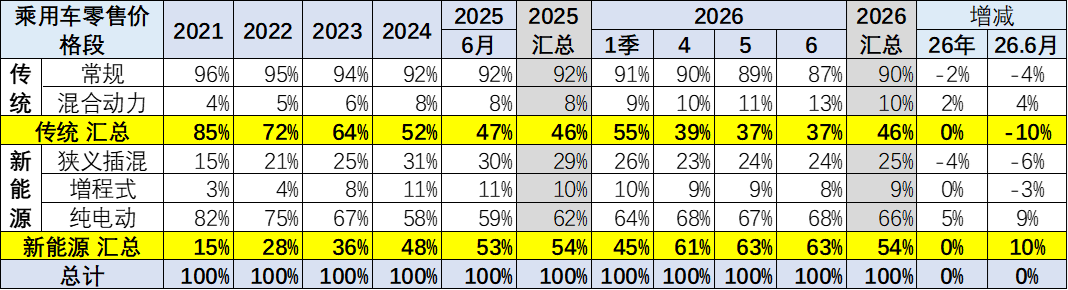
Domestic retail sales of pure electric new energy vehicles have continued to grow at a high rate. The mixed performance has been outstanding in recent years, and the growth rate has continued to grow slightly. Sales of traditional passenger cars are under continuous downward pressure.
The share of new energy vehicles reached a strong proportion of 54% in 2026, and the penetration rate of new energy vehicles reached 63% in June 2026, and the contribution of new energy vehicles driven by high fuel prices increased significantly.
5. Sales structure of internal dynamics in each price segment in June 2026
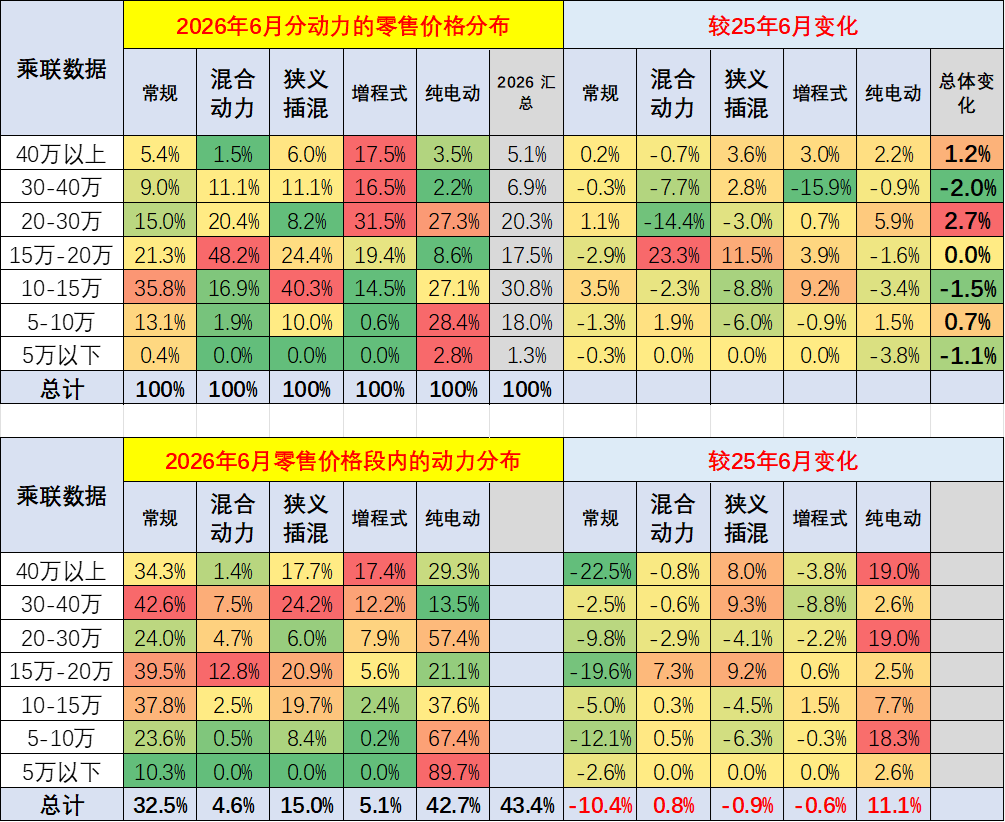
Within the price segment market, the distribution of power is relatively uneven. Among them, pure electric performance is the weakest in the market below 50,000 yuan, while extended-range electric vehicles have the strongest performance distribution in the high-end market, while hybrids have a slightly higher market share of 200,000 yuan or more, and are relatively strong in the 50-150,000 market.
Traditional fuel vehicles have a relatively strong performance of 100,000 to 150,000 yuan, and the market performance of more than 300,000 yuan is also strong, forming the characteristics of differentiated distribution. The distribution of hybrid power is relatively narrow, and products belonging to the middle to high price range are the main ones. Plug-in hybrids, on the other hand, are mainly mainstream models, with excellent performance above 300,000 yuan. The low-end market declined sharply in the first half of the year. This was also a contraction in consumption and a slowdown in low-end growth.
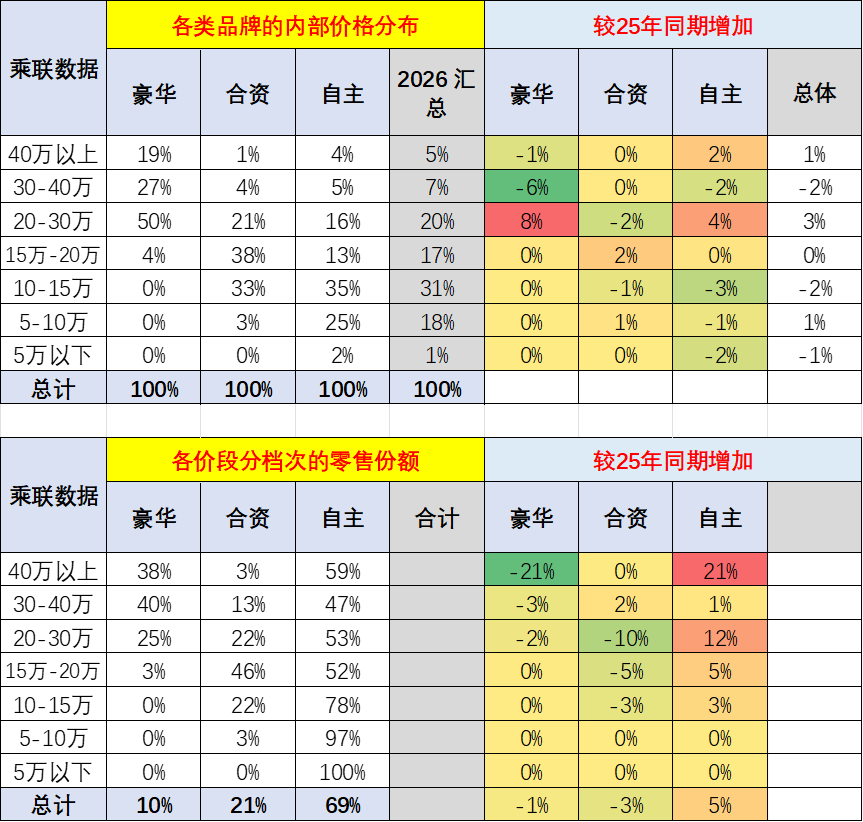
Independent brands have achieved good results in high-end breakthroughs, especially over 400,000 yuan. It has greatly increased its share in the 150,000+ market and achieved good growth.
6. Changes in market average prices for various brands
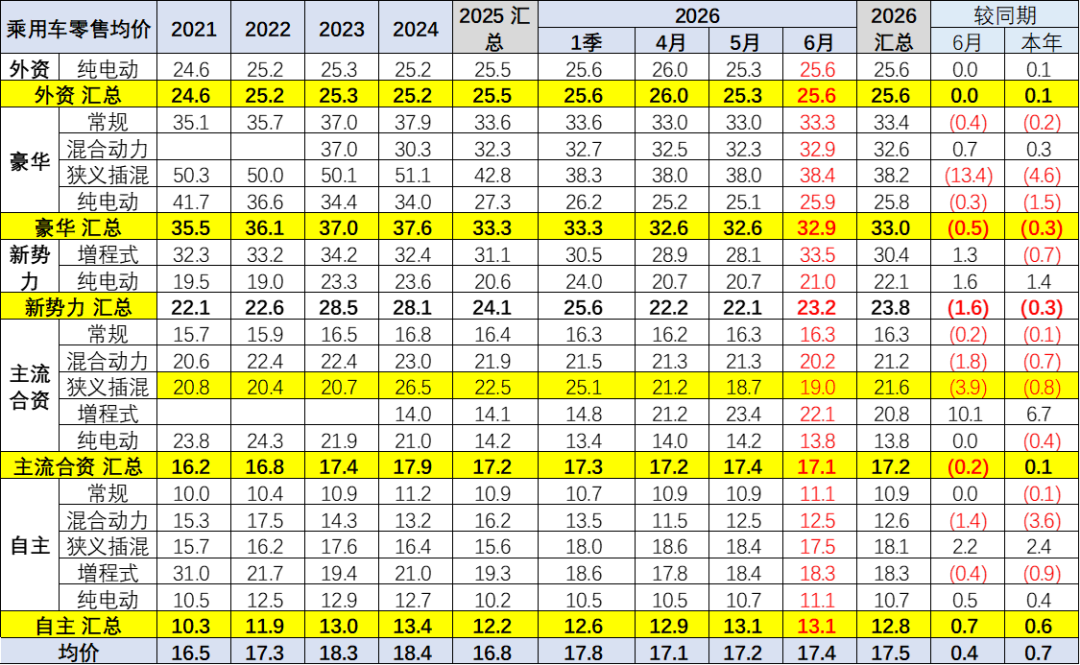
The average price of luxury cars in 2026 was 330,000 yuan, down 30,000 yuan from 2025; in June 2026, the average price of luxury cars was 329,000 yuan, down 50,000 yuan from the same period. In 2026, the joint venture brand was 172,000 yuan, an increase of 10,000 yuan over 2025; the average price of 171,000 yuan in June 2026 decreased by 20,000 yuan over the same period. In 2026, the new forces were 238,000 yuan, down 30,000 yuan from 2025; the average price in June 2026 was 232,000 yuan, down 16,000 yuan from the same period. In 2026, the average price of independent brands was 128,000 yuan, an increase of 60,000 yuan over the same period; in June 2026, the average price of independent brands was 131,000 yuan, an increase of 70,000 yuan over the same period.
Independent brand new energy sources are at full strength. Both pure electric and hybrid performance are under high pressure, and hybrid performance is strong. Overall, the price competitiveness of high-end new energy sources has increased. The structure of new forces has fluctuated greatly, and the pure electric market has clearly weakened. In June 2026, the average price of autonomous fuel vehicles was 111,000 yuan, and the price was basically the same as the same period.