


Ice and fire are two heavens! SK Hynix's US stock debut surged 13%, but Korean stocks plummeted 11% in a single day. What is the reason for the market divergence?
The Zhitong Finance App learned that SK Hynix's stock price fell in Seoul on Monday after the memory chip maker completed the largest foreign company IPO in US stock history. Traders pointed out that the settlement of profits and the shift to American Depositary Receipts (ADR) were the main reasons for SK Hynix's Korean stock decline.
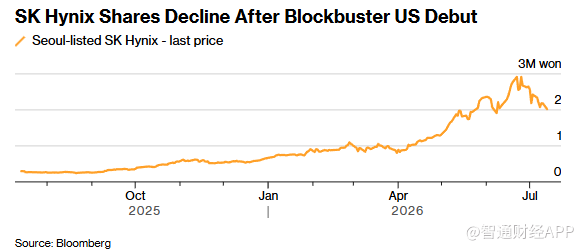
On Monday, SK Hynix Korea shares fell 11% to their lowest level in more than a month. Previously, SK Hyv.US (SKHYV.US) ADR landed on NASDAQ last Friday, surging nearly 13% on the first day of listing, mainly due to strong buying.
SK Hynix's Korean stock fell after a big success in its US stock debut
SK Hynix's stock price is hot and cold! Analysts quickly interpret
“The ADR listing was very successful, but most of the success factors have been digested by the market,” said Chan H Lee, managing partner of Seoul hedge fund Petra Capital Management. “Today's decline seems to reflect a typical 'sell fact' response and profit settlement rather than any change in fundamentals.”
Ryu Young-ho, a senior analyst at NH Investment Securities, also said that after SK Hynix completed its US listing, investors made a profit, and market sentiment was also affected by cautious expectations about SK Hynix's second-quarter results. He pointed out that investors originally expected SK Hynix HBM4 chip shipments to increase from the second quarter, but this increase did not seem to have been achieved on a large scale.
The company's $26.5 billion US IPO attracted much attention and was seen as a test of the demand for overseas distribution and the continuation of the AI boom. SK Hynix has attracted the attention of global investors due to its key position as a high-bandwidth memory (HBM) supplier. The product can be used in conjunction with Nvidia's AI processor.
Despite recent market concerns about excessive AI valuations and excessive spending levels, SK Hynix's current offering was oversubscribed by more than seven times. According to the data, its ADR closing price last Friday was about 15% premium over stocks listed in Seoul.
Since the end of 2022, the stock price of SK Hynix Korea has soared more than 25 times as the AI boom has boosted the price of various memory chips. Due to the popularity of leveraged exchange-traded funds (ETFs) that track this stock, its stock price is also prone to sharp fluctuations.
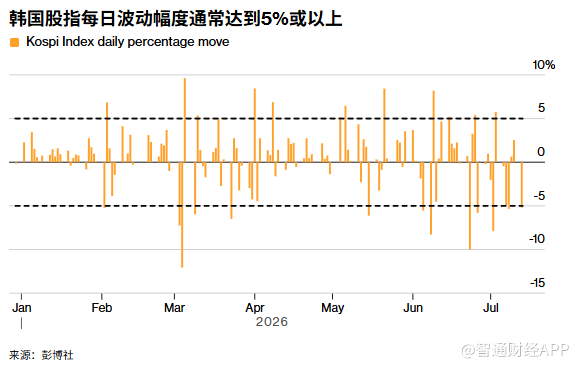
This fluctuation also affected Korea's benchmark index Kospi. On Monday, the index fell more than 6%, and the Korea Exchange suspended programmatic trading for a while. The stock price of Samsung Electronics, the main competitor of SK Hynix, also fell 7% at one point.
Looking ahead to the future market, can the “supercycle” of AI chips continue? The agency gave a countertrend layout idea
The AI boom has pushed market expectations to a height that is increasingly difficult to surpass. According to a report released by Korea KIS Securities on Monday, SK Hynix's operating profit for the second quarter is expected to reach 60.4 trillion won, 8% lower than the market's unanimous estimate of 65 trillion won. Reasons for the month-on-month decline in profit margins include: compared to the overall market, HBM's share of current shipments is high, and the average unit sales price (ASP) of products is lower than the market average.
Although overall memory prices continue to rise due to severe shortages, HBM's supply contracts are often based on less flexible long-term agreements. Using this as an argument, many industry insiders believe that AI has spawned a “supercycle” in the chip industry, and that industry trends will break the inherent boom-bust cycle of memory chip demand.
Guo Luzheng, CEO of SK Hynix, said on Friday that the shortage of memory chips may continue beyond 2030. Despite this, memory manufacturers are scrambling to expand production capacity, causing the market to worry that profits will eventually decline after demand subsides.
Aleksey Mironenko, Head of Global Investment Solutions at Leo Wealth, said, “SK Hynix's additional financing is not to distribute dividends, but to increase production capacity. At the same time, buyers are also constantly innovating to reduce the consumption of memory and computing power resources needed to complete tasks. This means that demand in the industry will gradually weaken while the supply side continues to expand.”
The market is concerned about the wave of industry expansion and doubts about the continuation of AI capital development support. SK Hynix's stock price has fallen by more than 30% from its all-time high in June. Many highly leveraged ETFs tracking this stock were listed in Seoul, South Korea at the end of May, and their net worth has dropped nearly 40% so far.
Technical indicators show that SK Hynix's gains have cooled down after a frenzy earlier this year. MRM Research analyst Nico Rosti said that the chipmaker's stock is currently “seriously oversold.”
“The stock price may drop for another week, but we think this is a good opportunity to buy,” said Rosti. The rebound in SK Hynix's Korean stock should push up the ADR price. So now is a good time to buy it.”