


IPO Foresight | Will XinTianxia benefit from a reversal in industry performance due to the flash memory boom, and take advantage of the heat to lay out “AI+” to get out of the cycle?
Since 2026, under the catalyst of the AI boom, flash memory has entered a new supercycle. According to industry data, the global flash memory chip market is about 74.5 billion US dollars in 2025, and this year this figure is expected to skyrocket to 264.4 billion US dollars, an increase of more than 2.5 times. The maturity and widespread application of AI technology is undoubtedly a key driving force in the flash memory chip industry market. According to forecasts by relevant agencies, the global flash memory chip market will further expand to US$538.5 billion by 2030, corresponding to a compound growth rate of 48.5% over the 2025-2030 period.
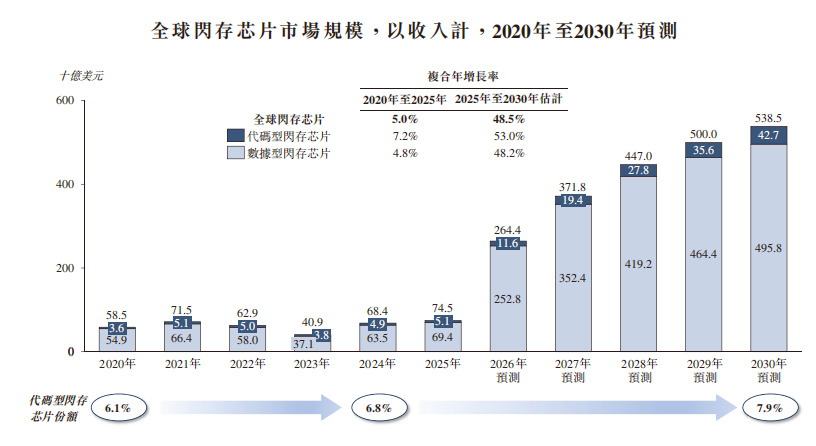
Following the industry boom cycle, Xintianxia Technology Co., Ltd. (hereinafter referred to as “Xintianxia”) submitted a listing application to the Hong Kong Stock Exchange for the second time during the year. As a fabric-free memory chip supplier focusing on the R&D, design and sales of code-type flash memory chips, Core World mainly provides the market with code-type flash memory chips with a storage capacity range of 1 Mbit to 8 Gbit. According to Insight Consulting, based on revenue from code-type flash memory chips in 2025, Xintianxia ranked fifth among all fabric-free companies in the world.
Performance fluctuates with the industry cycle
The flash memory chip industry has a certain periodicity. Going back in history, usually a cycle of three to four years. The cyclicality of the flash memory chip industry is also reflected in the financial data of Xintian.
On the revenue side, from 2023 to 2025, the company's revenue was 663 million yuan, 442 million yuan, and 519 million yuan, respectively. Revenue fell by more than 30% year on year in 2024, mainly due to the fact that the company actively made pricing adjustments to accelerate the digestion of inventory accumulated in strategic procurement in 2023, which led to a decrease of 16.9% and 25.4% in the average sales price of NOR Flash and SLC NAND Flash products, respectively. Entering 2025, the company's revenue bottomed out and rebounded, but it is worth mentioning that the company's recovery pace is lagging behind the industry: in 2024, the global flash memory chip market has grown 67% year on year, but Xintian's revenue is still bottoming out, which is in stark contrast to the overall trend of the industry.
By the first quarter of 2026, thanks to high industry prosperity, Xintian's revenue further soared to 224 million yuan, a year-on-year increase of 77.4%. Among them, SLC NAND product revenue surged from 67.99 million yuan in the same period last year to 149 million yuan, an increase of nearly 120%. Behind the explosive growth, the average selling price of the product jumped from 3.89 yuan to 13.04 yuan per piece. The price jump reflected a serious imbalance between supply and demand after upstream wafers cut production capacity.
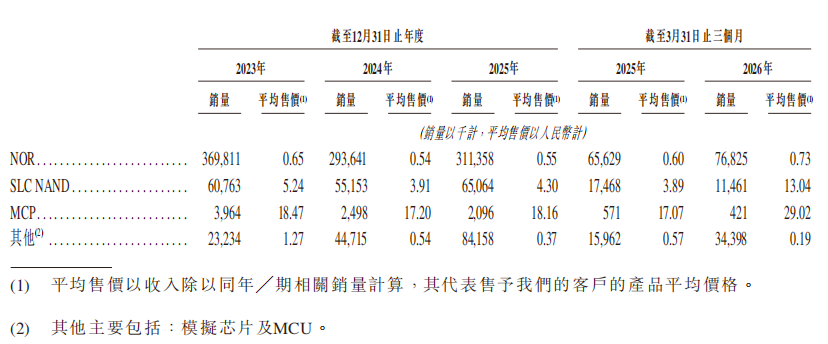
The profit side fluctuates more sharply. In 2023-2025, Xintian's gross profit was 103 million yuan, 61.86 million yuan, and 118 million yuan respectively. The corresponding gross margin declined from 15.5% in 2023 to 14.0% in 2024, rebounded to 22.8% in 2025, and reached 55.6% by the first quarter of 2026. Among them, the gross margin of SLC NAND products soared from 14.2% in Q1 2025 to 67.5% in Q1 2026, which is the most intuitive reflection of the “elastic dividend” granted by cycle reversal.
In terms of net profit, Xintian's net loss in 2023 was 14.03 million yuan, and the loss increased to 37.14 million yuan in 2024. The turning point occurred in 2025, when the company achieved net profit of 27.22 million yuan, turning a loss into a profit. In the first quarter of 2026, net profit for a single quarter reached 75.89 million yuan, and the net interest rate soared to 33.9%.
Looking at the business model, Xintian uses a typical Fabless model to outsource wafer manufacturing and sealing and testing processes. The sales side is mainly distribution, accounting for 84.7%, 71.2%, and 83.4% of distribution revenue from 2023 to 2025, respectively. As of the end of the first quarter of this year, the company had 83 dealers. This model helped the company quickly penetrate the market, but it also raised concerns about channel management and customer concentration — the revenue share of the top five customers in the first quarter of 2026 has rebounded to 52.8%.
Overall, the performance curve of Xintian clearly outlines the typical characteristics of a chip company that is deeply bound to the industry cycle: pressure during the downturn and eruption during the upward period. The data for the first quarter of 2026 has proved that when the Dongfeng cycle hits, the company's profit elasticity is amazing enough. But the problem is that for Xintianxia, which aims to enter the capital market, what investors want to see more is the company's ability to go through the cycle rather than simply “watch the sky and eat.”
Continued growth remains to be verified
Xintianxia chose to “knock on the door” of the Hong Kong Stock Exchange at a time when the industry is booming, but for investors, at a time when various AI concept stocks are currently becoming increasingly attractive, to find real growth stocks, it is also necessary to comprehensively examine long-term growth from more dimensions.
Judging from the industry card position, Xintianxia has a certain market position in the code-type flash memory chip segmentation circuit. As previously mentioned, the company ranked fifth among global wafer-free manufacturers in terms of revenue in 2025. Its products have successfully entered the supply chain systems of the world's top five communication equipment manufacturers, the top three OLED display equipment manufacturers, and the three major electronics manufacturers. This kind of recognition from leading customers itself forms a strong competitive barrier. Code flash memory chips require extremely high reliability and stability. Once customers complete product verification and introduction, replacement costs are high, and partnerships are often highly sticky.
At the technical level, the enhanced flash memory programming technology independently developed by Xintian can extend NOR Flash erase life by 2 times; the SLC NAND product area of the 24nm process node is 20% smaller than that of mainstream products. The company is also one of the few domestic manufacturers that can meet the needs of customers for NOR Flash and SLC NAND Flash products at the same time. Furthermore, the company has successfully mass-produced 2Gbit ultra-high-capacity SPI NOR Flash based on the 55nm process, breaking the monopoly of overseas manufacturers in high-end application scenarios such as communication base stations and AI servers.
More importantly, Chip World is trying to break out of the role of a simple memory chip supplier. According to the prospectus, the company has established a “storage +” and “AI+” two-wheel drive strategy. On the one hand, it is expanding to analog chips and MCUs to build a more complete product ecosystem; on the other hand, it lays out memory computing (CIM) AI chips based on ReRAM's new storage medium to directly perform AI inference tasks within the memory. If this strategy can be implemented, Core World is expected to complete the reshaping of the valuation logic from “cyclical stocks” to “growth stocks.”
However, after all, the elasticity given by the cycle and the resilience of endogenous growth are two different things. If Xintian wants to grow through cycles, it will still face multiple challenges in the future: First, the sustainability of the industry's supply and demand pattern is difficult to predict. The core driving force of SLC NAND's sharp rise in prices is supply contraction caused by upstream production capacity cuts. Once major manufacturers resume production capacity or the industry enters a new round of expansion cycle, there is considerable uncertainty about whether the current high gross margin of 67.5% can be maintained. Furthermore, strategic transformation will take time to test. The direction of “storage +” and “AI+” is certainly in line with industry trends, but there is a long verification cycle between technology development and commercialization to generating large-scale revenue. Finally, the balance between R&D investment and short-term profits will continue to test the core world. In 2025, the company's R&D expenses have dropped by more than 40% compared to 2023. In the semiconductor industry where technology iterates rapidly, how to maintain profit elasticity while ensuring that technology reserves are not left behind is an issue that management must face.
As far as Xintian is concerned, there may still be a long way to go from a company deep in a strong cycle industry to a growing enterprise with the ability to resist cycles. As to whether the Hong Kong stock listing will become a key springboard to help the company rise to the next level in the future, Zhitong Finance will also keep an eye on it.