


Cerebras Stock Sends Massive Expansion Signal at Paris Summit
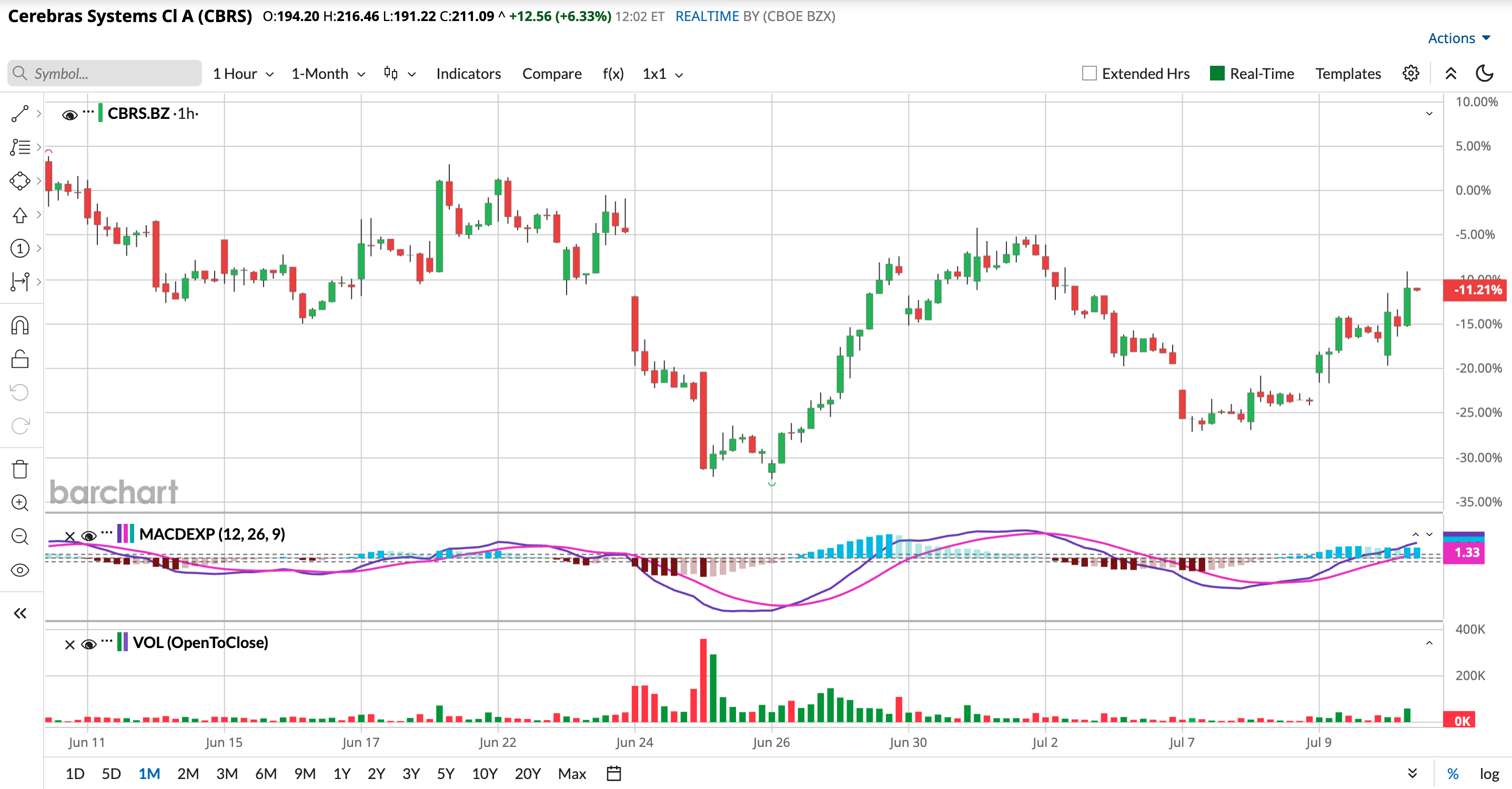
Recently going public, Cerebras Systems (CBRS) is currently valued at a market cap of $45 billion. At the RAISE Summit in Paris, Cerebras CEO Andrew Feldman laid out plans to plant the company's fastest AI chips across Europe, promising local firms and governments quick AI responses that have made it a favorite among frontier model builders like OpenAI.
The announcement lands just weeks after Cerebras completed the largest semiconductor IPO in history, raising $6.4 billion. The fresh capital appears to be going straight into global buildout, and Europe is now first in line.
Why Cerebras is Eyeing Europe
European companies, research labs, and government agencies have grown tired of routing their AI workloads through data centers in the United States and Asia. That distance adds delay, something Cerebras has built its entire business around eliminating.
Feldman has argued for months that speed determines the usefulness of AI. People only keep using AI tools that respond quickly. If an AI is slow, people give up on it, and if it's fast, they use it constantly.
Most AI chips (like Nvidia's (NVDA) GPUs) store data on separate memory chips located next to the processor. Every time the AI needs that data, it has to send a request across a wire to fetch it, which takes time. This is the "memory bottleneck."
Cerebras uses a different process. Instead of using separate memory chips, it prints the memory directly onto the same giant chip as the processor. There's no wire and no round trip, so data moves almost instantly. Basically, Cerebras designs wafer-scale chips that skip the memory bottlenecks that slow down traditional GPU setups, and the same argument is now driving the company overseas.
Cerebras plans to bring its first European data center capacity online by the end of 2026, with facilities spreading across France and the Nordics. By the end of 2027, the company aims to reach a total European capacity of 200 megawatts. Norway and Finland are already on the list for new sites.
"We are contracting significant capacity for 2027, with data centers slated for Norway and Finland as we actively build across Europe," Feldman said. "These deployments will enable us to move decisively on what our customers have been asking for: fast, high performance AI compute located in Europe."
A Partnership With OpenAI
Part of that new European capacity is expected to support OpenAI workloads, extending the two companies' existing partnership. On the company's first earnings call as a public company, held in June, Feldman detailed a definitive agreement signed with OpenAI in December 2025 worth more than $20 billion in compute purchases over several years.
Cerebras says it moved from signed contract to running a live model for OpenAI in just 35 days. GPT 5.4 is now running on Cerebras hardware for select OpenAI customers, and the two companies are working to bring GPT 5.5 onto the platform next.
If a meaningful slice of that OpenAI demand shifts to European data centers, it gives Cerebras a built-in customer for the new capacity rather than a bet that demand will show up later.
Cerebras also struck a deal with Amazon.com's (AMZN) Amazon Web Services earlier this year, pairing AWS' Trainium chips for the initial processing stage of an AI request with Cerebras hardware for generating the response. Executives have said that impact should show up mainly in 2027.
For European businesses, the pitch is simple. Cerebras offers faster AI running on servers physically closer to home, with data that does not have to cross an ocean to get an answer.
"Our customers don't just want AI compute. They want it close to home, powered responsibly, and available fast," Feldman said. "This expansion and capacity plan reflects our confidence in Europe as a long term growth market for Cerebras."
What's Next for CRBS Stock?
Cerebras reported first quarter core revenue of $191.3 million, up 92% year-over-year (YOY) with cloud and services revenue jumping 167%. Executives have said the current constraint on growth isn't chip supply or customer demand.
It's data center space, since the company relies on SRAM memory printed directly onto its wafers rather than on HBM memory, which is in short supply across the industry. That supply chain advantage is part of why Cerebras can move quickly into new regions without waiting on scarce components.
Adding Europe to the map spreads that advantage across a new customer base while giving existing partners like OpenAI more places to deploy capacity. The company has said full-year 2026 core revenue should land between $855 million and $865 million, roughly 69% growth at the midpoint.
Whether the European rollout accelerates that number will likely depend on the speed in which data centers in France, Norway and Finland come online, and the amount of OpenAI commitment running through them.
For now, the Paris announcement signals a company moving fast on two fronts at once, building out physical infrastructure while leaning harder into the fast AI story that took it public just weeks ago.
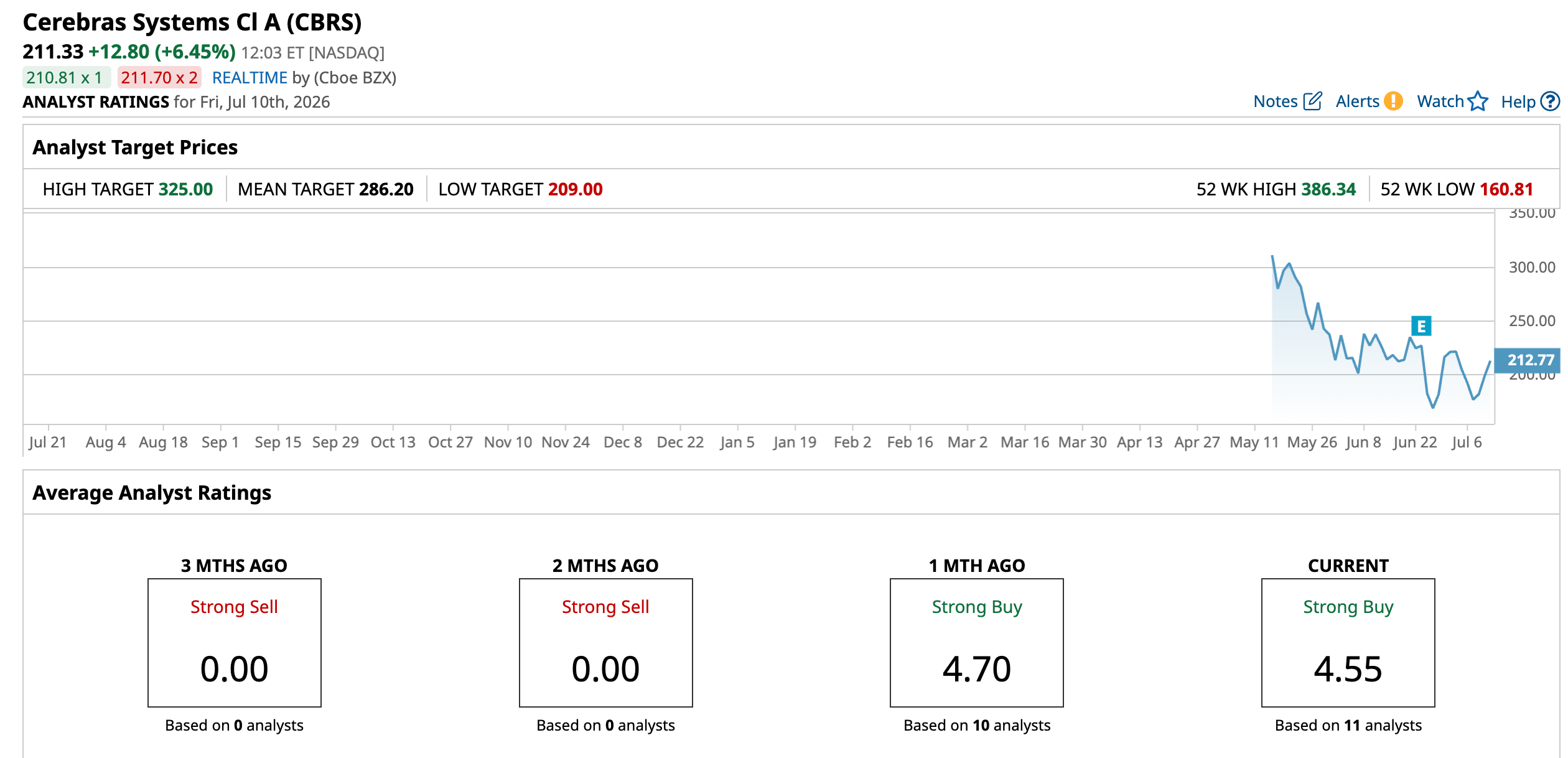
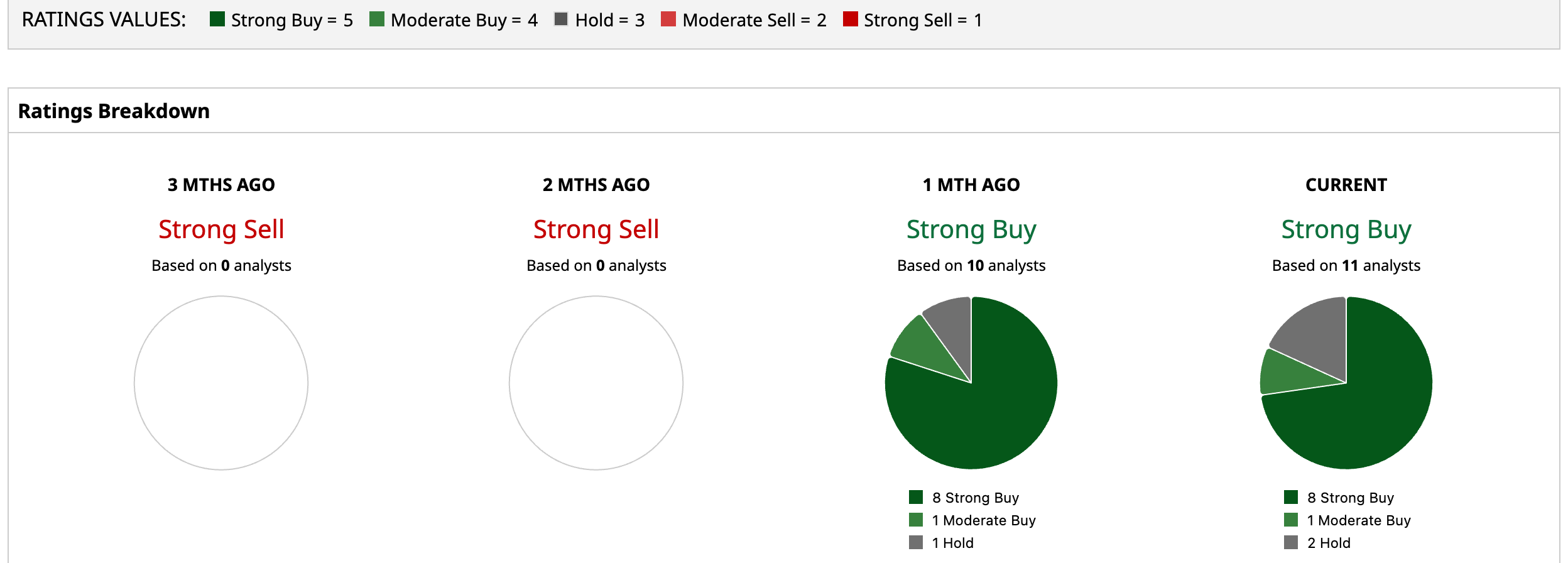
Out of the 11 analysts covering Cerebras stock, a consensus assigns it a “Strong Buy,” with eight recommend “Strong Buy," one recommends “Moderate Buy," and two recommend “Hold." The average CBRS stock price target is $286.20, implying a possible 35.4% upside from here, while the Street-high target price of $325 shows a potential of a 53.8% climb for the next 12 months.
On the date of publication, Aditya Raghunath did not have (either directly or indirectly) positions in any of the securities mentioned in this article. All information and data in this article is solely for informational purposes. For more information please view the Barchart Disclosure Policy here.