


The “highest leverage ratio in history” media mergers and acquisitions have been underrated! Arete: It may be difficult for Paramount (PSKY.US) to cut the target price of daily debt to $2 after the Warner (WBD.US) merger
The Zhitong Finance App learned that according to Arete Research's analysis, Paramount (PSKY.US) management may not have enough experience to deal with the huge debt generated after its merger with Warner Bros. Exploration (WBD.US.).
The parent company, which owns CBS and many other media businesses, announced at the end of February this year that it would buy Warner Brothers for 110 billion US dollars. Despite some regulatory hurdles, the deal is expected to close in September this year. Arete analyst Pierre-Marie d'Ornano (Pierre-Marie d'Ornano) pointed out in a report to clients that once the deal is settled, the merged media giants will bear a total debt of up to 86 billion US dollars.
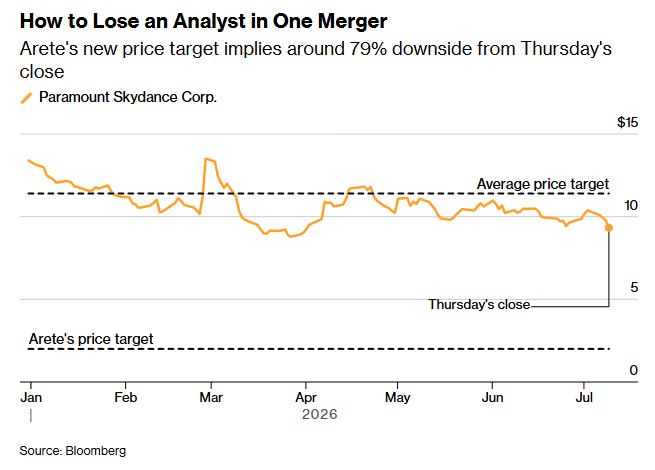
Based on this, Arete downgraded Paramount's stock rating from “neutral” to “sell,” and drastically cut the target share price to $2 — the lowest forecast among all Wall Street analysts in the relevant statistics. The target price means that compared to Thursday's closing price, the stock still has about 79% downside.
Arete explained in Thursday's report that judging from historical experience, “large-scale media mergers and acquisitions have always been difficult.” They described the Paramount and Warner deal as “the most leveraged media merger to date,” and bluntly stated that “it is unclear whether management is capable of handling such a highly leveraged balance sheet.”
This $2 target price is 71% lower than the $7 low target given by Wells Fargo analyst Steven Cahall (Steven Cahall). In contrast, Benchmark Co. and Morgan Stanley are the only two agencies that give a “buy” rating, and their target prices are $19 and $14, respectively. The average price target given by the 15 analysts tracking the stock is $11.40, which indicates a possible increase of about 22% over the next 12 months.
In response to questions from the outside world, a Paramount spokesperson said in an email statement: “The Paramount management team has developed a clear and rigorous balance sheet management plan, and we are ahead of schedule. Our capital allocation priorities have always been the same: investing in long-term growth, restoring investment-grade credit metrics, and returning excess cash to shareholders when targets are met.”
On Thursday, Paramount's stock price closed down 4.3% to $9.33, the fourth consecutive trading day of decline. At one point, the intraday decline reached 9.3%. Since this year, the stock's cumulative decline has exceeded 30%.
Meanwhile, Matthew Halbower (Matthew Halbower), CEO of Pentwater Capital Management, said in an email that the company holds about 1.3 billion US dollars of Warner Bros. shares and about 40 million dollars of Paramount shares. He pointed out that once the deal is completed, “a number of experienced institutional investors will inject a total of $47 billion in equity capital into Paramount at a price of $12 to $16 per share.” He added, “It's hard for research analysts to argue that Paramount's stock would be worth less than what so many institutional investors are willing to pay.”
Dornano, however, disagreed. He wrote in the report, “The history of large-scale mergers and acquisitions in the media is lackluster, and there are frequent cases where performance falls short of expectations, mainly due to the continued contraction of the traditional TV business, overly optimistic expectations for the streaming media business, and an unmanageable capital structure.” He believes that the acquisition “also faces similar challenges, except that the cost of debt is higher and a stricter maintenance contract is attached.”
Dornano further stated, “In our opinion, a highly leveraged balance sheet requires specific management ideas and skills, which doesn't seem obvious to the Paramount team.” He also mentioned that this ability is more evident in companies owned by cable TV billionaire John Malone (John Malone), and that Paramount is currently at the helm of David Ellison (David Ellison).
Although the US Department of Justice ended its antitrust investigation into this huge Hollywood deal last month, there are still some obstacles that have yet to be removed. Top lawyers in several states are drafting legal challenges to pave the way for antitrust lawsuits, and the Oregon Attorney General even called for a 60-day delay in the completion date of the deal. Furthermore, the British Government has expressed concerns about the deal.