


The market capitalization has broken through 2.5 trillion US dollars! SpaceX (SPCX.US) continues to perform humanity's biggest IPO frenzy. This week, it faces the opening of options and the “Three Witches Day” liquidity test
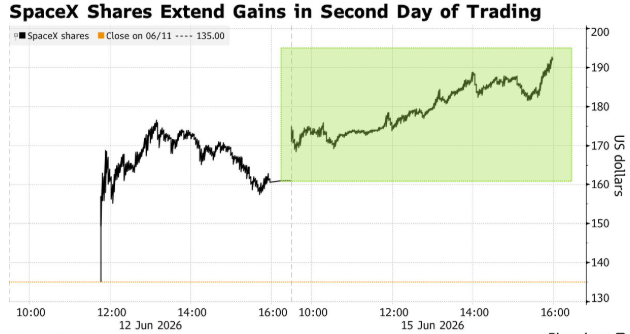
The Zhitong Finance App learned that on Monday, SpaceX (SPCX.US), the protagonist of the biggest IPO in human history, closed at 192.46 US dollars on the second full trading day of listing, a cumulative increase of more than 42% from the IPO price of 135 US dollars. The total market value broke through the 2.5 trillion US dollar mark in one fell swoop, ranking among the top six in the world by market capitalization, less than 135 billion US dollars from Amazon. After the IPO green shoe mechanism was fully exercised and retail purchases contributed 56% of the first day's trading volume, SpaceX is approaching Amazon's valuation at an alarming rate.
The IPO rose another 20% the next day, and SpaceX completed the wealth myth in two days
SpaceX's performance in the secondary market is breaking history at an almost incredible rate.
In the US stock market on Monday, SPCX hit a high of 188.8 US dollars, a record high since listing. The increase on the same day was over 15%, and the closing increase was locked at around 20%, which means that investors with an IPO price of 135 US dollars have surged more than 42% in less than two trading days. This increase drove the company's total market capitalization past the $2.5 trillion mark, surpassing Meta and Berkshire Hathaway to become the sixth largest listed company in the world by market capitalization, followed by Amazon (market capitalization of about $2.68 trillion).
Monday was the first full trading day for SpaceX (officially known as Space Exploration Technologies Corp.) stock. The stock opened a few minutes before noon EST last Friday, which means it has been trading for just over four hours.
The influx of huge sums of money did not only come from the primary market. According to statistics from financial data agency Vanda Research, on the first day of SpaceX's listing, the retail secondary market's net purchases reached US$117.6 million, accounting for 56% of all retail stock purchases in the US stock market on that day. Further analysis indicates that the total amount that retail investors bought in the two days before the stock was listed is almost equivalent to the total net purchases of retail investors in the entire US stock market last week. Within 20 minutes before the first day, retail investors bought about $18 million in SpaceX shares.
The insanity of retail investors, combined with massive institutional subscriptions — retail IPOs only account for about 20%, and the oversubscription ratio is about 4 times — has created the most dramatic distortion in IPO supply and demand in recent years. A company with a market capitalization of more than 1.77 trillion US dollars before opening. In just two trading days, its market value actually expanded by more than 40%.
SpaceX's strong performance on the first day allayed market concerns about whether it could absorb such a large-scale IPO, and also paved the way for potential IPOs for two major rivals, Anthropic PBC and OpenAI. They may go public as early as this year. SpaceX's steady performance has also boosted the market's confidence in the rising market in the artificial intelligence sector, which is the driving force behind most of the market's gains this year.
The full exercise of the “green shoe”: the $86.2 billion super ammunition and valuation game
On Monday, SpaceX issued a statement officially confirming that the IPO over-allotment option (“green shoe mechanism”) was fully exercised, allowing underwriters to sell an additional 83.3 million shares. As a result, the total amount raised increased to US$86.2 billion, and the net amount after deducting US$500 million in underwriting expenses was US$85.7 billion.
This tool unleashed a double signal. On the one hand, investment banks acted to prove that market demand far exceeded supply, directly pushing the IPO's net capital raising scale to the highest level in US stock history; on the other hand, Green Shoe gave underwriters the right to directly issue additional shares from the company instead of buying and closing positions from the market. The most intuitive impact was to further reduce the actual circulation ratio of the listed market.
According to data, SpaceX's total IPO circulation is about 555.6 million shares, accounting for only about 4.2% to 4.9% of the company's total share capital. When almost all tradable chips are robbed by retail investors and institutions at the same time, the extreme scarcity of the circulation market becomes one of the core logics supporting a short-term surge in stock prices.
The opening of options and the “Three Witches Day”: Another story of the week
On Tuesday, the CBoE Global Market will be the first to launch SPCX stock options contracts, and other exchanges are expected to follow suit as soon as possible within the week. Many derivatives market experts predict that the trading volume of SpaceX options on the first day will be huge, and their level of implied volatility may far exceed the average of US stocks. Well-known market commentator Ophir Gottlieb predicts that SPCX options may set a record for first-day trading volume in US dollars.
An options listing usually has a double effect. On the one hand, it provides long-term bullish investors with room to use leveraged tools to amplify earnings; on the other hand, the advent of put options also provides a tool for bears to express doubts without directly borrowing scarce stocks. However, under extremely low circulation conditions, if a large number of speculators collectively buy bullish options, it may trigger the so-called “Gamma squeeze” — market makers are forced to continue buying in the spot market to hedge against upward risks, thus further boosting stock prices and forming a self-strengthening spiral.
Coincidentally, this series of events happened in the same week as the first FOMC meeting and press conference of the new Federal Reserve Chairman Walsh. The market currently generally expects the Federal Reserve to keep interest rates unchanged in the 3.5% to 3.75% range. Walsh's communication strategy — whether to release hawkish signals, whether to change the bitmap transmission framework, and whether to suggest the risk of a rebound in inflation — will directly affect the overall pricing of risky assets. Following that, Thursday will usher in the quarterly “reunion of the Three Witches”. Index options, individual stock options, and futures with a nominal value of nearly a trillion dollars will expire at the same time. Market makers' delta hedging demand may further amplify price fluctuations in all major products in the target market — including SPCx of course.
“The macroeconomic context appears to be moving in a more favorable direction, which may motivate investors to continue to take higher risks,” said Angelo Kourkafas, senior global investment strategist at Edward Jones. “As yields decline and the Federal Reserve may relax some policies slightly, the range of investment opportunities may be expanding. This may encourage investors to focus on market segments with catch-up potential and lower barriers.”
In other words, the opening of SpaceX's options was not an isolated event; it was at a crossroads where three factors resonated: the first press conference of the new hawkish chairman, the third quarterly gathering, and the debut of SPCX options—a combination of the three. A-share investors are used to calling it “stock index delivery when the Federal Reserve does not raise interest rates,” while on Wall Street, this is what CBOE senior vice president JJ Kinahan called “probably the busiest shortened trading week on record.”
The end of valuation differences: from the Green Shoe to the sale of rights, how long can rockets fly?
After an IPO driven by retail FOMO, a two-way institutional layout, and derivatives leverage that is about to be fully opened, the SpaceX story has completely changed from “can it be listed” to “is this the dividend pricing of a technological revolution, or is it a superbubble of Wall Street's self-realization driven by financial leverage.”
In stark contrast to this fervor is the almost unanimous questioning of independent research institutes. Morningstar (Morningstar) equity analyst Nicolas Owens pointed out that the issue price of $135 has been significantly overestimated, and the fair price given by its multi-scenario model based on future financial performance is only 63 US dollars/share, which is only one-third -3 of the current market price. CFRA analyst Keith Snyder gave a sell-out rating even more rarely. The target price is $115, which is 15% -41 lower than the issue price.
On the other hand, Nobel laureate economist Paul Krugman unrelenting described Musk as a “human Ponzi scheme” in his personal column, criticizing SpaceX's sky-high valuation not based on fundamentals, but on belief in the future and “Musk's premium” --. Krugman's core question is that SpaceX's previous two major businesses, Starlink and Starship, have not contributed to steady and continuous profits, while xAI-related businesses are still in the early stages of financing and commercialization — from a purely fundamental perspective, there is a gap between valuation and existing business that is difficult to fill with numbers.
In the words of Max Gokhman, senior vice president of Franklin Templeton, “We are not surprised by market demand. Many investors, especially those retail investors who wait and see, have not been able to get in.” But then he raised an even more critical question: “What will happen when the flame of rocket demand from retail investors subsides, and when institutional investors and employees whose sales ban has expired begin to sell? At that time, who will be the marginal buyer will be the most important variable”.
At the moment when SpaceX has a market capitalization of $2.5 trillion, investors can clearly see two very different narratives unfolding in parallel: one line is Musk's long-term vision of artificial intelligence, space exploration, and robots to disrupt the future of humanity; the other line is an extreme financial structure composed of the green shoe mechanism, zero circulation, Gamma squeeze, 56% retail buying ratio, and short-term hype signals. If the former eventually defeats the latter, SpaceX will use a market capitalization of 2.5 trillion US dollars as a starting point and move towards 5 trillion US dollars or more; if the latter dominates the trend, then this may be the beginning of a textbook-style “lever set of levers” liquidity storm on Wall Street. The answer may have surfaced in the derivatives market this week — as SPCX options contracts begin trading, the game betting on the direction of this “rocket stock” has entered version 2.0.