


The war can't stop US stocks from reaching new highs! This week's “big test” for 16 trillion tech giants: Will the boom continue, or is the bubble bursting?
The Zhitong Finance App notes that despite the Iran war continuing to disrupt the market, Wall Street's biggest tech stocks have pushed the S&P 500 index to a record high. Investors are entering the busiest earnings week of the season after a strong week, and the results will be the key to testing the sustainability of this round of gains.
Super Earnings Week kicks off
The central focus of the market this week is undoubtedly the upcoming financial reports of five of the “Big Seven” technology companies. Alphabet (GOOGL.US), Microsoft (MSFT.US), Amazon (AMZN.US), and Meta (META.US) are scheduled to announce results on Wednesday. Apple (AAPL.US) will follow suit on Thursday, leaving only Nvidia to debut on May 20.
The total market value of these five tech giants is close to 16 trillion US dollars, accounting for a quarter of the market value of the S&P 500 index. Keith Lerner, chief investment officer at Truist Advisory Services, stated, “This will be a critical week, and results need to verify this recent wave of gains.”
In addition to tech giants, this week's earnings calendar is also very crowded: telecom operators Verizon and T-Mobile will release earnings on Monday and Tuesday, respectively; payment giants Visa and Mastercard will announce their results on Monday and Thursday, respectively; financial reports from energy giants ExxonMobil, Chevron, and British Petroleum, Phillips 66, etc. will provide clues to understand the impact of the Iran war on the energy market.
The Big Seven Tech Stocks “Submit Papers”
The “Big Seven” of US stocks drove the US stock market benchmark index to rise for four consecutive weeks, with an increase of 13%. Since the S&P 500 bottomed out on March 30, shares of Alphabet, Amazon, Nvidia, and Meta have all risen by more than 25%.
Prior to this round of gains, in the first three months of this year, large technology stocks dragged down the S&P 500 index due to market concerns about excessive spending on artificial intelligence. This round of sell-off emptied investors' positions in these stocks and compressed valuations, preparing the sector for a rebound.
Allen Bond, portfolio manager at Jensen Investment Management, said that the economic risks brought about by the Iran war are driving up oil prices and may cause inflation to remain high, which makes the strong profit growth of tech giants seem more attractive.
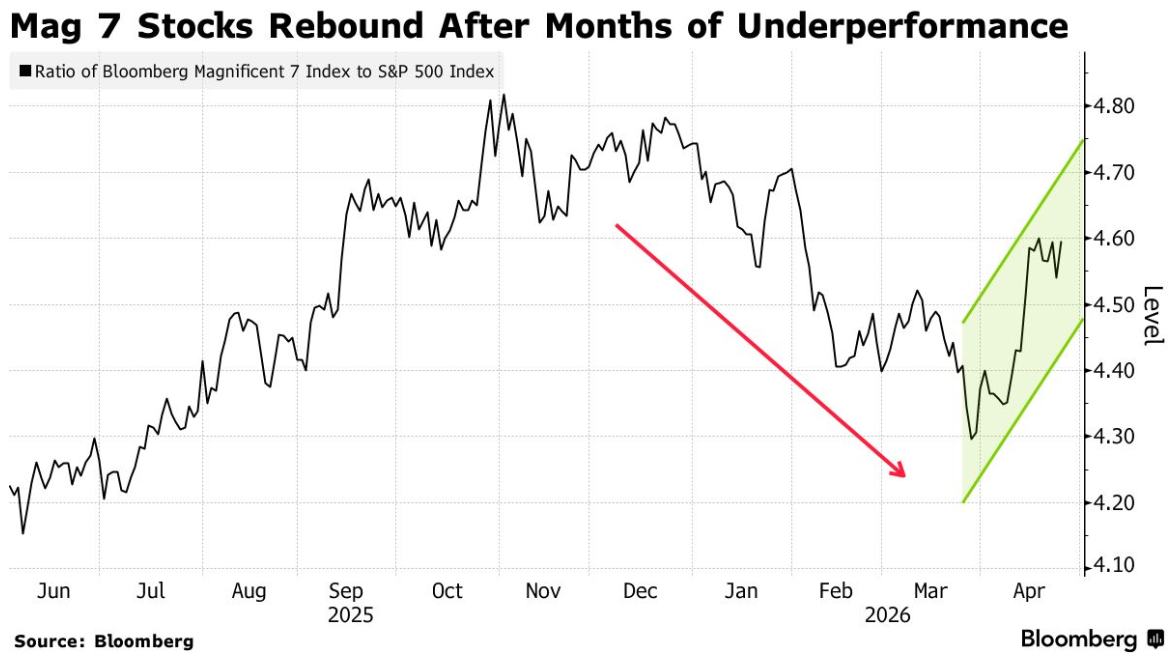
According to compiled data, analysts expect the profit of the “Big Seven” to increase by 19% in the first quarter, while that of the other components of the S&P 500 index will increase by 12%. So far, the group is off to a good start.
Last week, Tesla's first-quarter adjusted earnings beat Wall Street expectations, but concerns about a surge in capital spending overshadowed that highlight. Nvidia, the company with the highest market capitalization in the world, will announce its final earnings report on May 20.
“We believe the capital being deployed has a high return on investment and will lead to faster growth and margin expansion over time,” said Brian Barbetta, co-head of the technology team at Wellington Management, which manages approximately $5 billion in assets.
The market focuses on “AI monetization capabilities”
However, the size of the investment is having an impact on cash flow. Amazon's free cash flow for the first quarter is expected to be negative $13.3 billion. This will be the biggest gap since 2022, when investment in warehouses surged to meet demand driven by the pandemic. Meanwhile, Meta's free cash flow for the first quarter is expected to be $4 billion, the lowest level in nearly four years.
In response, some companies are tightening spending. Meta and Microsoft are planning layoffs to help offset the impact of larger AI spending. Shares of both companies fell after news of these moves broke on Thursday.
Investors are likely to keep a close eye on these companies' cloud computing business, where demand from AI startups such as Anthropic and OpenAI is driving rapid sales growth and surpassing supply.
Revenue from Amazon Cloud Services, the largest cloud service provider, is expected to grow 26% in the first quarter, while revenue for Microsoft Azure and Google Cloud is expected to increase by 38% and 50%, respectively. Last quarter, Azure's 38% revenue growth was insufficient to satisfy investors, causing Microsoft's stock price to drop 10% the day after the earnings report was released.
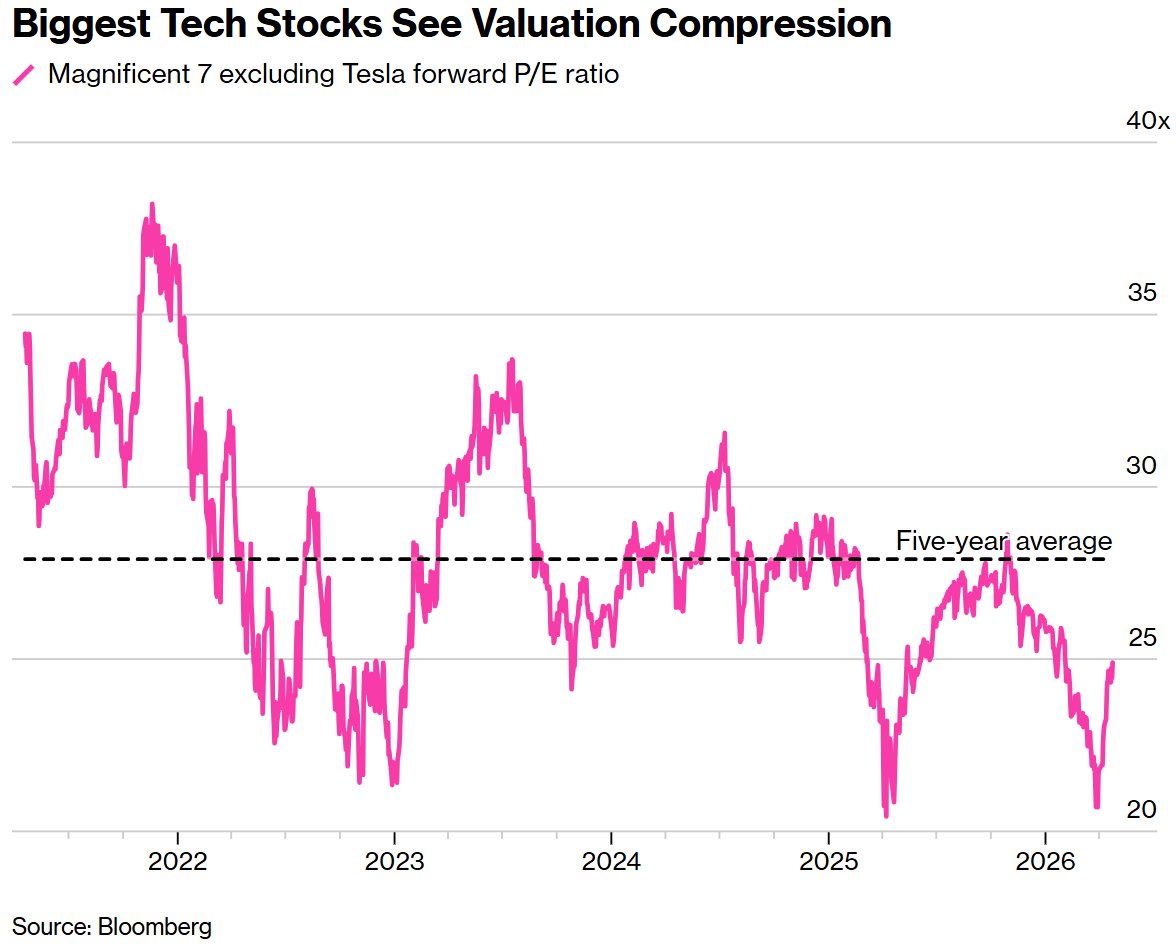
Changes in the valuation of major technology stocks
Jensen's Bond said that excitement about Anthropic's new AI service has allayed many people's concerns about whether such investments will eventually pay off. He added that while these developments have heightened anxiety about software makers that may be at risk of disruption, it is a positive factor for big tech companies that are actively investing in the future.
Bond said, “These are all extremely strong businesses with high profit margins and strong consistency, and valuations don't seem to be overestimated. These giants exist in a different world in terms of appeal.”
Federal Reserve Interest Rate Decision and New Chairman's Vote
On Wednesday, the Federal Reserve will announce its interest rate decision. Currently, the market expects the FOMC to maintain the 3.5% to 3.75% interest rate range with a 99.5% probability as high as 99.5%.
It is worth noting that this is not only the penultimate time for current Chairman Powell to preside over the conference, but his political pressure has also taken a turn. The Department of Justice recently dropped a criminal investigation into Powell's investigation into the cost of renovating the Federal Reserve building.
This cleared the political hurdle for Trump's next presidential candidate, Kevin Walsh, to successfully take over in May. Jeffrey Roach, chief economist at LPL Financial, pointed out that the previous investigation “threatened confirmation of Walsh's appointment and heightened concerns about the politicization of central banks.”
Now Powell and the Federal Reserve have a clear path ahead of them, and the White House has saved face through the Federal Reserve Inspector General's non-criminal investigation.
The Senate Banking Committee has scheduled an executive meeting at 10 a.m. on Wednesday, when it is likely to vote on Walsh's nomination.
The penultimate Federal Reserve meeting, presided over by Powell as chairman, is expected to be relatively dull, and traders almost unanimously bet that the FOMC will keep interest rates unchanged at the April meeting.
Although Powell said in March that data for the next six weeks is “very important” to assess the economic impact of the Iran war, the market expects that the Federal Reserve directors will continue to “wait and see the changes” as Powell said.
In addition, Thursday's personal consumption expenditure (PCE) price index data has also attracted much attention, which will provide investors and policy makers with an interpretation of the current state of sticky inflation. The March data will be closely watched for the potential impact of the Middle East conflict.