


From cease-fire frenzy to a “stagflation” storm that swept through stocks and bonds, the “Double Bull” narrative was severely tested
The Zhitong Finance App learned that expectations of an increasingly weak cease-fire between the US, Israel, and Iran are pushing global stock and bond market traders to return the focus of market transactions back to inflation, and have greatly strengthened hawkish expectations (the so-called “Higher-for-Longer”) that interest rate policies will remain near historical highs for a longer period of time. Higher energy costs over a longer period of time will significantly increase the pressure on global prices that were already rising before the Iran war, causing the market to cut interest rate cuts due to a sharp rise in inflation and even “stagflation” expectations, and even begin pricing the possibility that global central banks such as the Federal Reserve will return to interest rate hikes, becoming the primary consideration for stock and bond asset investors and professional traders.
This shift in the dominant narrative highlights how fast market narratives can change in the context of an uncertain geopolitical situation. The latest round of negotiations between the US and Iran has broken down, and oil prices are still far above pre-conflict levels. There are many obvious signs that global inflation is heating up and even expectations of “stagflation” are becoming more and more difficult to ignore. The “Higher-for-longer” narrative is putting expectations of a new round of “double bull market” trajectory in the equity market, which has recently become increasingly clear and fanatical due to the prospects for a two-week cease-fire between the US and Iran, and is undergoing a major test.
After the US-Iran peace agreement failed to be reached over the weekend and negotiations were temporarily concluded, what investors are currently most concerned about in the $31 trillion US Treasury bond market is undoubtedly that the traditional energy costs of oil and gas that remain near historical highs for a longer period of time may increase already high price pressure, thus completely shattering expectations of the Federal Reserve cutting interest rates.
Global fixed income investment giant Pacific Investment Management Co. (Pacific Investment Management Co.) Traders and strategists at Brandywine Global Investment Management, and Natixis North America all tend to abandon expectations for a new round of US bond bull pricing and tend to prepare enough to keep the US bond yield curve high — they are almost unwilling to make drastic adjustments to asset allocation until they have a clearer understanding of the inflation prospects.
The US-Iran cease-fire negotiations broke down over the weekend, temporarily declaring that the long-term cease-fire agreement between the two sides at least at the diplomatic level was fruitless. The “cease-fire — oil prices fall — inflation eases — the Federal Reserve restarts interest rate cuts — equity bonds strengthen at the same time” can be described as facing a major stress test. The news of the two-week cease-fire between the US and Iran on April 8 did fully trigger the restoration of typical risk appetite. In particular, the European stock market experienced the biggest single-day increase in nearly four years. However, after negotiations between the US and Iran temporarily ended on April 12, the market re-included repeated conflicts and energy supply risks. WTI crude oil futures prices soared more than 10% on Monday, breaking the important mark of 105 US dollars. It can be seen that the optimistic premise of the cease-fire agreement is not stable.
A short pause in the fire won't put out the flames of inflation! “Higher-for-Longer” returns to the main market narrative
According to the March CPI inflation data released by the US government on Friday, the consumer price index (CPI) recorded the biggest increase since 2022 on a monthly basis. This pushed 10-year US Treasury yields above the 4.3% mark, and prompted traders to drastically cut their bets on the Fed's interest rate cut this year, and some interest rate futures traders are starting to price that the Federal Reserve may restart the interest rate hike cycle in 2027 or even at the end of 2026.
John Briggs, head of US interest rate strategy from Natixis, said, “The pendulum has indeed returned to the side of inflation and stagflation. The US non-farm payroll market is stable at best, and is structurally not very dynamic, but as far as it is concerned, inflation and stagflation are the topics on the table.”
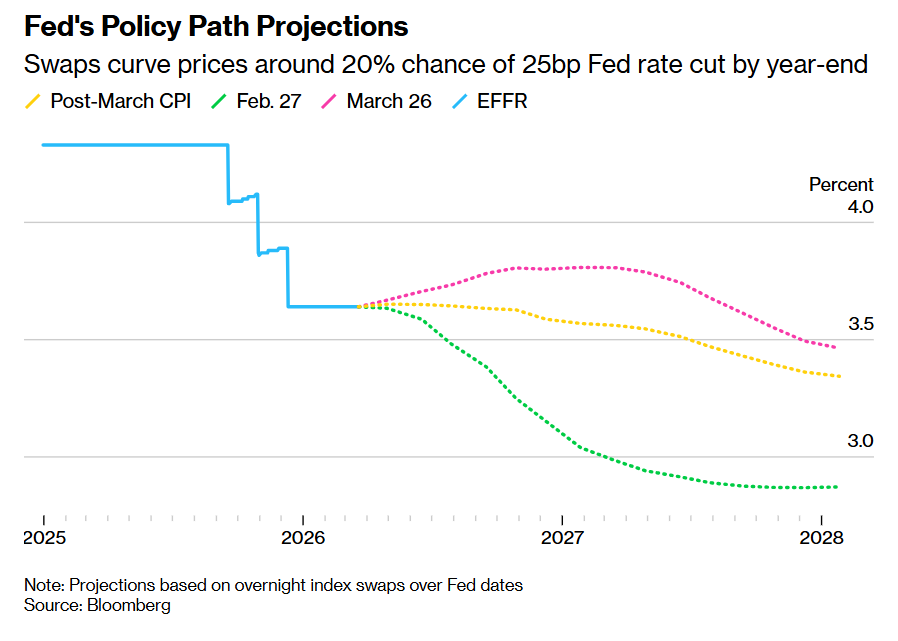
As shown in the chart above, the financial market's predictions about the Fed's monetary policy path have become more hawkish — the swap curve trajectory shows that the probability that the Fed will cut interest rates by 25 basis points by the end of the year has been reduced to only about 20%.
This shift underscores the speed at which the market's core narrative is shifting: as oil prices continue to rise well above pre-conflict levels, factors that are making a comeback in inflation are becoming increasingly difficult to ignore. For many investors in the equity market, they also have to deal with the possibility that if the geopolitical conflict continues for too long, it may eventually slow down global economic growth, and the more immediate question now is how long still high oil and gas energy costs will continue to be violently transmitted to the consumer price side.
Meanwhile, the overall US non-farm payroll labor market remains stable. In March, the number of non-farm payrolls recorded the biggest increase since the end of 2024, and the unemployment rate unexpectedly fell to 4.3%, further weakening the reasons for the Federal Reserve to relax monetary policy recently.
Kevin Flanagan, head of investment strategy at WisdomTree, said it will take at least “three months before we can see the path of inflation more clearly.” He added that since inflation is still about 1 percentage point above the Fed's target, and the unemployment rate is hovering around 4.5%, the Fed and other global central banks “are not as urgent to consider cutting interest rates from now on as high as at the beginning of the year than at the end of last year.”
Traders in the interest rate futures market have drastically adjusted their monetary policy expectations, drastically postponed the next 25 basis point rate cut by the Federal Reserve until mid-2027, and even some traders have begun to price the possibility that the Fed will return to the path of interest rate hikes during this period. Prior to the outbreak of the war in Iran, the market originally included two interest rate cuts this year. Since the Federal Reserve FOMC lowered the policy interest rate range to 3.5% to 3.75% in December last year, the Federal Reserve has remained on hold.
At the same time, there are still lingering questions about whether the cease-fire agreement will last, the dynamic state of large shipping vessels in the Strait of Hormuz, and oil price trends. These factors continue to put pressure on the front end of the US Treasury yield curve, mainly because the market's expectations for the monetary policies of central banks around the world, such as the Federal Reserve, are still changing.
Andrew Jackson, head of investment at asset management company Vontobel, said: “To some extent, the work of the Federal Reserve has become slightly easier because they can say that there is still uncertainty about how inflation will evolve in the medium term.” He said that a US Federal Reserve “is likely to stay on hold longer than previously anticipated” makes the three to five year period in the yield curve relatively more attractive for investment.
There are also people who are currently happy to wait and see for a while. Jack McIntyre, portfolio manager at Brandywine Global Investment Management, said: “If the US-Iran cease-fire agreement is maintained and oil price tendencies weaken, the focus of the market will return back to the labor market.” Currently, he is still holding on low allotted US Treasury bonds. “If the facts change, we will also adjust our views very quickly.”
The “inflation beast” wants to make a comeback! Sudden changes in the trend of market transactions
The March inflation report showed that prices rose sharply by 0.9% month-on-month, mainly driven by surging gasoline prices, while core prices excluding food and energy were slightly lower than expected. The overall increase was generally in line with expectations, and companies such as Delta Air Lines and the US Postal Service had previously signalled a round of strong price increases.
Molly Brooks, a senior US interest rate portfolio strategist from TD Securities, said, “In the absence of any deterioration in growth, the Federal Reserve needs to first see this price surge and then see several consecutive reports showing that inflation is a temporary shock and continues to ease before it can feel at ease about the prospects for continuing to cut interest rates. The Federal Reserve's dual mission is now more balanced, but recent labor market data has shown too much resilience.”
The minutes of the Federal Reserve's March 17-18 meeting show that even before the geopolitical conflict broke out, Fed officials had seen two-way risks. The vast majority of officials mentioned that inflation faced upward risks and employment faced downside risks.
Daniel Ivascyn, Pimco's chief investment officer, said that today this tense situation is being further exacerbated by rising traditional energy prices such as oil and gas, and the latter has caused a “sharp impact on supply-side inflation.” He said, “As of now, inflation remains high, and you see that financial assets such as stocks and bonds are weakening more widely. The new round of inflation can be described as a real market risk.” The company tends to allocate higher quality blue-chip bond assets on dips, while seeking to take advantage of any market misalignment and chaos to buy on dips.
As the Fed's policy outlook continues to change, there is still a resilient “market anchor” — that is, 10-year US Treasury yields have generally fluctuated between 4% and 4.5%, averaging about 4.25% since mid-2023.
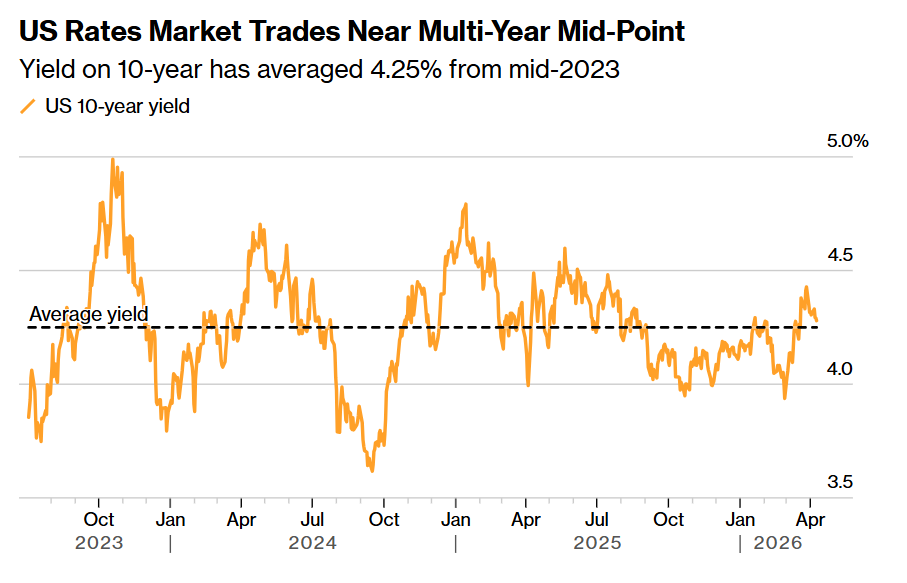
As shown in the chart above, US Treasury yields are still trading close to multi-year pivotal levels — 10-year US Treasury yields have averaged around 4.25% since mid-2023.
Flanagan from WisdomTree said, “There is still a lot of uncertainty, and the 10-year yield has returned to the relatively central region of its long-term range, which is not good news for risky assets such as stocks and cryptocurrencies.”
The 10-year US Treasury yield has the title of “the anchor of global asset pricing”. If this yield index continues to rise, driven by term premiums driven by fiscal stimulus, it will undoubtedly cause the world's most popular risk assets, such as high-yield corporate bonds, technology stocks, and cryptocurrencies, to face a new round of valuation collapse. If the yield on US Treasury bonds with a term of 10 years or more continues to rise, for core risk assets such as the stock market, cryptocurrencies, and high-yield corporate bonds, this is equivalent to “a significant increase in capital costs, weakening liquidity expectations, and an expansion of the macro denominator.”
From a theoretical perspective, the 10-year US Treasury yield is equivalent to the risk-free interest rate indicator r on the denominator side of the DCF valuation model, an important valuation model in the stock market. Other indicators (especially the molecular side's cash flow expectations) have not changed significantly — for example, during the earnings season, the molecular side is in a vacuum due to lack of active catalysts. At this time, if the denominator level is higher or continues to operate at a historically high level, the valuations of risky assets such as technology stocks, high-yield corporate bonds, and cryptocurrencies closely linked to AI are facing a collapse.
As far as the bond market is concerned, a number of recently released economic data are pulling back the market-dominant narrative back to “inflation is more urgent than growth” and the so-called “Higher-for-Longer,” and the bond market, which has recently recovered significantly, may be struggling. For global stock markets, including popular AI technology stocks, the optimism brought about by the cease-fire agreement can be described as continuing to face major tests. In addition to risk-off valuation risks brought about by the upward “anchor of global asset pricing,” another core issue is that stagflationary trading portfolios have begun to rise again: that is, the benchmark discount rate remains high, energy and transportation costs are rising, consumer spending and budgets are being eroded by gasoline, while global growth expectations are being revised downward.
The IMF Managing Director has clearly warned that “all roads lead to higher prices and slower growth,” and the World Bank and IMF are simultaneously revising growth and inflation expectations; US consumer sentiment has deteriorated significantly due to the impact of gasoline prices. This stagflationary macro-trading portfolio can be described as being extremely unfriendly to the expected trajectory of “stocks and bonds,” because it not only harms the long-term allocation logic of the bond market, but also harms the long-term profit and valuation logic of stocks. In particular, it is more detrimental to broad-spectrum indices and a few high-beta and high-boom investment themes.