
 Nasdaq
 華爾街日報
華爾街日報The “Internet Gatekeeper” has gone insane! AI agent workflow completely ignites Cloudflare (NET.US) Q4 revenue surges 34%
The Zhitong Finance App learned that the cloud computing service company Cloudflare Inc. (NET.US), which has the title of “Internet Gatekeeper” and focuses on “Connectivity Cloud (Connectivity Cloud)”, announced fourth fiscal quarter results that were better than Wall Street analysts' average expectations on Wednesday morning Beijing time, and announced that they were higher than Wall Street analysts recently continued to improve in OpenClaw (formerly known as Clawdbot, Moltbot) after it became viral Revenue outlook data for FY2026 Q1 and FY2026 for the full year. Driven by strong performance data and revenue prospects, Cloudflare's stock price soared sharply after the US market. At one point, the increase was more than 14%. When OpenClaw quickly became popular around the world in late January, it drove Cloudflare's stock price to soar by more than 20% in three trading days.
According to the results report for the fourth fiscal quarter of fiscal year 2025, Cloudflare's total revenue for the fourth fiscal quarter ended December 31, surged 34% to US$614.5 million, higher than Wall Street analysts' average forecast of about US$590 million — this forecast was also recently drastically revised by analysts. The company's earnings per share under non-GAAP standards were about $0.28, which meant a sharp increase of 47% year-on-year, higher than Wall Street's average forecast of about $0.27. Cloudflare's total revenue for the full year of fiscal year 2025 increased 30% year over year to US$2,1679 million.
In terms of other Q4 core performance data, the company's gross profit under GAAP standards was about US$452.6 million, and gross margin was about 73.6%. Compared with the gross profit for the same period of fiscal year 2024, the company's gross profit under non-GAAP standards was about US$460.2 million, or gross margin of about 74.9%, compared to only US$356.8 million for the fourth fiscal quarter of 2024. The company's operating profit under non-GAAP standards for the fourth fiscal quarter was approximately US$89.6 million, accounting for about 15% of total revenue, which is significantly higher than approximately US$67.2 million in the same period last year.
At the level of the most focused revenue outlook data in the market, Cloudflare management gave extremely strong revenue forecasts for FY2026 Q1 and the full year of FY2026. For the first fiscal quarter of fiscal year 2026, Cloudflare management expects the total revenue range to be between US$620 million and US$621 million. The median revenue range is significantly higher than Wall Street analysts' recent average expectations — about US$615.5 million — due to the recent wave of proxy AI agents sweeping the world by OpenClaw.
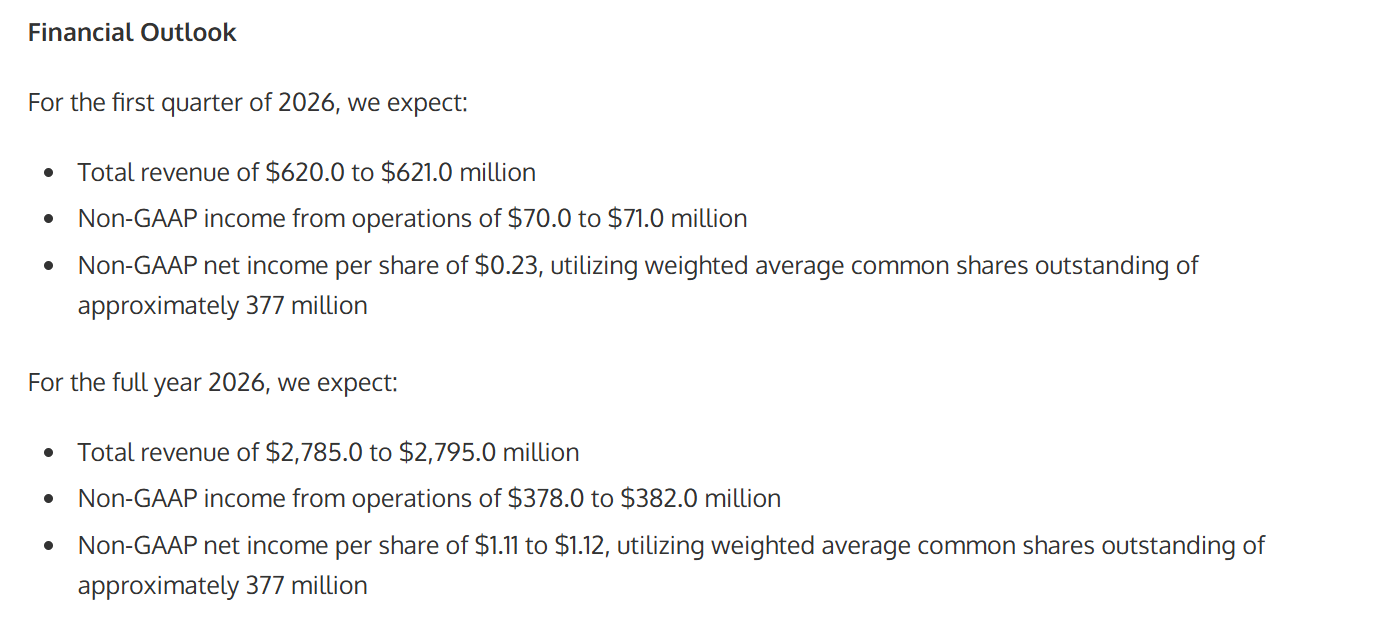
For the full fiscal year 2026, Cloudflare management expects the total revenue range of $2,785 billion to $2,795 million. The median range is also higher than Wall Street analysts' average expectations of about $2,740 billion, which is also higher than Wall Street analysts' average expectations of continuously improving. In terms of earnings per share forecast under non-GAAP guidelines, Cloudflare's management gave a non-GAAP earnings range of $0.23 per share for the first fiscal quarter of fiscal year 2026 and $1.11 to $1.12 for the full fiscal year 2026, which is basically in line with analysts' expectations.
The largest annual contract value deal ever
In the performance statement, Cloudflare co-founder and CEO Matthew Prince emphasized that in the fourth quarter, the cloud computing service company completed the largest annual level contract value transaction (ACV) in history, representing an average of 42.5 million US dollars per year, and the total amount of new ACVs increased nearly 50% year over year, which is the fastest growth rate since 2021.
Prince emphasized in the performance statement: “The global shift to artificial intelligence and proxy AI agents (AI and agents) represents a fundamental restructuring of the Internet and revolutionizes the market's strong demand for Cloudflare's connected cloud services and cybersecurity technology.”
“If proxy AI agents are new users of internet platforms, then our Cloudflare is the core platform they run and the network they have to go through. This has created a healthy flywheel: more proxy AI workflows drive more code to the Cloudflare Workers subscription platform, driving the demand for our performance, cybersecurity, and connected cloud services. We were built for this moment and the rise of the proxy internet.” Prince added.
Cloudflare is called the “internet gatekeeper” by many geeks. The core reason is that it acts as a reverse proxy (reverse proxy) and “traffic judgment point” at the “entry level” of many websites and applications: user requests usually go to Cloudflare's edge network and then forward to the origin; before forwarding, Cloudflare will do cache acceleration, TLS termination, WAF/bot identification, DDoS mitigation, and access control -- “release/blocking” all occur here This technical layer of the company.
Therefore, judging from the location of the technology stack, it is equivalent to standing at the “front door of a website” to check every request: release legal traffic, block malicious traffic, and restrict or block certain automated accesses (crawls/bots) based on policies. Precisely because of its “visible, controllable, and blockable” position in the network layer, some research and media discussions will also directly describe it as a “gatekeeper (gatekeeper)” of the Internet.
Cloudflare focuses on the “Connectivity Cloud (Connectivity Cloud)” positioning: unifying network acceleration (native CDN/Anycast network), security (WAF, DDoS, Zero Trust/Sase), and developer platforms (Workers Serverless, KV/D1/Queues, R2 Object Storage, etc.) into a global edge network architecture to “connect + protect + accelerate” the enterprise. This is also the company's core narrative and products that have been clearly defined for the past two years Packaging logic.
Unlike cloud computing giants such as Microsoft/Google, which are more biased towards central cloud/ hyperscale training and inference clusters, which bind model services and data platforms within their own ecosystem, Cloudflare favors the integration of edge+network+security, emphasizes “implementing inference, RAG, data access, and security control nearby”, and uses zero-egress R2, edge vector libraries, AI Gateway, and Workers AI to string “traffic - data - inference - security” in one line; it can also complement the central cloud architecture The “last hop” can also coexist with multiple clouds; it is more like a “network and edge operating system” in the AI inference era, using its global edge network/SASE/Zero Trust/Serverless platform as an innovative architecture for the AI era connection layer and runtime operation layer to help many AI applications operate efficiently, at low cost, and safely in edge environments.
OpenClaw completely ignites “Internet Gatekeeper” Cloudflare
Since this year, the advancement of the Gemini 3 series (continuous expansion for ecology/applications) and the popularity of Claude and OpenClaw (formerly known as Clawdbot, Moltbot) in “programming/agent use” can be described as completely accelerating the penetration depth and speed of generative AI and proxy AI agents at the B-side (enterprise process, development, customer service, analysis) and C-side (AI search/recommending/consumer intelligence) levels. Objectively, it will move computing power requirements from “AI training” “System” further promotes a wider range of AI inference and online services, thereby greatly boosting the global cloud computing IaaS infrastructure (AI GPU/AI ASIC accelerator, network, storage, large-scale data engineering) and the boom trajectory of complete cloud computing PaaS AI developer ecosystem platforms such as CloudFlare.
The explosion of OpenClaw (formerly Moltbot) can be described as helping Cloudflare explain “Agentic Internet (proxy AI Internet workflow) = next-generation infrastructure requirements” more specifically at the AI narrative level. Even Cloudflare itself started a new “long story”, directly introduced “everyone buys a Mac mini and runs Moltbot/OpenClaw” as a phenomenon, and launched Moltworker to make it It can easily run on Cloudflare's developer platform.
If an ordinary person prefers to use open source OpenClaw for “cloud-based proxy AI agent workflow deployment” (especially for public networks, multiple users, and multi-channel access), once users choose Cloudflare's Moltworker route, which has a low threshold and is most efficient for non-professional geeks, the key links will deeply use Cloudflare's many platform components: the portal uses workers as API routes and proxies, and OpenClaw's gateway and The integration runs in a sandbox container, uses R2 for persistent storage, and uses Cloudflare Access/Zero Trust to protect the management terminal and interface; at the same time, AI Gateway is used to unify and connect model vendors such as Anthropic, make keys and usage/costs observable, and use Browser Rendering to commercialize “browser automation required by agents” into usable edge capabilities. These aspects of Cloudflare's focus essentially correspond to the lowest requirements of a “proxy system”: orchestrable computing entrances, isolated execution environments, reliable storage, stable proxy layers for external models and tools, and security and auditing.
Since the OpenClaw open source community is more inclined towards “local-first (local priority)”, that is, the local deployment of proxy AI agent workflows, it emphasizes local gateway control plane, unified session/tool/event entry, multi-channel inbox and multi-agent routing, etc., which means it can run on its own hardware system or self-built server, and Cloudflare is not required to be established. As a result, “on-premise OpenClaw” relies significantly less on Cloudflare subscriptions — users can completely use other methods for domain names, reverse authentication, and persistence.
However, “local deployment” does not mean “no need for Cloudflare at all”: when you want to securely expose local agents to yourself/team remote use, or want to use model calls as a unified layer of cost and reliability governance, Cloudflare may still be a high-ROI option — for example, using AI Gateway as a unified proxy, log, and rollback for multiple models to avoid scattered vendor keys everywhere; use Zero Trust/Access to give Management and API plus enterprise-level access control and observability; combined with object storage/edge entry, “agent memory and assets” are more stable and external. However, these are all “icing on the cuisine/engineering hardening” and are not necessary prerequisites for OpenClaw to run locally.