
 Nasdaq
 華爾街日報
華爾街日報TI Cloud (HKG:2167) Could Be Struggling To Allocate Capital
There are a few key trends to look for if we want to identify the next multi-bagger. Firstly, we'll want to see a proven return on capital employed (ROCE) that is increasing, and secondly, an expanding base of capital employed. If you see this, it typically means it's a company with a great business model and plenty of profitable reinvestment opportunities. Although, when we looked at TI Cloud (HKG:2167), it didn't seem to tick all of these boxes.
What Is Return On Capital Employed (ROCE)?
Just to clarify if you're unsure, ROCE is a metric for evaluating how much pre-tax income (in percentage terms) a company earns on the capital invested in its business. Analysts use this formula to calculate it for TI Cloud:
Return on Capital Employed = Earnings Before Interest and Tax (EBIT) ÷ (Total Assets - Current Liabilities)
0.072 = CN¥37m ÷ (CN¥679m - CN¥160m) (Based on the trailing twelve months to June 2025).
Therefore, TI Cloud has an ROCE of 7.2%. In absolute terms, that's a low return but it's around the Software industry average of 6.4%.
View our latest analysis for TI Cloud
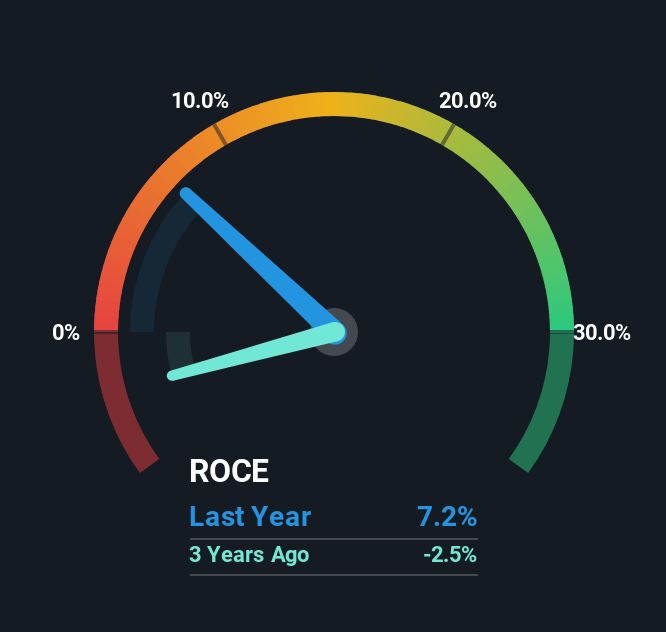
While the past is not representative of the future, it can be helpful to know how a company has performed historically, which is why we have this chart above. If you want to delve into the historical earnings , check out these free graphs detailing revenue and cash flow performance of TI Cloud.
How Are Returns Trending?
When we looked at the ROCE trend at TI Cloud, we didn't gain much confidence. To be more specific, ROCE has fallen from 29% over the last five years. Although, given both revenue and the amount of assets employed in the business have increased, it could suggest the company is investing in growth, and the extra capital has led to a short-term reduction in ROCE. And if the increased capital generates additional returns, the business, and thus shareholders, will benefit in the long run.
Our Take On TI Cloud's ROCE
In summary, despite lower returns in the short term, we're encouraged to see that TI Cloud is reinvesting for growth and has higher sales as a result. These growth trends haven't led to growth returns though, since the stock has fallen 61% over the last three years. As a result, we'd recommend researching this stock further to uncover what other fundamentals of the business can show us.
TI Cloud does have some risks though, and we've spotted 1 warning sign for TI Cloud that you might be interested in.
For those who like to invest in solid companies, check out this free list of companies with solid balance sheets and high returns on equity.
Have feedback on this article? Concerned about the content? Get in touch with us directly. Alternatively, email editorial-team (at) simplywallst.com.
This article by Simply Wall St is general in nature. We provide commentary based on historical data and analyst forecasts only using an unbiased methodology and our articles are not intended to be financial advice. It does not constitute a recommendation to buy or sell any stock, and does not take account of your objectives, or your financial situation. We aim to bring you long-term focused analysis driven by fundamental data. Note that our analysis may not factor in the latest price-sensitive company announcements or qualitative material. Simply Wall St has no position in any stocks mentioned.