
 Nasdaq
 華爾街日報
華爾街日報Is Cinevista (NSE:CINEVISTA) Using Debt Sensibly?
Warren Buffett famously said, 'Volatility is far from synonymous with risk.' So it might be obvious that you need to consider debt, when you think about how risky any given stock is, because too much debt can sink a company. We can see that Cinevista Limited (NSE:CINEVISTA) does use debt in its business. But the more important question is: how much risk is that debt creating?
What Risk Does Debt Bring?
Debt assists a business until the business has trouble paying it off, either with new capital or with free cash flow. Ultimately, if the company can't fulfill its legal obligations to repay debt, shareholders could walk away with nothing. However, a more common (but still painful) scenario is that it has to raise new equity capital at a low price, thus permanently diluting shareholders. Of course, plenty of companies use debt to fund growth, without any negative consequences. When we think about a company's use of debt, we first look at cash and debt together.
What Is Cinevista's Net Debt?
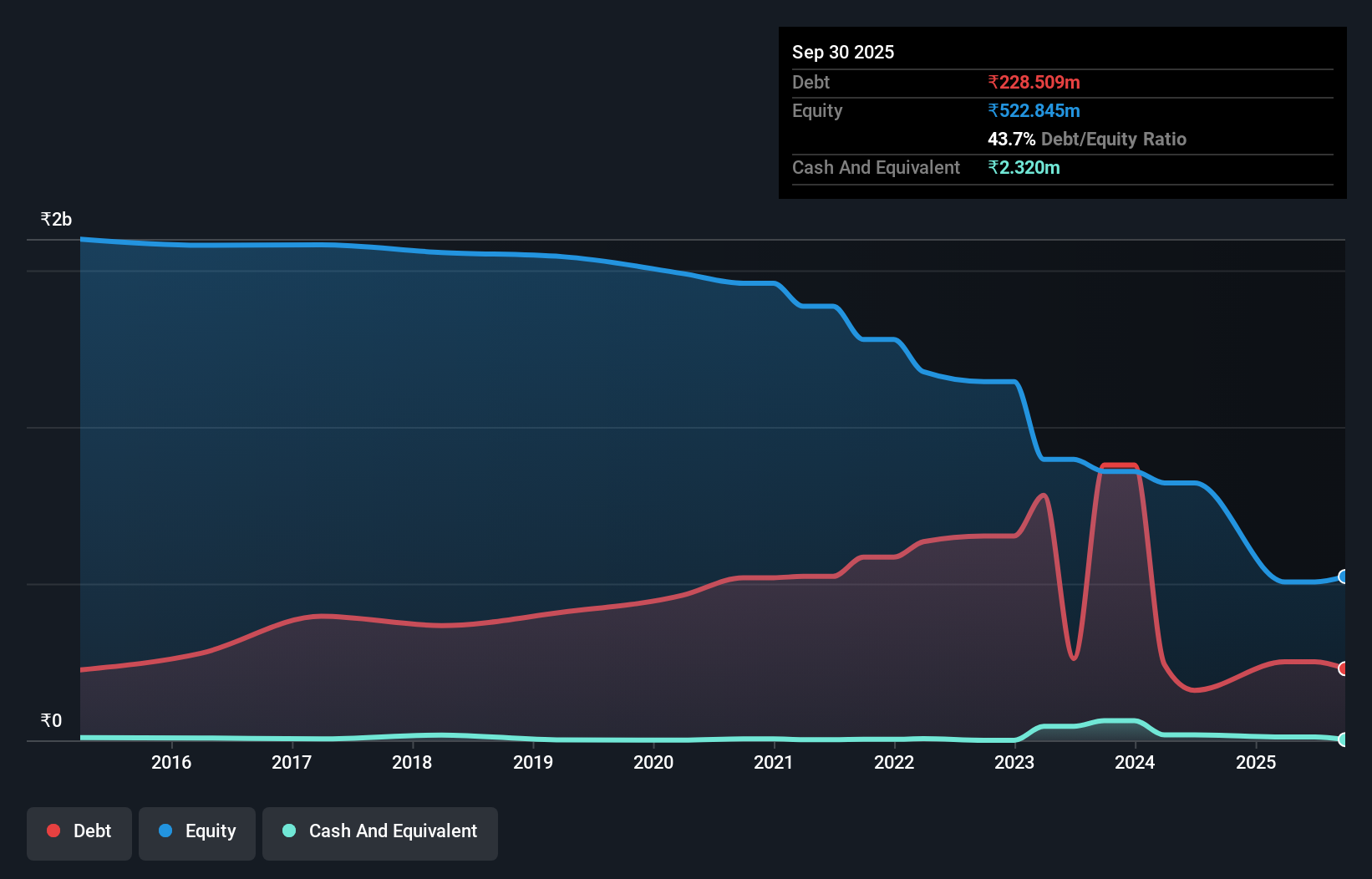
The image below, which you can click on for greater detail, shows that at September 2025 Cinevista had debt of ₹228.5m, up from ₹159.5m in one year. And it doesn't have much cash, so its net debt is about the same.
A Look At Cinevista's Liabilities
Zooming in on the latest balance sheet data, we can see that Cinevista had liabilities of ₹682.1m due within 12 months and liabilities of ₹226.8m due beyond that. On the other hand, it had cash of ₹2.32m and ₹112.0k worth of receivables due within a year. So its liabilities outweigh the sum of its cash and (near-term) receivables by ₹906.5m.
This deficit is considerable relative to its market capitalization of ₹1.02b, so it does suggest shareholders should keep an eye on Cinevista's use of debt. This suggests shareholders would be heavily diluted if the company needed to shore up its balance sheet in a hurry. The balance sheet is clearly the area to focus on when you are analysing debt. But you can't view debt in total isolation; since Cinevista will need earnings to service that debt. So when considering debt, it's definitely worth looking at the earnings trend. Click here for an interactive snapshot.
See our latest analysis for Cinevista
Over 12 months, Cinevista reported revenue of ₹199m, which is a gain of 37,559%, although it did not report any earnings before interest and tax. That's virtually the hole-in-one of revenue growth!
Caveat Emptor
While we can certainly appreciate Cinevista's revenue growth, its earnings before interest and tax (EBIT) loss is not ideal. Indeed, it lost a very considerable ₹131m at the EBIT level. Considering that alongside the liabilities mentioned above does not give us much confidence that company should be using so much debt. Quite frankly we think the balance sheet is far from match-fit, although it could be improved with time. We would feel better if it turned its trailing twelve month loss of ₹263m into a profit. So we do think this stock is quite risky. There's no doubt that we learn most about debt from the balance sheet. However, not all investment risk resides within the balance sheet - far from it. Case in point: We've spotted 3 warning signs for Cinevista you should be aware of, and 1 of them can't be ignored.
Of course, if you're the type of investor who prefers buying stocks without the burden of debt, then don't hesitate to discover our exclusive list of net cash growth stocks, today.
Have feedback on this article? Concerned about the content? Get in touch with us directly. Alternatively, email editorial-team (at) simplywallst.com.
This article by Simply Wall St is general in nature. We provide commentary based on historical data and analyst forecasts only using an unbiased methodology and our articles are not intended to be financial advice. It does not constitute a recommendation to buy or sell any stock, and does not take account of your objectives, or your financial situation. We aim to bring you long-term focused analysis driven by fundamental data. Note that our analysis may not factor in the latest price-sensitive company announcements or qualitative material. Simply Wall St has no position in any stocks mentioned.