
 Nasdaq
 華爾街日報
華爾街日報Market Cool On Tokuyama Corporation's (TSE:4043) Earnings
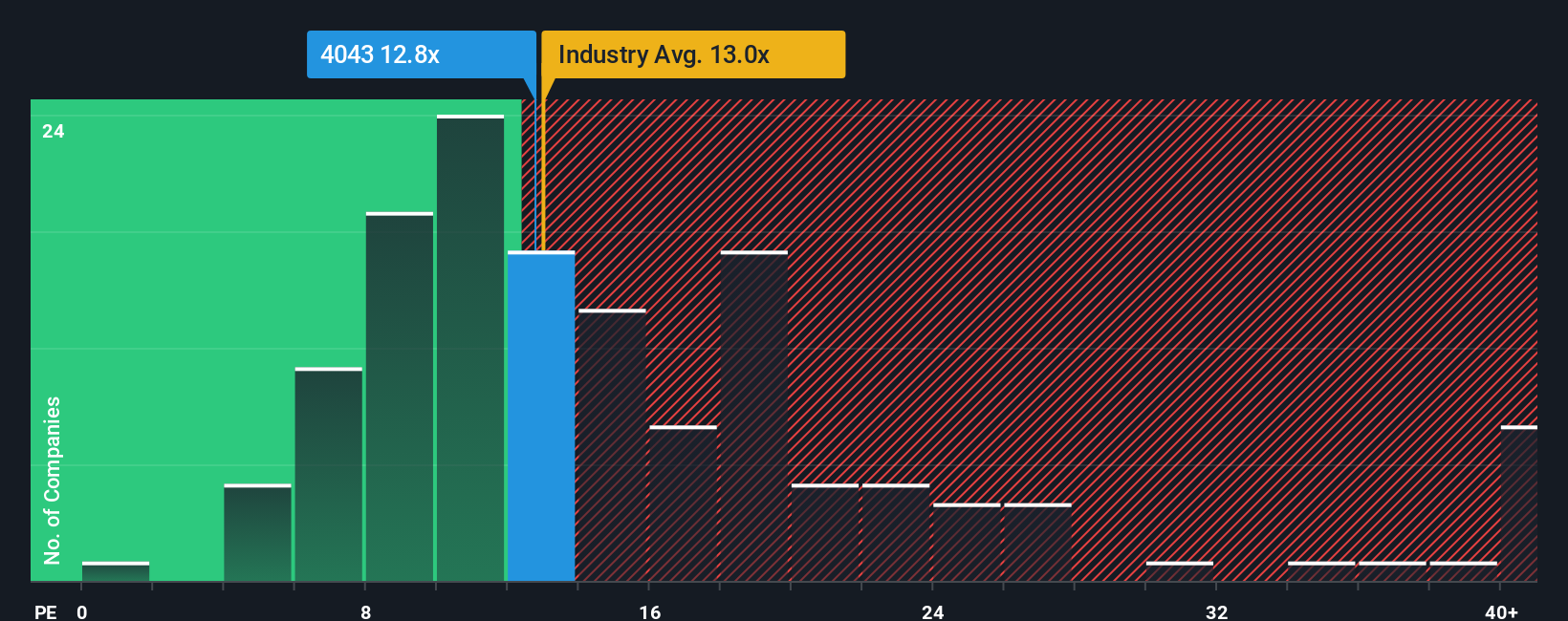
There wouldn't be many who think Tokuyama Corporation's (TSE:4043) price-to-earnings (or "P/E") ratio of 12.8x is worth a mention when the median P/E in Japan is similar at about 15x. While this might not raise any eyebrows, if the P/E ratio is not justified investors could be missing out on a potential opportunity or ignoring looming disappointment.
Recent times haven't been advantageous for Tokuyama as its earnings have been rising slower than most other companies. One possibility is that the P/E is moderate because investors think this lacklustre earnings performance will turn around. If not, then existing shareholders may be a little nervous about the viability of the share price.
View our latest analysis for Tokuyama
How Is Tokuyama's Growth Trending?
Tokuyama's P/E ratio would be typical for a company that's only expected to deliver moderate growth, and importantly, perform in line with the market.
If we review the last year of earnings growth, the company posted a worthy increase of 3.1%. However, this wasn't enough as the latest three year period has seen an unpleasant 5.6% overall drop in EPS. So unfortunately, we have to acknowledge that the company has not done a great job of growing earnings over that time.
Shifting to the future, estimates from the three analysts covering the company suggest earnings should grow by 15% each year over the next three years. That's shaping up to be materially higher than the 9.0% per year growth forecast for the broader market.
With this information, we find it interesting that Tokuyama is trading at a fairly similar P/E to the market. Apparently some shareholders are skeptical of the forecasts and have been accepting lower selling prices.
The Bottom Line On Tokuyama's P/E
It's argued the price-to-earnings ratio is an inferior measure of value within certain industries, but it can be a powerful business sentiment indicator.
We've established that Tokuyama currently trades on a lower than expected P/E since its forecast growth is higher than the wider market. When we see a strong earnings outlook with faster-than-market growth, we assume potential risks are what might be placing pressure on the P/E ratio. At least the risk of a price drop looks to be subdued, but investors seem to think future earnings could see some volatility.
Many other vital risk factors can be found on the company's balance sheet. Our free balance sheet analysis for Tokuyama with six simple checks will allow you to discover any risks that could be an issue.
Of course, you might find a fantastic investment by looking at a few good candidates. So take a peek at this free list of companies with a strong growth track record, trading on a low P/E.
Have feedback on this article? Concerned about the content? Get in touch with us directly. Alternatively, email editorial-team (at) simplywallst.com.
This article by Simply Wall St is general in nature. We provide commentary based on historical data and analyst forecasts only using an unbiased methodology and our articles are not intended to be financial advice. It does not constitute a recommendation to buy or sell any stock, and does not take account of your objectives, or your financial situation. We aim to bring you long-term focused analysis driven by fundamental data. Note that our analysis may not factor in the latest price-sensitive company announcements or qualitative material. Simply Wall St has no position in any stocks mentioned.