
 Nasdaq
 華爾街日報
華爾街日報U.S. Lumber Coalition: Canada and Homebuilders Misleading Claims That United States Need Unfairly Traded Softwood Lumber Imports Have Run Their Course
-- It Is Canada That Needs To Right-Size Its Lumber Industry Consistent With Market Realities
WASHINGTON, Jan. 6, 2026 /PRNewswire/ -- Softwood lumber prices remain at historically low levels. Prices today are 54% lower than their 1975 average and 49% lower than their 1995 average, adjusted for inflation. Yet Canada and the National Association of Home Builders (NAHB) spared no efforts in 2025 to spread misinformation about the impact of President Trump's U.S. trade law enforcement on lumber prices and the cost of lumber in new construction.
The Canadian government and the NAHB throughout 2025 claimed that increased tariffs and duties on Canadian lumber imports responding to unfair trade practices increased costs for U.S. consumers and contributed to the housing affordability crisis in the United States. Canada claimed it would walk away from the U.S. market and instead export lumber to other markets. And they claimed that the U.S. lumber industry does not have enough capacity to replace Canadian lumber when it leaves our market.
The reality is:
- The Canadian lumber industry maintains a massive level of excess production capacity and ships 60 to 70 percent of its total production into the United States – flooding the U.S. market and suppressing lumber prices below normal market rates as it desperately seeks to hold onto an artificially high U.S. market share.
- Canadian softwood lumber imports are subject to antidumping and anti-subsidy (or "countervailing") duties because of Canada's persistent abuse of the U.S. market through massive government subsidies to Canadian lumber producers and pervasive and harmful dumping practices by those producers.
- The current antidumping and countervailing duties reflect the fact that Canadian lumber companies shipped large quantities of softwood lumber to the United States even as U.S. demand for softwood lumber was weakening. The unrelenting supply of Canadian lumber in the face of that declining demand further drove down prices, leading to large losses at both U.S. and Canadian firms. Had Canadian firms responded to market realities responsibly, their current antidumping and countervailing duty margins would be much lower. Instead, Canada can only express dismay that they are facing consequences for their behavior.
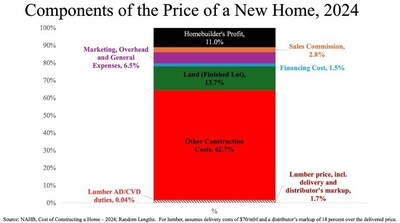
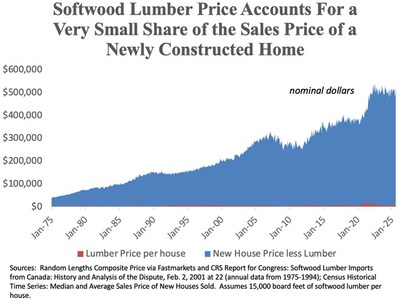
- The increase in U.S. home prices is unrelated to the price of softwood lumber. Lumber accounts for a very small share of the sales price of a newly constructed home (typically 1-2 percent) and, regardless, lumber prices are currently low by historical standards and have not kept pace with inflation. The cost of lumber makes up less than 2 percent of the total cost of a new home, and hence never has and never will be a factor in housing affordability. One must look elsewhere for a solution to new home prices -- land, labor, regulatory restrictions, and the free market reality of homebuilding demand has boosted many homebuilding input prices.
- Canadian politicians are going to great lengths to tout Canada's potential to increase exports of softwood lumber to other markets, particularly in Asia. They have also attempted to showcase efforts to build more Canadian housing domestically. But the fact is that weak demand for Canadian lumber in international markets and in Canada has led to increased reliance on the U.S. market, and increasing unused capacity that is uniquely destabilizing for the U.S. lumber market.
- U.S. lumber production capacity has increased by over 8 billion board feet since 2016 when the current antidumping and countervailing duty cases began, with U.S. producers supplying over 36 billion additional board feet of American-made lumber to build American homes.
"The true aim of the U.S. trade remedy measures and the Section 232 tariff is to enable the U.S. lumber industry to grow to its potential without market-disrupting surges of imported lumber," stated Zoltan van Heyningen, Executive Director of the U.S. Lumber Coalition. "Eight years of enforcing AD and CVD laws have already demonstrated that U.S. producers are prepared to capitalize on that opportunity."
"U.S. annual softwood lumber capacity increased by approximately 8 billion board feet from 2015 to July 2025," elaborated van Heyningen. "The Section 232 tariffs implemented by President Trump also have the potential to accelerate U.S. capacity expansions by creating additional pressure on Canada to reduce its excess capacity. Another decade of growth at this rate would enable the U.S. industry to achieve a capacity level sufficient to meet U.S. consumption needs in a typical year."
"For 2026, the U.S. Lumber Coalition urges Canada and its Canada First U.S. allies to cease their campaign of misinformation falsely claiming that the United States needs unfairly traded Canadian lumber. The time has come for Canada to right-size its lumber industry consistent with market realities," concluded van Heyningen.
More Information
U.S. lumber industry and workers sent a letter to President Trump on the need for continued strong enforcement of the U.S. trade laws to keep expanding U.S. lumber manufacturing and availability to build more American homes with American lumber. https://uslumbercoalition.org/story/u-s-lumber-industry-and-workers-letter-to-president-trump/
Enforcing U.S. trade laws helps increase the U.S. supply of lumber to build American homes, all without impacting the cost of a new home, as demonstrated by data from the National Association of Home Builders (NAHB) and Fastmarkets Random Lengths.
About the U.S. Lumber Coalition
The U.S. Lumber Coalition is an alliance of large and small softwood lumber producers from around the country, joined by their employees and woodland owners, working to address Canada's unfair lumber trade practices. Our goal is to serve as the voice of the American lumber community and effectively address Canada's unfair softwood lumber trade practices. The Coalition supports the full enforcement of the U.S. trade laws to allow the U.S. industry to invest and grow to its natural size without being impaired by unfairly traded imports. Continued full enforcement of the U.S. trade laws will strengthen domestic supply lines by maximizing long-term domestic production and lumber availability produced by U.S. workers to build U.S. homes. For more information, please visit the Coalition's website at www.uslumbercoalition.org.
CONTACT: Zoltan van Heyningen
zoltan@uslumbercoalition.org | 202-805-9133

 View original content to download multimedia:https://www.prnewswire.com/news-releases/us-lumber-coalition-canada-and-homebuilders-misleading-claims-that-united-states-need-unfairly-traded-softwood-lumber-imports-have-run-their-course-302653770.html
SOURCE The U.S. Lumber Coalition
