
 Nasdaq
 華爾街日報
華爾街日報Is Wedbush’s Downgrade and AV Risk Focus Altering The Investment Case For Lyft (LYFT)?
- On December 19, 2025, Wedbush downgraded Lyft to Underperform, flagging the ride-hailing company’s heavy exposure to US ridesharing and emerging autonomous vehicle disruption risks.
- Jefferies’ earlier concerns about rising operational investments and AI-related margin pressure add to a growing debate over how resilient Lyft’s focused business model really is.
- Next, we’ll examine how these fresh worries about autonomous vehicle disruption could reshape Lyft’s previously optimistic, partnership-driven investment narrative.
AI is about to change healthcare. These 29 stocks are working on everything from early diagnostics to drug discovery. The best part - they are all under $10b in market cap - there's still time to get in early.
Lyft Investment Narrative Recap
To own Lyft today, you need to believe its focused US rideshare platform can keep growing usage and earnings despite heavy competition and fast evolving autonomous vehicle technology. The Wedbush downgrade and Jefferies’ margin concerns sharpen attention on near term profitability as the key catalyst, while intensifying the perception that concentrated exposure to US ridesharing and future AV disruption is the single biggest current risk rather than a distant issue. If the impact proves limited, that would likely reassure shareholders.
Among recent announcements, Lyft’s expanding autonomous vehicle partnerships, including Mobileye and Baidu Apollo Go, sit squarely in the crosshairs of these new worries. These deals were originally framed as growth catalysts by widening access to driverless fleets and lowering long term costs, but Wedbush’s critique raises the question of whether such AV initiatives reduce disruption risk or simply underscore how central AV economics and execution have become to Lyft’s investment case.
Yet behind the improving profit story, investors should also be aware of how exposed Lyft remains if autonomous vehicle economics or regulation...
Read the full narrative on Lyft (it's free!)
Lyft’s narrative projects $8.7 billion revenue and $324.2 million earnings by 2028.
Uncover how Lyft's forecasts yield a $24.06 fair value, a 22% upside to its current price.
Exploring Other Perspectives
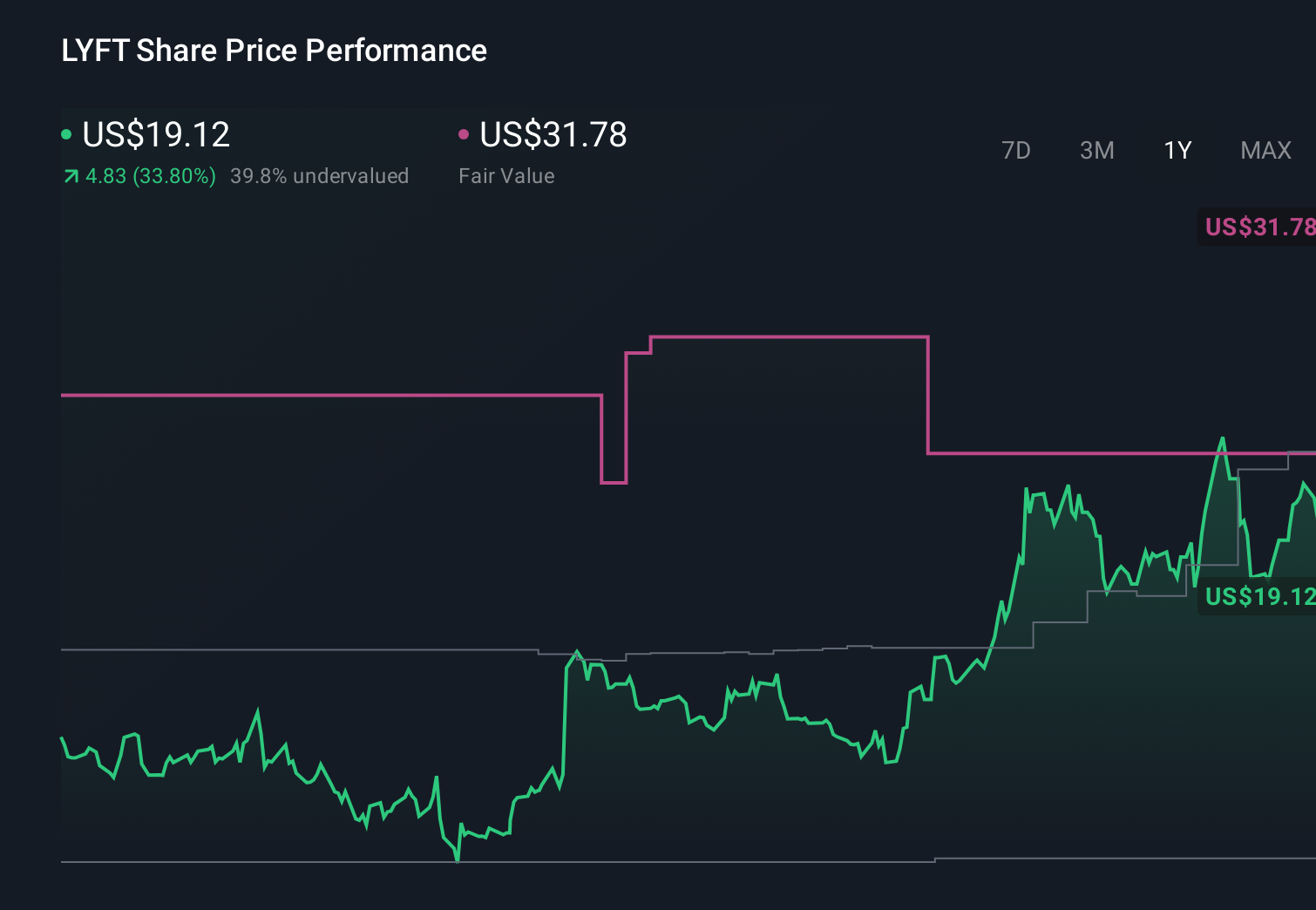
Thirteen members of the Simply Wall St Community currently see Lyft’s fair value anywhere between US$12.87 and US$56.03, highlighting how far apart individual assessments can be. Against that backdrop, the fresh concern around autonomous vehicle disruption and Lyft’s US concentration may matter a lot for how you think about its long term earnings power and whether to explore more than one viewpoint.
Explore 13 other fair value estimates on Lyft - why the stock might be worth over 2x more than the current price!
Build Your Own Lyft Narrative
Disagree with existing narratives? Create your own in under 3 minutes - extraordinary investment returns rarely come from following the herd.
- A great starting point for your Lyft research is our analysis highlighting 3 key rewards that could impact your investment decision.
- Our free Lyft research report provides a comprehensive fundamental analysis summarized in a single visual - the Snowflake - making it easy to evaluate Lyft's overall financial health at a glance.
Seeking Other Investments?
Our top stock finds are flying under the radar-for now. Get in early:
- This technology could replace computers: discover 29 stocks that are working to make quantum computing a reality.
- The latest GPUs need a type of rare earth metal called Neodymium and there are only 38 companies in the world exploring or producing it. Find the list for free.
- The best AI stocks today may lie beyond giants like Nvidia and Microsoft. Find the next big opportunity with these 25 smaller AI-focused companies with strong growth potential through early-stage innovation in machine learning, automation, and data intelligence that could fund your retirement.
This article by Simply Wall St is general in nature. We provide commentary based on historical data and analyst forecasts only using an unbiased methodology and our articles are not intended to be financial advice. It does not constitute a recommendation to buy or sell any stock, and does not take account of your objectives, or your financial situation. We aim to bring you long-term focused analysis driven by fundamental data. Note that our analysis may not factor in the latest price-sensitive company announcements or qualitative material. Simply Wall St has no position in any stocks mentioned.
Have feedback on this article? Concerned about the content? Get in touch with us directly. Alternatively, email editorial-team@simplywallst.com