
 Nasdaq
 華爾街日報
華爾街日報Optimistic Investors Push Transformers and Rectifiers (India) Limited (NSE:TARIL) Shares Up 36% But Growth Is Lacking
Those holding Transformers and Rectifiers (India) Limited (NSE:TARIL) shares would be relieved that the share price has rebounded 36% in the last thirty days, but it needs to keep going to repair the recent damage it has caused to investor portfolios. Unfortunately, the gains of the last month did little to right the losses of the last year with the stock still down 46% over that time.
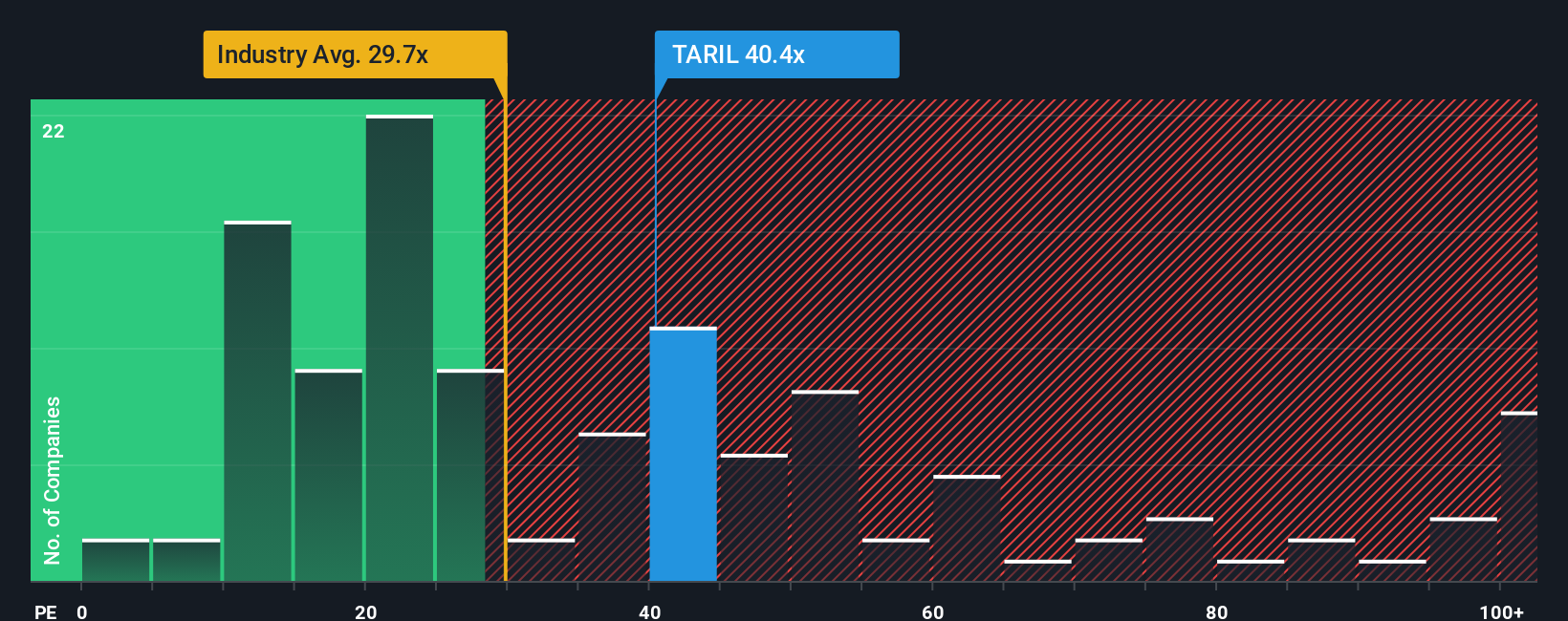
Since its price has surged higher, Transformers and Rectifiers (India)'s price-to-earnings (or "P/E") ratio of 40.4x might make it look like a strong sell right now compared to the market in India, where around half of the companies have P/E ratios below 25x and even P/E's below 14x are quite common. However, the P/E might be quite high for a reason and it requires further investigation to determine if it's justified.
Recent times have been advantageous for Transformers and Rectifiers (India) as its earnings have been rising faster than most other companies. It seems that many are expecting the strong earnings performance to persist, which has raised the P/E. If not, then existing shareholders might be a little nervous about the viability of the share price.
View our latest analysis for Transformers and Rectifiers (India)
What Are Growth Metrics Telling Us About The High P/E?
The only time you'd be truly comfortable seeing a P/E as steep as Transformers and Rectifiers (India)'s is when the company's growth is on track to outshine the market decidedly.
If we review the last year of earnings growth, the company posted a terrific increase of 99%. Pleasingly, EPS has also lifted 809% in aggregate from three years ago, thanks to the last 12 months of growth. So we can start by confirming that the company has done a great job of growing earnings over that time.
Looking ahead now, EPS is anticipated to climb by 19% each year during the coming three years according to the two analysts following the company. With the market predicted to deliver 20% growth per year, the company is positioned for a comparable earnings result.
With this information, we find it interesting that Transformers and Rectifiers (India) is trading at a high P/E compared to the market. It seems most investors are ignoring the fairly average growth expectations and are willing to pay up for exposure to the stock. These shareholders may be setting themselves up for disappointment if the P/E falls to levels more in line with the growth outlook.
What We Can Learn From Transformers and Rectifiers (India)'s P/E?
The strong share price surge has got Transformers and Rectifiers (India)'s P/E rushing to great heights as well. Generally, our preference is to limit the use of the price-to-earnings ratio to establishing what the market thinks about the overall health of a company.
Our examination of Transformers and Rectifiers (India)'s analyst forecasts revealed that its market-matching earnings outlook isn't impacting its high P/E as much as we would have predicted. When we see an average earnings outlook with market-like growth, we suspect the share price is at risk of declining, sending the high P/E lower. This places shareholders' investments at risk and potential investors in danger of paying an unnecessary premium.
There are also other vital risk factors to consider before investing and we've discovered 2 warning signs for Transformers and Rectifiers (India) that you should be aware of.
Of course, you might also be able to find a better stock than Transformers and Rectifiers (India). So you may wish to see this free collection of other companies that have reasonable P/E ratios and have grown earnings strongly.
Have feedback on this article? Concerned about the content? Get in touch with us directly. Alternatively, email editorial-team (at) simplywallst.com.
This article by Simply Wall St is general in nature. We provide commentary based on historical data and analyst forecasts only using an unbiased methodology and our articles are not intended to be financial advice. It does not constitute a recommendation to buy or sell any stock, and does not take account of your objectives, or your financial situation. We aim to bring you long-term focused analysis driven by fundamental data. Note that our analysis may not factor in the latest price-sensitive company announcements or qualitative material. Simply Wall St has no position in any stocks mentioned.