
 Nasdaq
 華爾街日報
華爾街日報When the Hong Kong stock offering was underway, Red Star Cold Chain (01641) used the central cold chain industry to develop “Dongfeng” and set sail
By the end of the year, Hong Kong stock IPOs continued to be active, and investors' enthusiasm for new ideas remained high. The data shows that since this year, both the winning rate and apparent yield of Hong Kong stocks have increased markedly. The average first-day increase of IPOs reached 38%, and the breakout rate was only 28%, the best level in the past 5 years.
Under these circumstances, another new stock, Red Star Cold Chain (01641), which has recently started a stock offering, has naturally entered the eyes of investors.
According to the prospectus, Red Star Cold Chain will raise shares from December 31, 2025 to January 8, 2026, and plans to sell 23.263 million H shares globally, of which Hong Kong sales account for 10% and international sales account for 90%. The sale price is set at HK$12.26 per share, 500 shares per lot, and the entry fee is approximately HK$6191.83. The company is expected to be officially listed and traded on the Stock Exchange on January 13, 2026.
Red Star Cold Chain's current offering has been “protected” by investors. Fuhuida (Hong Kong) Co., Ltd. will be offering shares at the sale price of HK$12.26 per share for a total subscription amount of RMB 20 million. This arrangement is seen not only as recognition of the company's long-term value by industry investors, but also sends a positive signal to the market.
According to the prospectus, the shares offered this time accounted for about 23.7% of the total number of shares issued after the completion of the global offering. Based on the prospectus of HK$12.26 and the company's net profit in 2024, the total market value of the company was about HK$1,203 billion, and the price-earnings ratio was about 13.04 times. The lower issuance valuation left room for the share price increase after listing to a certain extent.
However, valuation appeal is only one aspect of Red Star's cold chain growth story. Going back to the roots, the company's business philosophy, business layout and future strategy are the keys to maintaining its long-term value.
After being deeply involved in the cold chain market for 20 years, how did Red Star Cold Chain become a regional leader?
If you want to tell the story of the growth of Red Star Cold Chain, it is inseparable from the “Red Star Village spirit”, which is deeply rooted in the company's history. During the reform and opening up period in the 80s of the last century, villagers in Hongxing Village saw that Changsha lacked the opportunity of a large-scale furniture wholesale market and established Changsha Red Star Industrial Company. After years of development and growth, Red Star Industrial Group has now become a multi-industry comprehensive giant with total assets exceeding 10 billion dollars. The business covers various fields such as agricultural product circulation, processing, trade, exhibition, supply chain finance, and market development and operation.
In the development process of Red Star, the concept of “merchants first” has continued throughout: the prosperity of the market is rooted in the success of merchants. In the words of Yang Jinhua, consultant of Red Star Industrial Group, “If you have a cup of tea, you have to give the merchant to drink first; if you have a bench, you also have to seat the merchant first.”
The predecessor of Red Star Cold Chain was Hunan Red Star Frozen Food Co., Ltd., which was established by Red Star Industrial and other early shareholders in 2006. From the beginning, it was a frozen food trading platform and warehousing service. At the end of 2019, the company completed the shareholding system reform. Calculated, the company has been rooted in the cold chain field for nearly 20 years and has accumulated quite rich industry experience.
Red Star Cold Chain uses an original “warehousing service” and “trading platform” dual-wheel drive model, combining food freezers with frozen food store leasing to serve wholesalers and retailers in the frozen food supply chain. This is in line with Red Star's “merchant first” operating logic. Essentially, it is all about constructing a service system around merchant needs.
At the same time, Red Star Cold Chain's business can also have a synergy effect with other businesses under the Group. Cold chain logistics mainly serves food and pharmaceutical products. Among them, the demand for food accounts for more than 90%, covering various categories such as vegetables and fruits, meat, poultry, aquatic products, dairy products, and frozen food. However, Red Star Industrial Group's deep heritage in the field of agricultural product distribution just provides comprehensive upstream and downstream industrial collaboration and deep customer resources for the cold chain business.
In recent years, Red Star Cold Chain has continued to expand its industrial chain layout, and has now formed an entire industry chain system including frozen product storage, import and export trade, e-commerce platform trading, customs supervision workshops, frozen product processing, and cold chain logistics distribution.
Specifically, Red Star Cold Chain has two main storage bases in Changsha, with a total design capacity of more than 1 million cubic meters and usable storage capacity of more than 230,000 tons. According to past operating data, the utilization rate of the company's warehouses has remained above 88%, and as of June 30, 2025, it has served more than 700 customers; in terms of trading platforms, the company had a site covering an area of more than 36,000 square meters for rent as a store. In the past, the site rental rate was over 94%, which also ranked high.
Having been deeply involved in Hunan Province for many years, Red Star Cold Chain has become a well-deserved regional leader. Its mature and steady profit model can be seen from financial data: the prospectus shows that in the past, the company's gross margin remained high at over 50%, and the net profit margin was stable between 33% and 38%. According to public information, the average profit margin of China's cold chain storage industry is only about 8% to 12% due to factors such as low industry concentration, small scale, and high technical maintenance costs. In comparison, the profitability of Red Star Cold Chain is particularly outstanding.
The Zhitong Finance App learned that according to the 2024 revenue report, Red Star Cold Chain ranked first in the frozen food storage service market in the central region and Hunan Province; it also ranked among the highest in the frozen food store rental service market, ranked second in the central region, ranked first in Hunan Province, and had a market share of about 54.7% in Hunan Province, which has established a clear leading edge.
Now, Red Star Cold Chain's ambition is no longer limited to the province of Hunan, but has set its sights on the broader central cold chain market. According to reports, about 57.5% of the capital raised by Red Star Cold Chain will be used to increase production capacity to meet the growing market demand in the central market; another 19.7% will be used for potential strategic acquisitions and cooperation to promote the transformation and upgrading of the company from a regional cold chain enterprise to a full-chain cold chain service provider in the central region with wider coverage and more complete service links; and about 12.8% will be invested in intelligent upgrades to continuously improve operational efficiency and help the company continue to maintain its high gross profit advantage.
Cold chain logistics is the next growth pole, why is Red Star Cold Chain betting on the central market?
Looking at the current point in time, Red Star Cold Chain is shifting its focus to the central market; there are actually realistic considerations behind it. In Hunan Province, the “basic market” where Red Star Cold Chain has taken root, the company is welcoming a strong new competitor called Yuhu Cold Chain, a subsidiary of Hong Kong's Yuhu Group.
According to public information, Yuhu Cold Chain has planned to build a trading center with a construction area of more than 360,000 square meters and a storage capacity of more than 280,000 tons in Changsha. It is expected to introduce more than 700 enterprises, and it is expected to be officially put into operation in 2026. This will undoubtedly directly divert the market share of Red Star Cold Chain and bring new variables to the local cold chain market.
It is worth mentioning that Red Star Cold Chain chose to take the initiative to “get out of Hunan”. In addition to the intention of finding the next new growth pole, it also focused on the “golden window period” of rapid development in the central cold chain market.
According to data, in 2024, the central region accounted for 25.73% of the country's population, and the six central provinces are important populous provinces in China; at the same time, with the results of industrial transformation and economic acceleration in the central provinces, the central consumer market as a whole showed strong growth resilience. The total retail sales rate of social consumer goods in Hunan and Henan provinces last year was 5.4% and 6.1% respectively, both outperforming the national average.
According to Insight Consulting data, the frozen food storage service market in the central region is expected to maintain a compound annual growth rate of about 6.6% from 2025 to 2029, and the frozen food cold chain service market is expected to maintain a compound annual growth rate of about 8.5%, reflecting that the market is entering a period of rapid development.
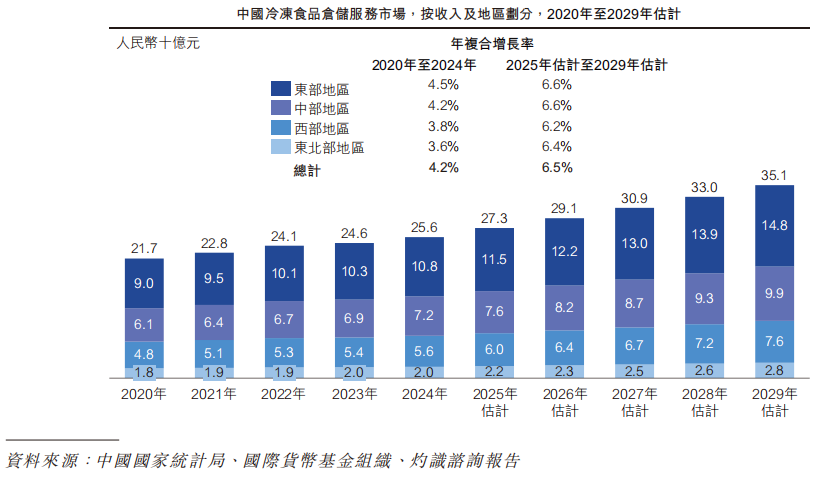
Looking at the overall environment of the industry, under the dual drive of favorable policies and consumption upgrades, cold chain logistics is already a Chaoyang industry with high growth certainty.
At the policy level, the “14th Five-Year Plan” Cold Chain Logistics Development Plan clarifies the important position of cold chain logistics in large-scale agricultural industrialization and the process of improving the quality control of pharmaceutical products, and provides top-level design and system guidance for the high-quality development of cold chain logistics. Since this year, Tianjin, Hubei, Jiangxi and other places have also introduced relevant policy responses, repeatedly referring to building cold chain logistics infrastructure, improving cold chain logistics networks, and improving the level of standardization and intelligence in the industry.
In this context, Red Star Cold Chain's current listing raised sufficient “ammunition” for the company's next phase of capacity expansion, efficiency improvement, and regional integration.
The company's greater ambition comes from the forward-looking layout of its parent company, Red Star Industrial. According to public reports, in recent years, Red Star Industrial has already settled in central China, built the largest modern agricultural products trading platform in the central and southern regions, the Red Star Global Agricultural Wholesale Center, and built an agricultural product distribution network covering 280 million consumers in the six central provinces. At present, the Group has established stable production and marketing relationships with major agricultural product production areas in more than 10 provinces and more than 30 counties across the country, such as highland summer vegetables in Gansu, lychee from Leiling in Guangdong, and grapefruit from Zhangzhou, Fujian. The business network covers all parts of the country.
With the Group's existing production and marketing network and customer resources, Red Star Cold Chain is expected to quickly enter new markets and fully enjoy the synergy between upstream and downstream industries under the Group. This is an innate advantage that is difficult for many third-party cold chain companies to match.
In summary, the growth logic of Red Star Cold Chain is clearly visible: regional leaders have been deeply involved in market segmentation for many years, and their mature profit model has obtained performance and market verification. At the same time, they are backed by physical industry groups, and industrial synergy advantages are remarkable. Taking advantage of this strategic opportunity of high growth in the central cold chain market, the company is expected to quickly replicate past regional success models and accelerate the leap to a full-chain cold chain service provider. For market investors, the company's current stock listing also provides a rare opportunity to share the company's high-certainty growth dividends.