
 Nasdaq
 華爾街日報
華爾街日報Stora Enso Oyj (HEL:STERV) Has A Somewhat Strained Balance Sheet
Some say volatility, rather than debt, is the best way to think about risk as an investor, but Warren Buffett famously said that 'Volatility is far from synonymous with risk.' It's only natural to consider a company's balance sheet when you examine how risky it is, since debt is often involved when a business collapses. We note that Stora Enso Oyj (HEL:STERV) does have debt on its balance sheet. But should shareholders be worried about its use of debt?
What Risk Does Debt Bring?
Debt is a tool to help businesses grow, but if a business is incapable of paying off its lenders, then it exists at their mercy. If things get really bad, the lenders can take control of the business. While that is not too common, we often do see indebted companies permanently diluting shareholders because lenders force them to raise capital at a distressed price. Of course, the upside of debt is that it often represents cheap capital, especially when it replaces dilution in a company with the ability to reinvest at high rates of return. When we think about a company's use of debt, we first look at cash and debt together.
What Is Stora Enso Oyj's Net Debt?
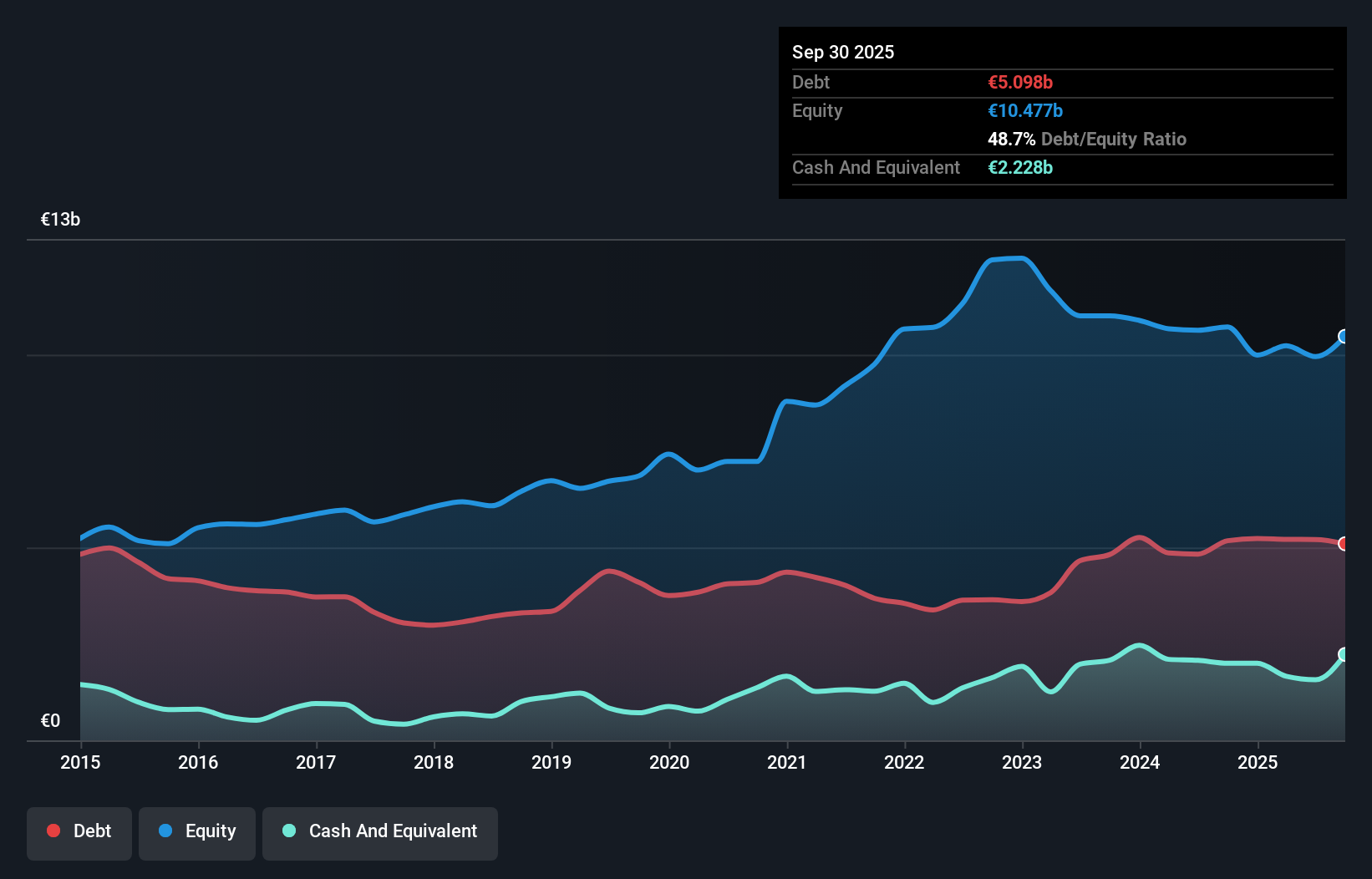
As you can see below, Stora Enso Oyj had €5.10b of debt, at September 2025, which is about the same as the year before. You can click the chart for greater detail. However, because it has a cash reserve of €2.23b, its net debt is less, at about €2.87b.
A Look At Stora Enso Oyj's Liabilities
According to the last reported balance sheet, Stora Enso Oyj had liabilities of €4.17b due within 12 months, and liabilities of €5.23b due beyond 12 months. Offsetting these obligations, it had cash of €2.23b as well as receivables valued at €1.12b due within 12 months. So its liabilities total €6.05b more than the combination of its cash and short-term receivables.
This deficit is considerable relative to its market capitalization of €8.35b, so it does suggest shareholders should keep an eye on Stora Enso Oyj's use of debt. This suggests shareholders would be heavily diluted if the company needed to shore up its balance sheet in a hurry.
See our latest analysis for Stora Enso Oyj
We use two main ratios to inform us about debt levels relative to earnings. The first is net debt divided by earnings before interest, tax, depreciation, and amortization (EBITDA), while the second is how many times its earnings before interest and tax (EBIT) covers its interest expense (or its interest cover, for short). This way, we consider both the absolute quantum of the debt, as well as the interest rates paid on it.
Stora Enso Oyj's debt is 3.3 times its EBITDA, and its EBIT cover its interest expense 4.4 times over. This suggests that while the debt levels are significant, we'd stop short of calling them problematic. The good news is that Stora Enso Oyj improved its EBIT by 5.0% over the last twelve months, thus gradually reducing its debt levels relative to its earnings. When analysing debt levels, the balance sheet is the obvious place to start. But ultimately the future profitability of the business will decide if Stora Enso Oyj can strengthen its balance sheet over time. So if you're focused on the future you can check out this free report showing analyst profit forecasts.
Finally, while the tax-man may adore accounting profits, lenders only accept cold hard cash. So we clearly need to look at whether that EBIT is leading to corresponding free cash flow. During the last three years, Stora Enso Oyj burned a lot of cash. While investors are no doubt expecting a reversal of that situation in due course, it clearly does mean its use of debt is more risky.
Our View
We'd go so far as to say Stora Enso Oyj's conversion of EBIT to free cash flow was disappointing. But at least its EBIT growth rate is not so bad. Overall, we think it's fair to say that Stora Enso Oyj has enough debt that there are some real risks around the balance sheet. If all goes well, that should boost returns, but on the flip side, the risk of permanent capital loss is elevated by the debt. Even though Stora Enso Oyj lost money on the bottom line, its positive EBIT suggests the business itself has potential. So you might want to check out how earnings have been trending over the last few years.
If, after all that, you're more interested in a fast growing company with a rock-solid balance sheet, then check out our list of net cash growth stocks without delay.
Have feedback on this article? Concerned about the content? Get in touch with us directly. Alternatively, email editorial-team (at) simplywallst.com.
This article by Simply Wall St is general in nature. We provide commentary based on historical data and analyst forecasts only using an unbiased methodology and our articles are not intended to be financial advice. It does not constitute a recommendation to buy or sell any stock, and does not take account of your objectives, or your financial situation. We aim to bring you long-term focused analysis driven by fundamental data. Note that our analysis may not factor in the latest price-sensitive company announcements or qualitative material. Simply Wall St has no position in any stocks mentioned.