
 Nasdaq
 華爾街日報
華爾街日報IPO Outlook | Ninety percent of revenue comes from the US. How long can Global Horticulture's overseas dividends last?
The “garden economy” is reshaping the global consumer market with unprecedented popularity. This trend is particularly evident in European and American countries, where the common single-family home type has spawned a complete product ecosystem from cleaning tools and decorative ornaments to outdoor furniture.
The data shows that the global Lawn & Garden (Lawn & Garden) e-commerce market is entering a rapid growth channel. According to Statista's forecast, the market size will reach approximately US$80.9 billion in 2024, and surpass US$115 billion by 2029 at a compound annual growth rate of more than 7%. What supports this market is a solid base of nearly 180 million home gardens in Europe and the US — the US accounts for about 100 million, while Europe has about 80 million.
It is in this context that Global Horticulture Co., Ltd., which specializes in decorative plastic flower pots and is deeply tied to the North American home retail giant, recently officially submitted a listing application to the Hong Kong Stock Exchange, with CMB International as the sole sponsor.
However, in stark contrast to the diversified growth pattern of the global market, this company, which claims to be the most profitable company in the global decorative plastic flower pot industry, depended on the US market for more than 90% of its revenue, and experienced a decline in performance in the first half of 2025. At a time when mainland China's “garden economy” rapidly emerged along with policies and consumption upgrades, this industry leader was almost absent from the domestic market.
This can't help but trigger the market to think: is Global Horticulture going public in Hong Kong this time as a sign of the trend to take advantage of the expansion of global horticultural consumption, or does it reflect deep concerns that its growth model is too concentrated in a single market?
The global horticultural market is growing steadily, and the Asia-Pacific region has become a new engine
Let's start by looking at the industry. The global horticultural market has been booming over the past few years. According to retail sales statistics, the global horticultural market grew from US$91.6 billion in 2020 to US$104.6 billion in 2024, with a compound annual growth rate (CAGR) of 3.4%. This growth trajectory reflects people's enthusiasm for continued investment in home beautification and the “garden economy” around the world, particularly in the post-pandemic era. 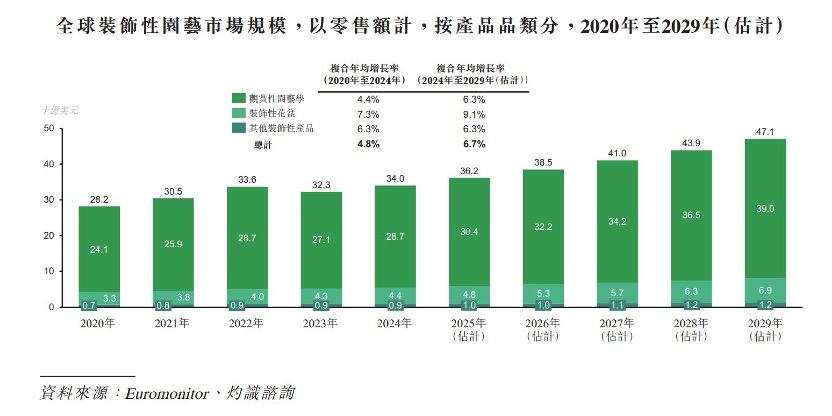
In the future, the garden economy will continue to expand and drive steady growth in the global horticultural market. The overall market is expected to grow from US$104.6 billion in 2024 to US$128 billion in 2029, with a compound annual growth rate of 4.1% during this period. Among all product categories, horticultural flower pots account for about 7.1% of the market share, and the compound annual growth rate is expected to reach 6.9% from 2024 to 2029, which is the core driving force for overall market growth.
At the same time, with the rise of the “garden economy” and the increase in people's demand for beautifying the living environment, decorative gardening products are becoming more and more popular among global consumers. The global market for decorative horticultural products reached US$34 billion in 2024 and is expected to grow to US$47.1 billion by 2029. The compound annual growth rate during this period is about 6.7%, showing a strong and sustainable growth momentum. Among them, North America is the main core market, accounting for about 45.0% of the global market.
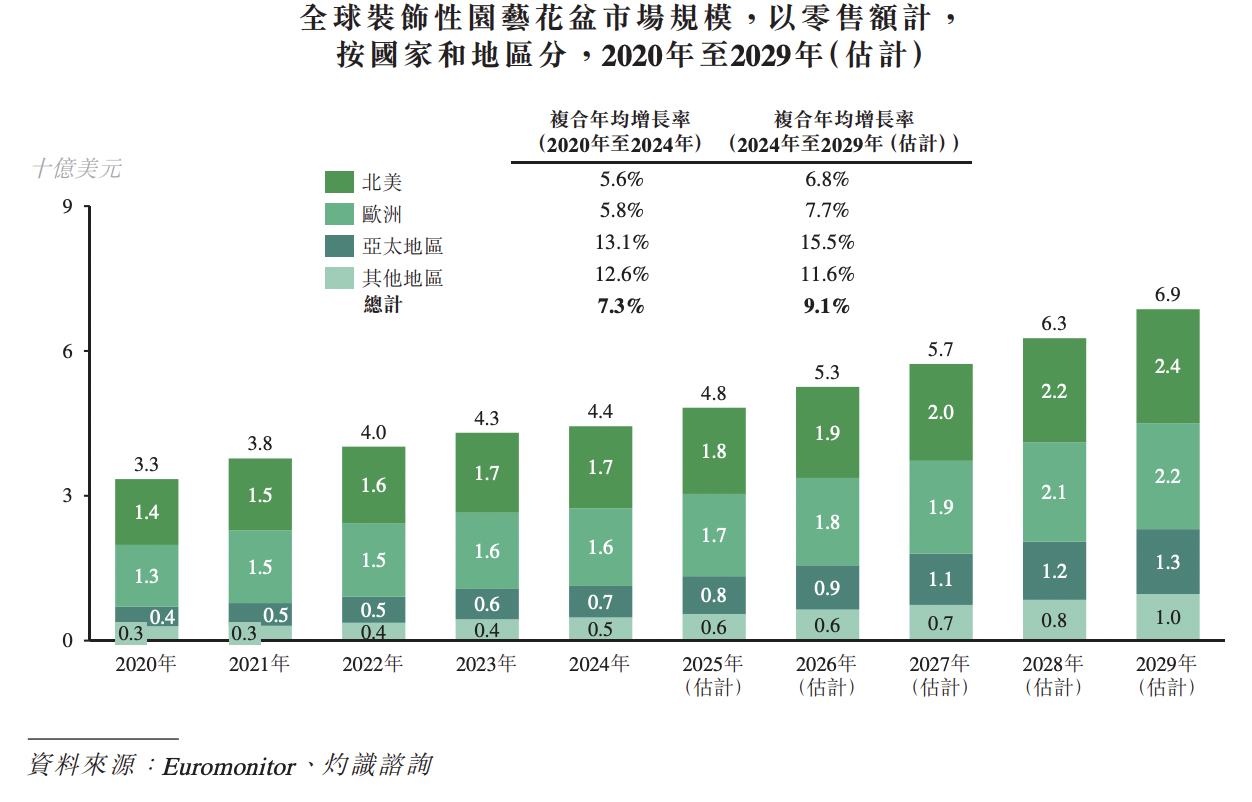
Furthermore, due to increasing urbanization, the demand for lifestyle-oriented home decoration, and the growing popularity of gardening as a leisure activity, the global decorative gardening pot market has been steadily expanding. The global ornamental gardening pot market is expected to grow from US$4.4 billion in 2024 to US$6.9 billion in 2029, with a compound annual growth rate of 9.1%. As the two core markets, North America and Europe account for the vast majority of the market. It is worth noting that since this year, the market growth rate in the Asia-Pacific region has continued to increase, and the compound annual growth rate is expected to grow from 13.1% in 2020-2024 to 15.5% in 2024-2029. However, the balance of growth is tilting eastward: the Asia-Pacific region is showing the fastest growth momentum, and its compound annual growth rate is expected to rise further from 13.1% in 2020-2024 to 15.5% in 2024-2029, and is becoming a key force driving the evolution of the global market landscape.
As the world's largest manufacturer of decorative plastic flower pots and the largest exporter among Chinese flower pot manufacturers, Global Horticulture has established its unique industry coordinates.
Performance fluctuated significantly, and “North American addiction” was highlighted
According to the prospectus, the company is a leading manufacturer and exporter of decorative horticultural products, focusing on decorative plastic flower pots suitable for indoor and outdoor use. With long-term and stable supply chain relationships with major North American retail giants, the company achieved significant sales concentration.
In terms of financial performance, the company's revenue and profit fluctuated significantly. From 2022 to 2024, revenue was $423 million (HK$, same below), $358 million and $474 million, respectively, with corresponding net profit of $82.61 million, $79.73 million and $126 million. The decline in 2023 was mainly affected by North American customers' inventory removal, and the subsequent rebound confirmed its strong correlation with the North American market. In the first half of 2025, both revenue and profit declined year-on-year, to 186 million yuan and 33.88 million yuan, respectively.
It is worth mentioning that from 2022 to 2024, the company's gross margins were 50.0%, 55.9% and 59.5%, respectively, and reached 60% in the first half of 2025. According to the Zhitong Finance App, the company's high gross margin is mainly due to its unique integrated operating model — the company covers the entire industry chain from product design, mold development, material procurement to manufacturing, and operates five factories in China while preparing to build a new production base in Cambodia. This vertically integrated global production capacity layout not only effectively controls production costs, but also enhances supply chain flexibility and export resilience, and is an important moat for its profitability. However, this structural advantage has not fully offset concerns that its growth momentum is weakening.
Looking at the regional market, although Global Horticulture's product sales network covers many countries such as Canada, Mexico, Australia, the United Kingdom, and Chile, its revenue structure is highly concentrated in the US market. According to the prospectus, from 2022 to the first half of 2025, the company's revenue share from the US market reached 90.1%, 94.8%, 93.5% and 93.9%, respectively, and stabilized at more than 90% for four consecutive years, which can be called the company's “ballast stone of revenue” and core profit source.
In terms of specific amounts, the revenue contributed by the US market increased from HK$381 million in 2022 to $443 million in 2024. Although there was a slight decline in 2023 due to fluctuations in overall demand, growth resumed rapidly thereafter. In the first half of 2025, US revenue reached 175 million yuan, still accounting for nearly 90% of total revenue, showing strong customer stickiness and channel stability.
In contrast, other markets have limited contributions and are showing a structural contraction trend. Among them, Canada's revenue fell from HK$14.075 million in 2022 to $7.947 million in 2024, accounting for less than 3% in the first half of 2025; although Mexico achieved contrarian growth in 2024, it only recorded 2.198,000 yuan in the first half of 2025, indicating that its market potential has not been steadily unleashed; Australia and other countries, including the United Kingdom and Chile, have a combined revenue of less than 20 million yuan, accounting for less than 20 million yuan.
On the one hand, this highly concentrated regional layout reflects the success of Global Horticulture's deep binding on North American home retail giants, and on the other hand, it also reveals hidden systemic risks facing geopolitical risks, changes in trade policies, and fluctuations in single market demand. As the global supply chain pattern adjusts and consumer preferences evolve, how to consolidate America's basic market while expanding diversified international markets in an orderly manner will become a key proposition for its future sustainable development.
In fact, with the deepening of China's rural revitalization strategy, the “garden economy” was first written into the Central Committee Document No. 1, and the horticultural consumer market potential in rural and urban areas is huge. Meanwhile, Asia Pacific is already the fastest growing region in the world for decorative horticultural pots. However, according to the prospectus, the company's layout for the Asia-Pacific market, including China, is almost empty.
The fund-raising plan is to acquire factories, expand factory capacity in China and Cambodia, develop high-end products, and expand the European and Australian markets. However, the capital market is probably more concerned about: how can companies break the single market dependency? Can listing financing be turned into strategic capital to open up new markets, particularly the high-growth local market in the Asia-Pacific region?
Taken together, Global Horticulture's IPO presented a story of a Chinese manufacturing company reaching the top in the global segment with cost and supply chain advantages, and also revealed the structural weakness of its growth model. In the context of the overall improvement of the industry and the differentiation of regional growth highlights, whether the company can use the opportunity of listing to complete the transformation from a “North American supplier” to a “global horticultural solutions provider” with balanced development will be the key to its long-term recognition in the capital market. The current fluctuations in performance and market concentration have sounded a wake-up call for it and indicated a potential direction of transformation.