
 Nasdaq
 華爾街日報
華爾街日報Up! Up! Up! Geographic risk compounded the weakening of the US dollar, precious metals soared at the end of the year, and gold, silver, and platinum all reached record highs
Precious metals set off historic markets at the end of the year, driven by the escalation of geopolitical tension, weakening of the US dollar, and low market liquidity at the end of the year. Gold, silver, and platinum prices together set new records on Friday, continuing the strong gains that have been rare since this year.
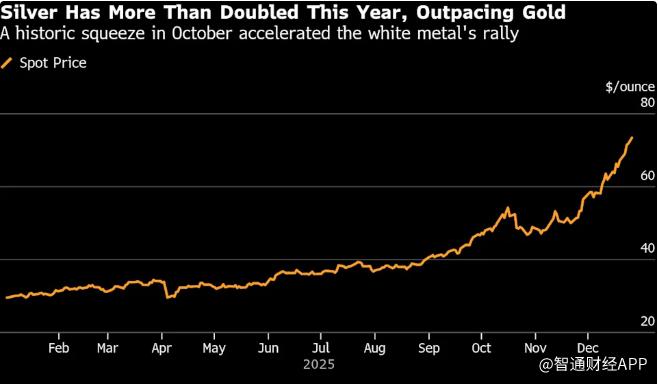
Spot gold once rose 1.6%, above $4,540 per ounce; spot silver rose for the fifth consecutive trading day, surging more than 10%, breaking through the $79 per ounce mark. Platinum also performed well, breaking through $2,400 per ounce for the first time, a new high since statistics were available in 1987.
Analysts pointed out that safe-haven demand is an important driving force behind this round of growth. Recently, the US blocked Venezuelan oil tankers and increased pressure on the Venezuelan government. At the same time, it also cooperated with the Nigerian government to launch military attacks against the “Islamic State,” increasing global geopolitical uncertainty.
Daniel Takieddine, CEO of Sky Links Capital Group, said that geopolitical tension continued to strengthen the appeal of safe-haven assets such as gold and silver, while low liquidity at the end of the year further amplified price fluctuations.
At the same time, the weakening dollar also provided important support for precious metals. The US dollar spot index fell 0.7% this week, the biggest weekly decline since June. Since gold and silver are denominated in dollars, depreciation of the dollar usually enhances its relative appeal.
Judging from the annual performance, precious metals can be called an “epic market” this year. Gold has accumulated a cumulative increase of about 70% during the year, and silver has increased by more than 150%. Both are expected to record their best annual performance since 1979. Factors driving the rise include continued purchases by central banks, inflows of traded funds (ETFs), and the Federal Reserve cut interest rates three times in a row during the year. The lower interest rate environment has weakened the opportunity cost of interest-free assets, and the market is also betting that interest rates may be cut further in 2026.
Furthermore, Trump's tough stance on reshaping the global trade pattern earlier this year, as well as remarks about the independence of the Federal Reserve, once “added fuel” to the rise in precious metals. As the size of government debt grew and the attractiveness of sovereign bonds and the currency they issued declined, investors turned to so-called “currency depreciation transactions,” further supporting demand for gold.
The flow of ETF funds is also critical. The world's largest precious metals ETF, SPDR Gold Trust, managed by State Street Corp., has increased its gold holdings by more than 20% since this year, becoming an important driver for gold prices to reach new highs in this round.
Silver's rally was even more intense. After the market experienced a historic “emptying” in October, the supply mismatch problem in major trading centers has not been completely mitigated. Combined, speculative capital continued to flow in, driving the rise in silver prices at an accelerated pace. The London Treasury has attracted large inflows of silver since October, but global silver stocks that can be quickly delivered are still highly concentrated in New York. Traders are closely monitoring the findings of the US Department of Commerce's investigation into whether imports of key minerals pose a national security risk. The review may pave the way for tariffs or trade restrictions.
Manav Modi, a commodity analyst at Motilal Oswal Financial Services, pointed out that a large number of “paper transactions” in the market require physical silver to be hedged, but currently available supply is limited. This mismatch between supply and demand is the core reason for the sharp rise in prices.
In terms of platinum, this month's increase has exceeded 40%. In addition to strong physical demand, platinum used in the automotive and jewelry industry is expected to experience a global supply gap for the third year in a row this year, mainly affected by supply disruptions in South Africa, the largest producer.