
 Nasdaq
 華爾街日報
華爾街日報This International Pharma Stock Just Hit 5-Year Highs
- Teva Pharmaceutical (TEVA) is trading at new 5-year highs.
- Shares are up more than 40% over the past year.
- The stock has strong technical momentum, maintaining a 100% “Buy” opinion from Barchart.
- TEVA offers international diversification and is favored by both Wall Street and individual investors.
Today’s Featured Stock
Valued at $36.40 billion, Teva Pharmaceutical (TEVA) is a global pharmaceutical company that develops, manufactures, and markets both branded and generic drugs, as well as active pharmaceutical ingredients in North America, Europe, Latin America, India, and Israel.
Teva’s generic product portfolio includes tablets, capsules, liquids, ointments, creams, liquids, injectables, and inhalants. The company’s branded products include Copaxone, Austedo, Ajovy, and respiratory products like ProAir and Qvar.
What I’m Watching
I found today’s Chart of the Day by using Barchart’s powerful screening functions to sort for stocks with the highest technical buy signals; superior current momentum in both strength and direction; and a Trend Seeker “buy” signal. I then used Barchart’s Flipcharts feature to review the charts for consistent price appreciation. TEVA checks those boxes. Since the Trend Seeker signaled a new “Buy” on Oct. 29, the stock has gained 56.90%.
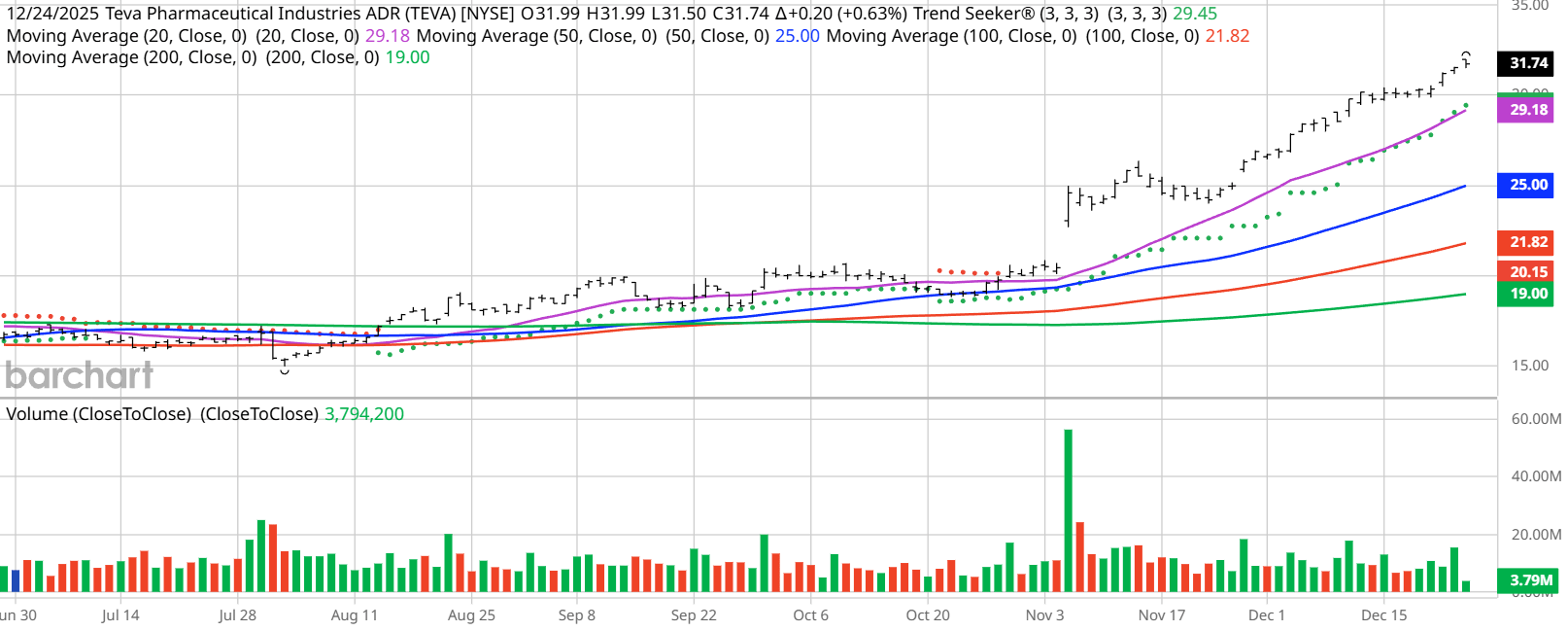
Barchart Technical Indicators for Teva Pharmaceuticals
Editor’s Note: The technical indicators below are updated live during the session every 20 minutes and can therefore change each day as the market fluctuates. The indicator numbers shown below therefore may not match what you see live on the Barchart.com website when you read this report. These technical indicators form the Barchart Opinion on a particular stock.
Teva Pharmaceuticals scored a new 5-year high of $31.99 on Dec. 24.
- TEVA has a Weighted Alpha of +79.48.
- Teva Pharma has a 100% “Buy” opinion from Barchart.
- The stock gained 40.4% over the past year.
- TEVA has its Trend Seeker “Buy” signal intact.
- The stock recently traded at $31.75 with a 50-day moving average of $25.24.
- TEVA made 14 new highs and gained 20.66% in the last month.
- Relative Strength Index (RSI) is at 84.17
- There’s a technical support level around $31.50.
Don’t Forget the Fundamentals
- $36.40 billion market capitalization.
- 12.22x trailing price-earnings ratio.
- Revenue is expected to grow 2.45% this year but decrease by 0.15% next year.
- Earnings are estimated to increase 6.04% this year and an additional 5.54% next year.
Analysts and Investor Sentiment on Teva Pharmaceuticals
Both Wall Street analysts and individual investors are high on this stock.
- Wall Street analysts tracked by Barchart have given 11 “Strong Buy,” and 1 “Hold” opinion on the stock with price targets between $20 and $40.
- Value Line rates the stock “Highest” with price targets of $19-$48.
- CFRA’s MarketScope Advisor rates the stock as “Hold” but with a price target of only $24.
- Morningstar thinks with the stock’s recent runup, it’s 26% overvalued.
- 5,130 investors following the stock on Motley Fool think it will beat the market, while 305 think it won’t.
- 102,540 investors are monitoring the stock on Seeking Alpha, which rates the stock a “Hold.”
- Shorth Interest is a low 3.98% of the float.
The Bottom Line on Teva Pharmaceuticals
Wall Street analysts and individual investors agree on this international pharmaceutical. If you want to diversify your portfolio with some international exposure, this pharma is a good place to do that.
Additional disclosure: The Barchart Chart of the Day highlights stocks that are experiencing exceptional current price appreciation. They are not intended to be buy recommendations as these stocks are extremely volatile and speculative. Should you decide to add one of these stocks to your investment portfolio it is highly suggested you follow a predetermined diversification and moving stop loss discipline that is consistent with your personal investment risk tolerance.
On the date of publication, Jim Van Meerten did not have (either directly or indirectly) positions in any of the securities mentioned in this article. All information and data in this article is solely for informational purposes. For more information please view the Barchart Disclosure Policy here.