
 Nasdaq
 華爾街日報
華爾街日報The unexpected slowdown in inflation in Tokyo in December was unstoppable by the Bank of Japan's pace of austerity, and the pace of interest rate hikes became the focus of the market
The Zhitong Finance App learned that as pressure on food and energy prices weakens, inflation in Tokyo, which is regarded as a leading indicator of the national inflation trend, has cooled more than market expectations, but this is unlikely to stop the Bank of Japan from raising interest rates further. According to data released by Japan's Ministry of Internal Affairs and Communications on Friday, the consumer price index (CPI) excluding fresh food in the Tokyo region rose 2.3% year on year in December, a marked decrease from 2.8% in the previous month, and lower than the 2.5% predicted by economists. This is the first time since August that inflation has slowed, mainly reflecting a fall in food price increases and lower energy costs. The overall inflation index fell to 2% from 2.7% the previous year, while the deeper inflation index excluding energy slowed to 2.6%.
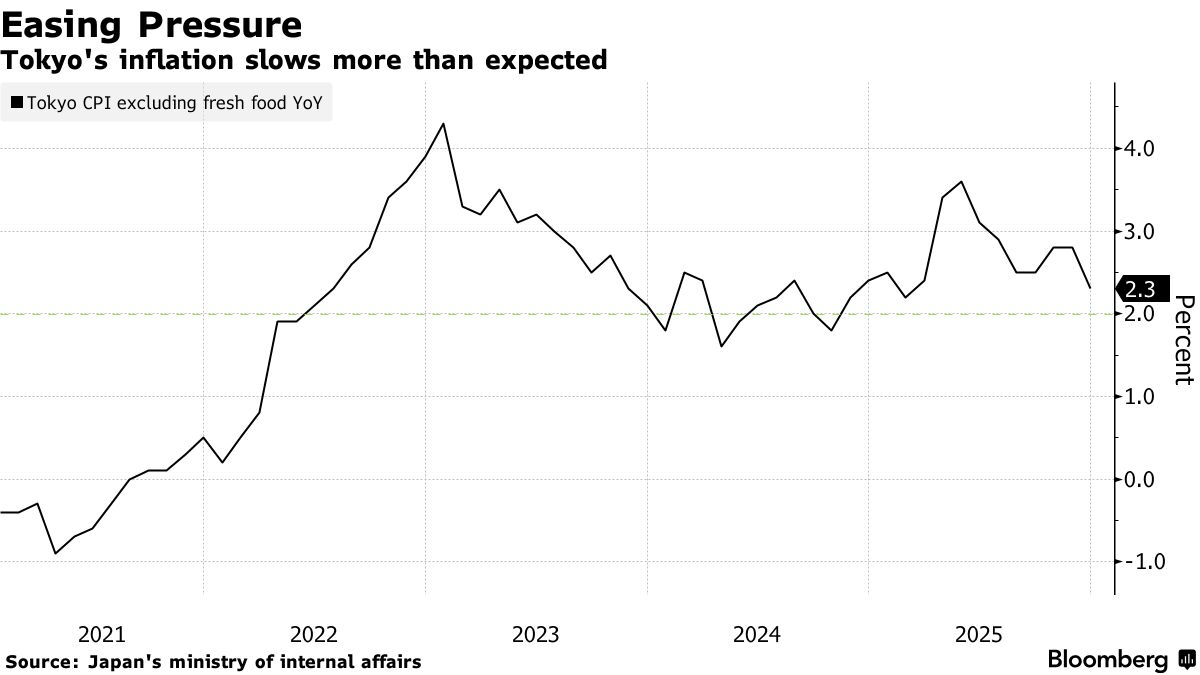
At the time of the release of this data, the market is closely monitoring the price trend in Japan to determine when the next policy adjustment will take place. Last week, the Bank of Japan's monetary policy committee voted unanimously to raise the policy interest rate to 0.75%, the highest level since 1995. Bank of Japan Governor Kazuo Ueda said at a press conference after the meeting that if the price outlook is realized as expected, the central bank will continue to tighten its policy, but the pace of interest rate hikes or the level of terminal interest rates is not clear.
Although the overall inflation data has clearly slowed, it is still above the Bank of Japan's target level of 2%, which keeps the central bank's path of continuing policy tightening unchanged. The current results are also generally in line with the Bank of Japan's benchmark judgment, that is, inflationary pressure will gradually ease. In its latest policy statement, the Bank of Japan said that inflation is expected to reach the central bank's target in the second half of the forecast period ending the 2027 fiscal year.
Economists expect the Bank of Japan to raise interest rates approximately every six months, and the terminal interest rate level is expected to be around 1.25%. This means that analysts expect the Bank of Japan to raise interest rates about two more times during this cycle.
Although Kazuo Ueda has hinted that interest rates may be raised further in the future, and the spread between the US and Japan is expected to narrow, the yen's performance is still weak. The yen hovers near the weakest level against the US dollar since January of this year, which may push up import costs, which may be transmitted to domestic prices. The recent fall in yen has prompted Japanese officials to issue strong warnings, saying they are ready to enter the market to interfere in the foreign exchange market at any time if necessary.
Economist Taro Kimura said, “The cooling of the overall inflation index will buy space for Japanese Prime Minister Sanae Takaichi and urge the Bank of Japan to be patient on the issue of interest rate hikes. We expect the Bank of Japan will not take the next step until at least July.”