
 Nasdaq
 華爾街日報
華爾街日報Looking ahead to US stocks 2026: After three consecutive years, three key factors determine whether the bull market can continue
The Zhitong Finance App learned that the US stock market achieved double-digit percentage increases for the third year in a row. Achieving a fourth glorious year in 2026 is likely to be very difficult, requiring strong corporate profits, the Federal Reserve's dovish stance, and strong investment in artificial intelligence.
The bull market in the US stock market, which began in October 2022, was mainly driven by artificial intelligence optimism, interest rate cuts, and continued economic growth amid concerns about the recession. US stocks experienced a roller coaster year this year. Previously, the Trump administration announced tariff measures that exceeded expectations in April, causing the stock market to plummet and then rebounded strongly; then declined due to concerns about the artificial intelligence valuation bubble, and began to pick up at the end of the year. There are only a few trading days left until the end of the year, and the S&P 500 index has risen by more than 17% in 2025. Previously, the increase in 2024 and 2023 was 23% and 24%, respectively.
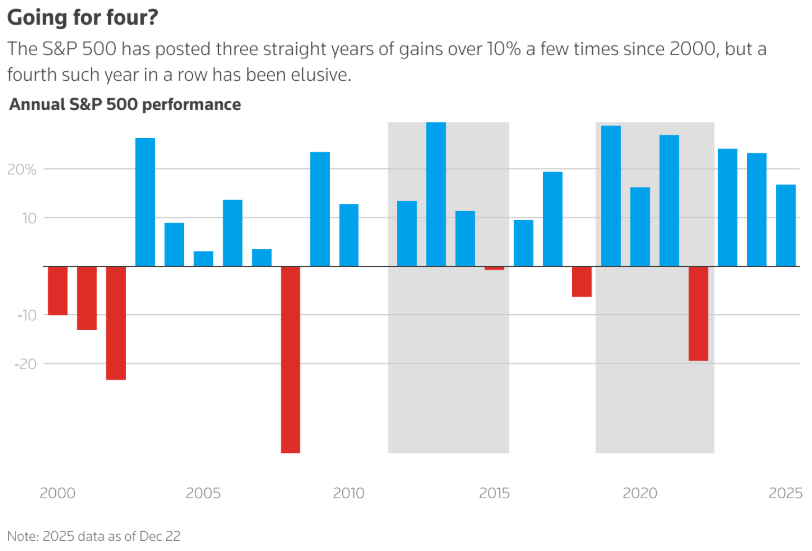
Sam Stovall, chief investment strategist at CFRA, said that in order to obtain strong double-digit percentage returns for the fourth year in a row, the market needs “full firepower in all aspects.” The strategist's target level for the end of 2026 is 7,400 points, which is about 7% higher than the current level. Stovall said, “The many negative factors suggest that while we may finally have an unexpectedly good year, I don't think it will be another brilliant year.”
Many market strategists predict strong market performance in 2026. The target price for the S&P 500 index given by some strategists is equivalent to an increase of 10% or more, including Deutsche Bank's target price of 8,000 points, which is about 16% higher than the current level.
Can earnings growth and artificial intelligence bring strong gains to US stocks?
The bulls are optimistic about US stocks and believe that the profit prospects of US companies are optimistic. Tajinder Dhillon, head of profit research at LSEG, said that the profits of S&P 500 companies are expected to increase by more than 15% in 2026, and have previously achieved steady growth of 13% in 2025.
Earnings growth is expected to be driven by a wider group of companies, as fiscal stimulus and loose monetary policies can help boost the economy and consumer spending, not just a few relevant tech giants. These giant companies include Nvidia (NVDA.US). , Microsoft (MSFT.US), Google (GOOGL.US), Amazon (AMZN.US), etc. According to Dhillon, these seven companies are known as the “Big Seven Tech Giants,” and the profit growth rate will reach 37% in 2024, while the profit growth rate of the other components of the S&P 500 index is only 7%. By 2026, this gap is expected to close significantly: the earnings growth rate of the seven tech giants is expected to reach 23%, while the earnings growth rate of the other companies in the index is expected to reach 13%.
Kristina Hooper, chief market strategist at Man Group, said: “There has been an improvement in earnings growth for 493 other stocks in the S&P 500 — we've seen some of these improvements — which will definitely help the stock market achieve double-digit returns next year.” Investors say profit growth is critical because it is difficult for stock valuations to break through high levels any more.
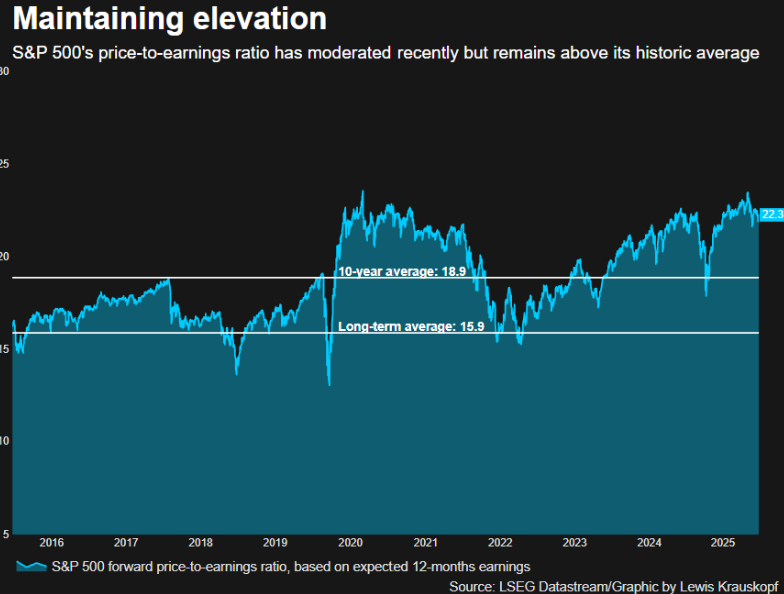
The boom in the AI sector has boosted the valuation of related stocks, including large-scale investments in infrastructure and anticipated strong demand for AI applications. However, recent questions about return on capital expenditure have put pressure on technology stocks and other AI-related stocks, and this is likely to remain a key issue in 2026.
Jeff Buchbinder, chief stock strategist at LPL Financial, said: “If companies start cutting capital expenditure targets they have set and the market loses confidence in the return that AI investments will generate... then you may see a flat or even a slight decline in the stock market this year.”
The dovish Federal Reserve, complex historical signals and uncertainties
Investors said that another key factor in the strong rise in US stocks is that the economy is weak enough to curb inflation and push for further interest rate cuts, but not into recession. According to federal funds futures, investors expect to cut interest rates at least twice in 2026, 25 basis points each time, after cutting interest rates by 175 basis points in 2024 and 2025.
Yung-yu Ma, chief investment strategist at PNC Financial Services Group, said, “The driving factor I am most concerned about is probably the Fed's maintenance of a dovish stance.”
Investors are closely watching Trump's nomination for the Federal Reserve Chairman (expected to be announced in early 2026) as a sign that the Fed will be more dovish, but they are also concerned that the independence of the Federal Reserve will be tested.
Historical data shows that the potential returns for 2026 are mixed. On the positive side, according to LPL Research, since 1950, there have been seven bull markets that have continued until the fourth year, with an average increase of 12.8% in the fourth year, and six out of seven have achieved positive returns.
However, in the US midterm election year, stock market performance is often poor because elections to the new Congress will bring uncertainty about the formation of the federal government. According to CFRA's Stovall, the average increase in the S&P 500 index in the midterm election year was only 3.8%, while the average increase during the other three years of the presidential term was 11%.
Additionally, there are many uncertainties that may arise. For example, Ma said that although tariffs are no longer a market-dominant issue after triggering sharp market fluctuations in early 2025, the relationship between the world's two largest economies — the US and China — is likely to be around 2026 in the stock market. He said, “Actually, there is a possibility of a breakthrough between the US and China. This may be a positive catalyst, and this kind of catalyst was not included in expectations.”