
 Nasdaq
 華爾街日報
華爾街日報AI threats and the cold wave of advertising hits established European media giants and ushered in a “difficult 2026”
The Zhitong Finance App learned that established European media giants — that is, the largest media content publishers and broadcasters — may face more serious business challenges in 2026, mainly because artificial intelligence begins to threaten and disrupt their long-standing traditional business models. Combined with global macroeconomic uncertainty, it is likely that companies' advertising budgets will be drastically reduced compared to 2025.
According to a Bloomberg Intelligence (BI) statistic, analysts agree that the media and entertainment sub-index companies in the European stock market benchmark, the Stoxx Europe 600 Index, may achieve 6.9% profit growth in 2026, far lower than the growth rate of up to 10% of analysts who are part of the Stoxx Europe 600 Index.
Tom Ward, a senior analyst from BI, said, “The pressure on European publishers and broadcasters caused by the huge uncertainty brought about by the advertising market and artificial intelligence is likely to continue until 2026,” and this negative trend may continue to affect the industry's stock price pricing logic after experiencing a “sharp downturn” in 2025.
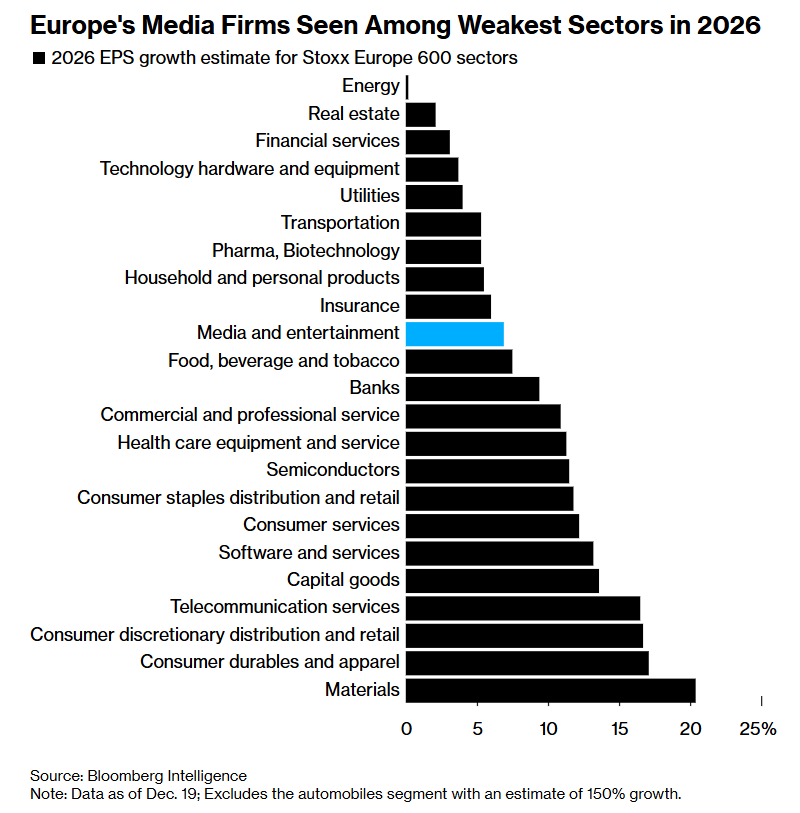
As shown in the chart above, according to analysts' unanimous expectations, Europe's century-old media companies may become one of Europe's weakest industry segments in 2026.
Needless to say, ongoing global trade tension and European political uncertainty have drastically weakened European companies' confidence in expansion and significantly squeezed their marketing budgets, putting tremendous pressure on the fundamentals of the performance of advertising media companies and broadcasters that rely on advertising revenue.
“There is a close link between ad spend and confidence in economic growth, and when expectations deteriorate, advertisers usually cut ad investments drastically,” Ward said.
In October, advertising agency media company WPP Plc lowered its performance forecast, mainly due to loss of customers and dry up demand. In November, the BBC ITV Plc said that “widespread caution” surrounding the UK budget had drastically stifled advertising demand, forcing it to find £35 million (approximately $47 million) of savings to mitigate the negative impact of the decline in revenue.
Overall, Ward's estimates suggest that European Broadcasting Corporation's overall ad type sales in 2025 may drop by an average mid-single digit level, and “when will visibility still be low.”
The huge risk from artificial intelligence technology is another important concern for Europe's weakened media sector. Deutsche Bank analyst Silvia Cuneo said, “Just as the dust on Trump's tariff issue seems to have settled, the market is not in a moment of cheering for the media industry; the emergence of artificial intelligence as a disruptive factor poses new risks.”
This is particularly relevant for publishers like Informa Plc, and online media platforms such as Rightmove Plc and Scout24 SE, which have discovered that artificial intelligence is a double-edged sword. Although the technology may create new sales growth opportunities by improving the efficiency of the company's advertising tools, the combination of generative artificial intelligence and some new platforms may also replace some key advertising and marketing products, making part of its business redundant.
Some of these traditional business models are particularly at risk, including Pearson Plc's online higher education digital course, according to John Davies, another analyst from BI. The drastic reduction in US government research funding has also brought additional significant headwinds to the content publishing industry, particularly for companies like Springer Nature AG & Co KGaA, which generate significant revenue and profits from research journals.
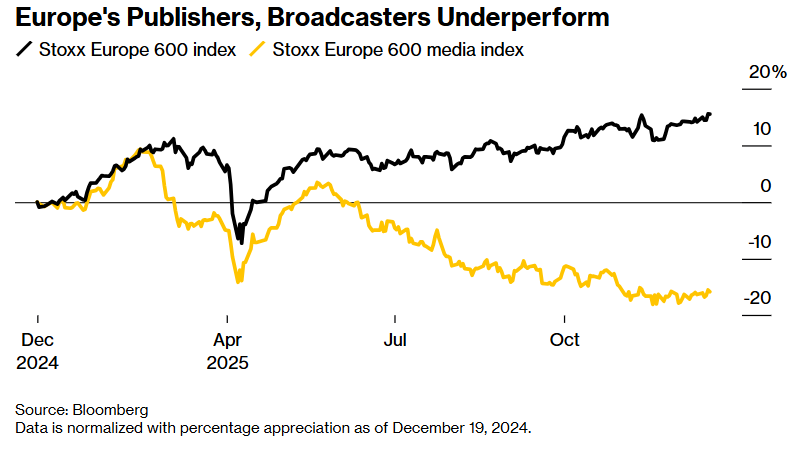
In terms of stock prices, as shown in the chart above, European content publishers and broadcasters continued to have poor stock price performance, falling far short of the European stock market.
However, the threat posed by artificial intelligence technology to traditional European media companies is still debated among analysts. Analysts Daniel Kerven and Lara Simpson from Wall Street financial giant J.P. Morgan Chase believe these concerns have been exaggerated and expect a “more detailed” positive response from the market next year.
The two analysts said that the losers will be companies that fail to adapt to artificial intelligence technology. “Although this is still a volatile and uncertain situation, it may take a few years before the impact of artificial intelligence on various industries is really clear,” said Cuneo from Deutsche Bank. She anticipates that the winners in Europe's traditional media industry will be those “media companies that are actively starting to use artificial intelligence as an opportunity and risk at the same time.”
One of these probably includes the German real estate platform Scout24. The company has an exclusive artificial intelligence tool that allows agents to create listings and optimize images, which allows it to continuously promote its B2B products, said Doyinsola Sanyaolu, an analyst from Citi. “Its proprietary data also opens up potential partnerships with large language model (LLM) providers,” added analyst Sanyaolu, which makes Scout24 “one of the most innovative real estate companies in this AI+ space.”
Although investors are actively waiting for the big stories brought about by artificial intelligence to develop positively among portals and content publishers, market investment sentiment is likely to remain sluggish next year. “The macro environment is still relatively fragile, and investment themes that are being disrupted by artificial intelligence, including media companies, are far from the market narrative.” Cuneo displayed.