
 Nasdaq
 華爾街日報
華爾街日報Many favorable factors are gaining momentum. Will US stocks open a “Santa Claus market” this week?
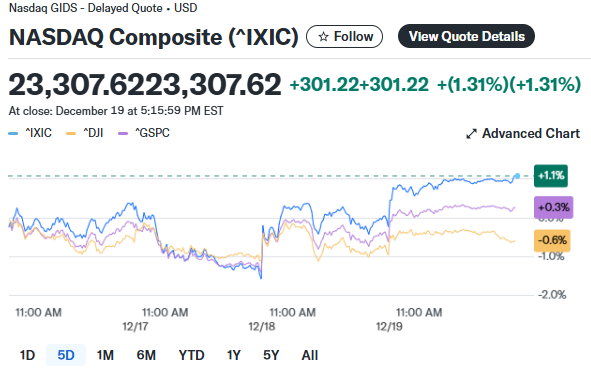
The stock market rebounded last Friday, putting an end to a week of mixed ups and downs for major stock indexes, and this week was also the last full trading week of 2025. By the last seven trading days of 2025, the three major stock indexes will all be close to their all-time highs, with a gap of no more than 3%. This week, the US stock market will have a relatively quiet week. US stocks only opened for half a day on Wednesday and were closed on Christmas Day on Thursday. Many international markets will also continue to be closed on Friday.
Over the next week, investors who remain active during the holidays will turn their attention to the “Santa Claus Market” outlook, while on Tuesday some lagging data delayed due to the US government shutdown will be released. The consumer confidence index released by the World Federation of Major Businesses on Tuesday morning should be the focus of attention, as one of the major trends in 2025 is the K-type economy emerging among American consumers.
Economic data: Focus on consumer conditions
American consumers are feeling slightly cooler during the holidays this year than last year. According to data released by the University of Michigan on Friday, the December consumer confidence index rebounded slightly from November, but the index was 52.9, which is 28.5% lower than last December's reading. Meanwhile, home sales rose slightly for the third month in a row in November, but sales in 2025 are likely to end the year at their lowest level in 25 years, according to the American Association of Realtors.
Joanne Hsu, director of consumer research at the University of Michigan, said, “Consumers have made it clear that they think the economic outlook has deteriorated significantly since the beginning of the year.”
This week, US economic data is being released intensively. The core focus is on the real GDP for the third quarter to be announced on December 23. The market expects its annualized quarterly rate to reach 2.5%. The key focus of this data is the resilience of the service sector and consumption of non-durable goods, whether it can maintain resilience from the overdraft demand for durable goods caused by early consumption due to “tariff fears” in the second quarter, and focusing on consumer differentiation.
According to Bank of America, although consumer spending remained generally stable in the second half of this year, the highest-income households in the US contributed more than half of the expenses; about a quarter of households were unable to make ends meet. Jeffrey Roach, chief economist at LPL Financial, said, “The 'K-type' economy has scattered consumer groups. High-income families live well, and can even be said to be affluent, while low-income families face problems such as high rents, rising repayment arrears, and unstable employment.”
Perhaps this is another reason why the inflation data released by the US Bureau of Labor Statistics last Thursday was so surprising. The US CPI for November shows that overall prices have risen 2.7% over the past 12 months, far below expectations. Bill Adams, chief economist at Comerica Bank, said that this data should give the Fed more confidence to cut interest rates again next year, and on this basis, cut interest rates by a total of 75 basis points in 2025.
Adams said in an email that “the Federal Reserve will be happy to see a slowdown in overall and core CPI growth” because the report “reinforces the reasons for further interest rate cuts in 2026.” Even so, he said, “Consumer feelings about inflation will probably still be stronger than optimistic headlines suggest, as prices for many necessities other than housing are still rising rapidly.”
Christmas quotes
Traders have been waiting for “Santa's quotes” all year round. It covers the last five trading days of each year and the first two trading days of the following year, and is one of the best performing weekly trading windows in the market. On Friday, market trends showed signs of meeting historical expectations.
The term “Santa Claus Market” was coined by legendary Yale Hirsch, the author of “The Stock Trader's Yearbook,” which refers to the phenomenon of stocks rising on the last five trading days of the year and the first two trading days of the new year. According to data compiled by CFRA Research, since 1945, the S&P 500 index has risen by an average of 1.5% in December. This performance is second only to November.
Notably, big tech stocks also performed well. Among them, shares of Oracle (ORCL.US) have dropped nearly 40% since their September high due to market concerns about its promise of artificial intelligence. On Friday, there was news that Oracle would lead a group of US partners to acquire TikTok from its ByteDance. After the news broke, Oracle's stock price rose more than 7%.
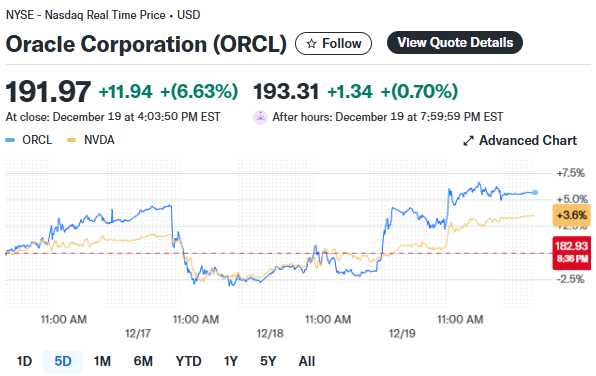
On Friday, it was reported that the Trump administration is reviewing plans by chip manufacturing giant Nvidia (NVDA.US) to sell H200 chips to Chinese buyers. Boosted by this news, Nvidia's stock price rose. Shares rose more than 10% after Micron Technology (MU.US) released its earnings report last week, easing investors' concerns about artificial intelligence and the market as a whole as the last few trading days of 2025 arrive.
The analysis points out that weak US labor market data, the unexpected drop in US inflation data, and the Federal Reserve's nominal dovish stance all provided support for stock prices. Although the Federal Reserve has almost given the green light to the Christmas market, reasonable concerns about excessive valuations are still holding back the market, preventing it from reaching a record high.
Despite this, most Wall Street strategists are still optimistic about next year's market prospects. The economic growth and profit environment have also provided investors with enthusiasm other than artificial intelligence trading, which has become a “crutch” for many investors over the past few years. Wall Street strategists believe that loose monetary and fiscal policies, combined with artificial intelligence trading, are the reason for the rise in the stock market next year.
Goldman Sachs analysts wrote in a client note: “2025 is a great example of an early optimistic phase of the macroeconomic cycle. Many stock markets... valuations rise as earnings grow. We are confident that optimism will continue in 2026.”
Goldman Sachs analysts predict earnings growth of more than 12% in 2026, mainly due to the strong growth of the top seven tech giants in the index by market capitalization.
UBS Global Wealth Management wrote in a report to clients on Thursday: “Regardless of any individual stocks, we believe the overall development prospects of artificial intelligence are still good. We have seen no sign of an investment bubble, and overall company fundamentals remain strong.” The company predicts that by the end of 2026, the S&P 500 will rise to 7,700 points, up 13% from last Friday's level.