Nasdaq
 華爾街日報
華爾街日報World Gold Council: The impact of the new gold value-added tax policy on the Chinese gold market in November is gradually showing
The Zhitong Finance App learned that the World Gold Council released the “China Gold Market Monthly Review”, which mentions that recently released value-added tax adjustments have accelerated the integration of the jewellery industry, have now had a negative impact on jewellery consumption, and may continue to impact jewellery sales in the short term. However, the Association believes that this move will eliminate stores with weak financial strength and product competitiveness, make the industry structure more reasonable, develop healthier, and promote the return of the market to focus and innovation on the “jewellery” attributes of gold jewellery.
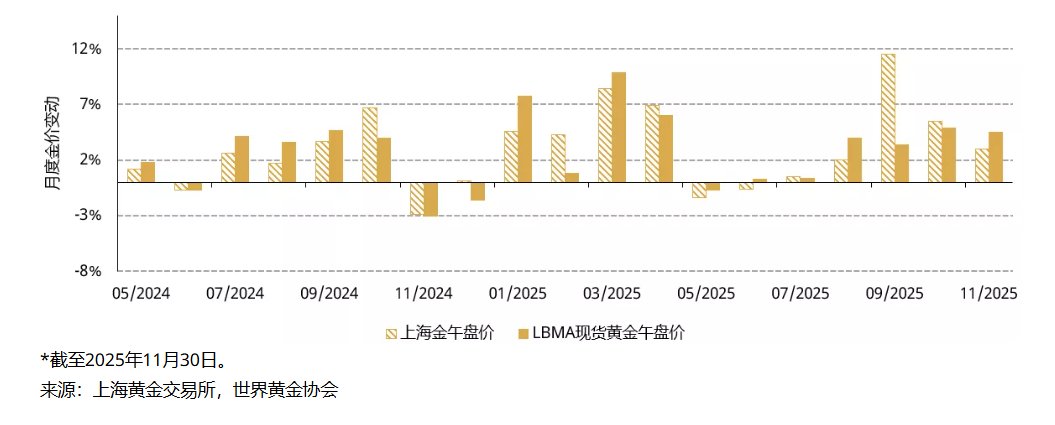
The World Gold Council said that in November, factors such as rising investors' expectations of the Federal Reserve's interest rate cut in December boosted the price of gold. London LBMA's midday gold price, which is denominated in US dollars, rose 4.5% in November, and the Shanghai SHAUPM gold price rose 3% in midday trading (Figure 1). The appreciation of the RMB against the US dollar and the moderate weakening of domestic demand limited the latter increase. Since the beginning of 2025, the rate of return on the RMB gold price and the US dollar gold price has increased to 54% and 61%, respectively.
Figure 1: Global gold prices continued to rise in November
Monthly returns on the Shanghai Gold SHAUPM Midday Price and London LBMA Spot Gold Midday Price*
The impact of the new VAT policy is evident, and upstream physical gold demand is under pressure
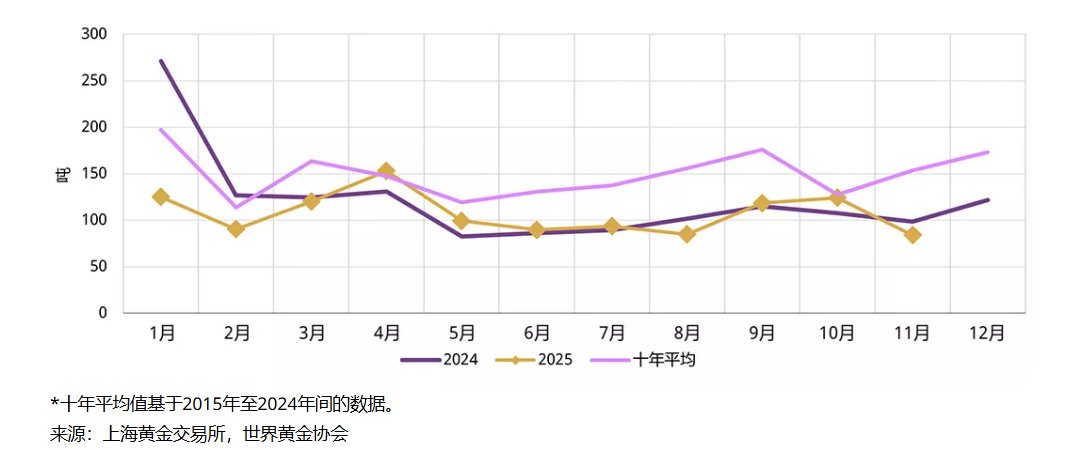
Gold shipments from the Shanghai Gold Exchange (SGE), a representative indicator of China's upstream physical gold demand, fell 32% month-on-month to 84 tons in November (Figure 2), down 15% year-on-year from last year, the weakest November performance since 2009. Historical rules show that upstream physical gold demand usually gradually picks up after October, but there was an abnormal weakening in November of this year. This is mainly due to the fact that the jewellery industry has been significantly affected by the recent new value-added tax policy in the gold market. As we detailed in “You Ask Me”, the tax reform has boosted the cost of jewellery and inhibited consumer purchases, which in turn has led to a slump in retailers' willingness to make up goods.
In contrast, physical gold bar sales through Shanghai Gold Exchange member channels were not affected by this VAT change. The November performance was still steady, but it was still not enough to offset the weakness in the jewellery demand sector. We believe that the strong impetus for investment demand comes from: gold jewellery consumers who previously had investment purposes are turning to gold bars and coins because they now face additional tax burdens; heightened geopolitical risks and the A-share pullback are both boosting safe-haven demand; gold prices continue to strengthen; and the People's Bank of China's continuous gold purchase announcements.
Figure 2: Upstream physical gold demand weakened in November
Monthly shipments from the Shanghai Gold Exchange*
Chinese investors continue to buy gold ETFs quickly
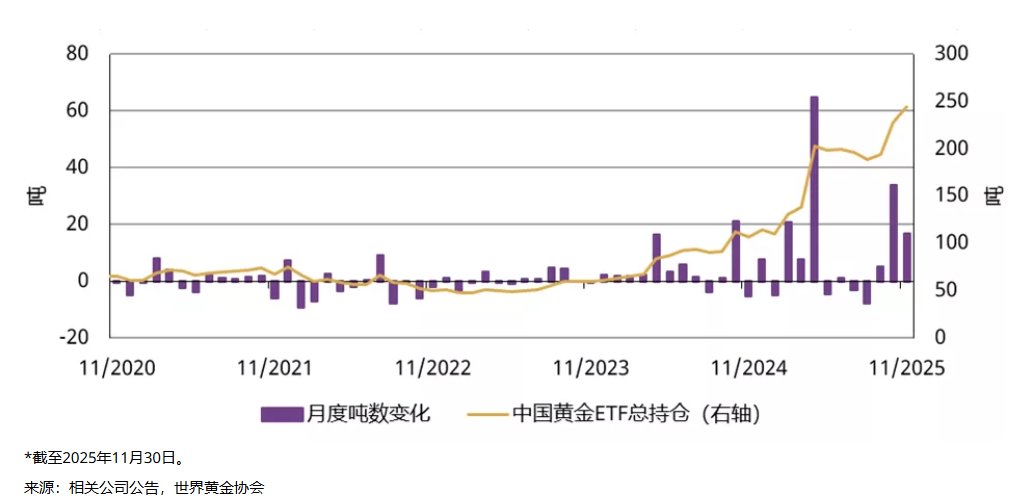
In November, gold ETFs in the Chinese market attracted capital of about 16 billion yuan (about 2.2 billion US dollars, 17 tons), achieving the third consecutive month of inflows, which is far higher than the average monthly level of 2.6 billion yuan in 2024. In the same month, the total asset management scale of gold ETFs in the Chinese market increased 10% month-on-month to reach 231 billion yuan (approximately US$29 billion), and their holdings increased 7% to 244 tons in the same month, setting a new month-end record in terms of both value and tonnage (Figure 3). We believe that the factors driving the increase in demand for gold ETF investment are similar to the factors supporting physical gold bar sales described above.
Figure 3: Demand for gold ETFs in China remained high in November
Monthly demand for gold ETFs in the Chinese market*
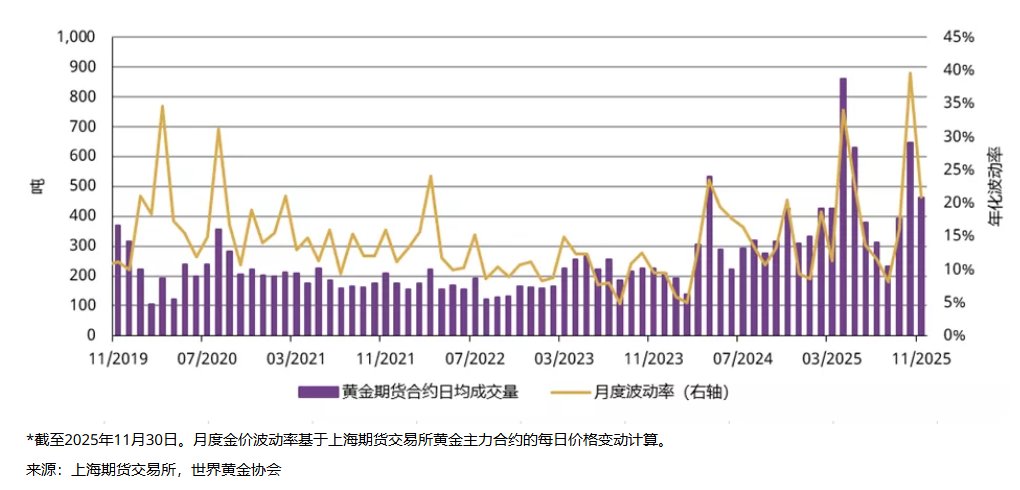
In November, the average daily trading volume of gold futures on the Shanghai Futures Exchange fell 29% month-on-month to 461 tons per day, mainly due to a decrease in gold price volatility. Despite the decline in trading volume, it is still well above the 2024 average of 302 tons per day (Figure 4). So far in 2025, the average daily trading volume of gold futures was 463 tons, which is significantly higher than the five-year average of 216 tons/day between 2020 and 2024.
Figure 4: Gold futures trading volume declined month-on-month but remained high
Average daily trading volume of gold futures on the Shanghai Futures Exchange and monthly gold price volatility*
China's official gold reserves have increased further
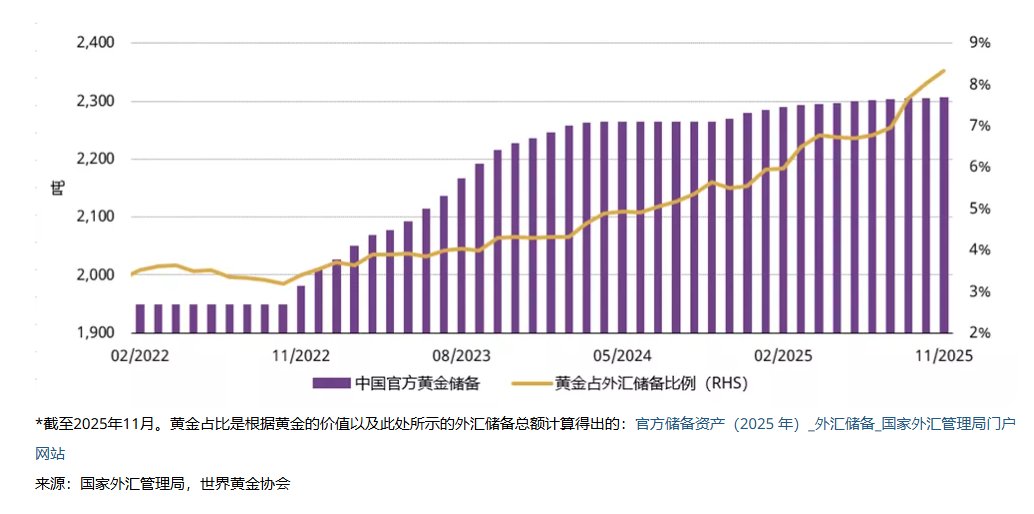
The People's Bank of China announced the purchase of about 0.9 tons of gold in November (Figure 5), driving total reserves to 2,305 tons. Since the beginning of the year, the Central Bank of China has reported an increase of 26 tons of gold holdings, raising the share of gold in its total foreign exchange reserves from 5.5% in December last year to 8.3% in November this year - mainly driven by continued gold purchases and rising gold prices.
Figure 5: The People's Bank of China reports purchases for 13 consecutive months
The official gold reserves of the People's Bank of China and their share in total foreign exchange reserves*
Gold imports fell in October
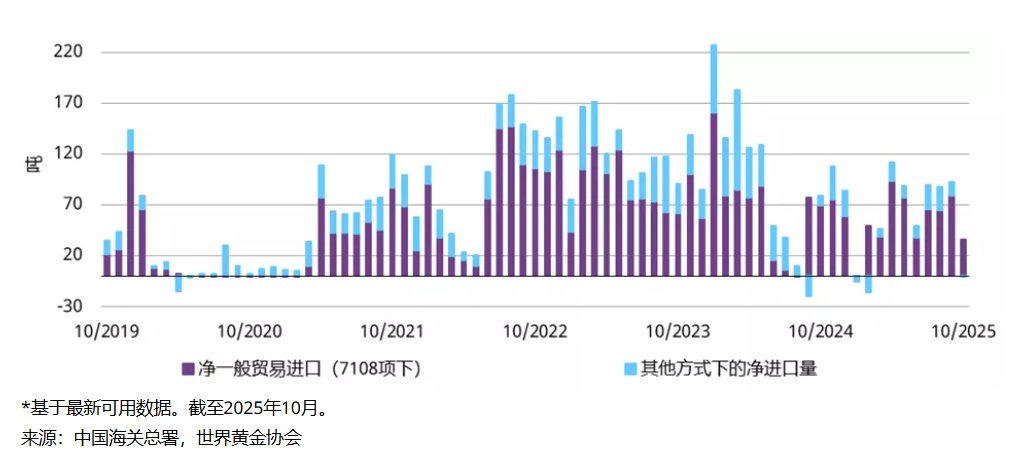
In October, China's net gold imports were about 36 tons (Figure 6), a month-on-month decrease of 57 tons, and a year-on-year decrease of 43 tons. The combined eight-day holiday of National Day and Mid-Autumn Festival in 2025 led to fewer working days and was a key factor in curbing gold imports. Furthermore, the Shanghai-London gold price spread was negative for half of November, further weakening the enthusiasm of importers. The overall weakness in the jewellery sector since this year has also caused gold imports to fall below the same period in previous years.
Figure 6: Gold imports fell sharply in October
Net import volume of 7108 gold under different trade modes*