
 Nasdaq
 華爾街日報
華爾街日報BOJ rate hike boots have landed! The benchmark interest rate reached its highest since 1995, and the market began to bet on “raising interest rates every six months”
The Zhitong Finance App learned that the Bank of Japan announced an interest rate hike as expected by the market, raising the benchmark interest rate to the highest level in 30 years in one fell swoop, and indicated that if conditions permit, it will raise interest rates further in the future. This latest development shows that the Bank of Japan is increasingly convinced that it can achieve the long-term stable inflation and stable wage growth targets it has been pursuing for more than 10 years. The Bank of Japan raised borrowing costs to the highest level since 1995, and the monetary policy statement revealed that the interest rate hike path is not over, causing financial markets to bet that the Bank of Japan will raise interest rates at a semi-annual pace until it reaches around 1.5%.
According to the Bank of Japan's statement on Friday, the Bank of Japan's Monetary Policy Committee, led by Bank of Japan Governor Kazuo Ueda, made a unanimous decision (passed at 9:0) to raise interest rates by 25 basis points to 0.75%, which is completely in line with Wall Street economists' general expectations. The Bank of Japan said that the possibility that its economic outlook will be realized is rising significantly.
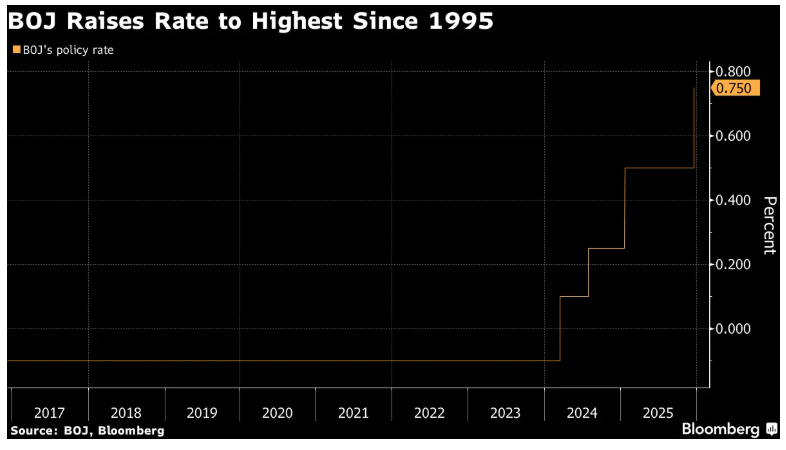
Notably, the Bank of Japan clearly stated in its latest monetary policy statement that the interest rate hike cycle will continue, saying that if its economic outlook continues to be realized, the central bank plans to continue to raise borrowing costs. The Bank of Japan also said that potential inflation is continuing to rise moderately in a benign manner.
Shortly after the announcement was issued, the exchange rate of the yen weakened. Generally speaking, interest rate hikes will promote an upward trend in the exchange rate of the country's sovereign currency. Instead, the yen continues to depreciate mainly because of this interest rate hike, which has been fully priced by the market, and the Bank of Japan's statement showed a neutral stance, and did not release a hawkish tone that surprised the market like on the eve of the collapse of the Japanese stock market in August last year.
After Japan announced the decision to raise interest rates, Kei Fujimoto, a senior economist from Sumitomo Mitsui Trust, said that the Bank of Japan's attitude towards interest rate hikes reflects that inflation is taking root, and factors such as import prices, raw material costs, and labor costs are increasing inflation.
Harumi Taguchi, chief economist from S&P Global Market Intelligence, said, “I think this rate hike is long overdue. Judging from the statement, the Bank of Japan's position remains unchanged, that is, if the economic and price conditions develop as expected, it will continue to raise interest rates. This means that interest rates are likely to rise further in the future.”
“My opinion is largely in line with what the market generally thinks. I think the Bank of Japan may continue to raise interest rates about every six months,” Kazuo Moma, a former member of the Bank of Japan's monetary policy committee, said shortly after the announcement of the resolution. “Perhaps interest rates will be raised twice in 2026 and again in 2027, reaching a neutral interest rate level of 1.5%.”
Has the long-lost “era of healthy inflation and wage growth” finally arrived?
This policy change highlights the determination of the Bank of Japan, led by Kazuo Ueda, to continue to raise interest rates at a time when inflation is gradually embedded in the Japanese economy. This also marks a major shift: after Japan's housing bubble burst in the 1990s, Japan experienced decades of price weakness. Currently, Japan is expected to return to a healthy economic growth trajectory of “long-term and moderate upward inflation - wages”. The era of healthy growth that the Japanese people have lost for a long time seems to have arrived.
According to an economic data released earlier on Friday, one of Japan's key consumer price indicators rose 3% in November, extending the cumulative achievement month for inflation to reach or exceed the 2% inflation target anchored by the Bank of Japan to a full 44 months.
Although Japanese Prime Minister Takaichi Sanae, who advocates long-term monetary easing, became prime minister in October, raised doubts about the room for Ueda Kazuo to continue to normalize monetary policy, continued inflationary pressure and the political costs brought about by the weakening yen prompted the Japanese government led by Takaichi not to stop this move.
The Bank of Japan, led by Kazuo Ueda, raised borrowing costs for the first time since January. Earlier economic data showed that the tariff policy led by US President Donald Trump did not have a major impact on the Japanese economy. Furthermore, the wage growth targets set by various trade unions in Japan before annual wage negotiations are similar to last year's strong increase, which can be said to have further strengthened the Bank of Japan's determination to adhere to the interest rate hike policy; last year's wage negotiations brought historic wage increases, which is enough to show that the momentum for wage growth is still intact, and this year is expected to continue this healthy economic trend of steady “inflation-wage” growth.
Market focus shifts to the pace of interest rate hikes
The financial market's current focus on the Bank of Japan's monetary policy and the Japanese yen arbitrage transaction (the so-called “yen carry trade”) is now completely shifting to a specific point in time on the future trajectory of Japan's interest rate hikes. Most Bank of Japan observers expect that the pace of the Bank of Japan's interest rate hike will be “a process of raising interest rates every six months.” Current interest rate futures market pricing shows that the Bank of Japan may announce another rate hike as early as next June.
This latest rate hike also highlights the Bank of Japan's “different” position among global central banks — it is the only important central bank in the world to announce interest rate hikes this year. Last week, the Federal Reserve announced its decision to cut interest rates for the third time this year. Even after the interest rate hike was announced on Friday, interest rates in Japan are still far below the current level of inflation in Japan, while US borrowing costs are significantly higher than the growth rate of domestic prices. These changes suggest that the benchmark interest rates between the two countries seem to be converging.
Since this year, the yield spread between Japan and the US 10-year treasury bonds has been reduced by 125 basis points. The narrowing of interest spreads has not reversed the trend of the yen in the global foreign exchange market, and the general weakening of the yen continues. Currently, the yen exchange rate (USD/JPY) continues to hover around 156 points, which is significantly weaker than its 20-year average of 111.61, and the depreciation trend continues.
This was the first time during Kazuo Ueda's tenure that a decision to raise interest rates was unanimously passed; in the previous two monetary policy meetings, two members of the nine Bank of Japan policy committee members had voted against keeping interest rates unchanged. Despite this, two members opposed the Bank of Japan Committee's statement on “price prospects” in the interest rate hike resolution.
At a press conference that usually starts at 3:30 p.m. local time, Ueda will further explain his monetary policy decision on Friday and may reveal important clues about the Bank of Japan's future interest rate path.
Taro Kimura, a senior economist from Bloomberg Intelligence, said: “We expect him to insist on careful messaging and avoid hinting at the timing of future interest rate hikes. This strategic ambiguity will help prevent the yen from fluctuating again—the experience after the Bank of Japan raised interest rates in July 2024 reinforces this lesson.” “Furthermore, the policy statement says interest rates are 'at an extremely low level', even though interest rates are approaching the Bank of Japan's 1% lower neutral rate forecast. This shows that the Bank of Japan now believes that neutral interest rates should be higher, leaving room for it to further tighten its monetary policy.”
Megumi Fujikawa, a senior analyst at the international rating agency Morningstar, said that as trade uncertainty abates and inflation continues, the stage seems set for the Bank of Japan to restart interest rate hikes. “Another important influencing factor in determining when the Bank of Japan will raise interest rates is the trend of wage growth, and accurate signs in this regard may not appear until March next year. Bank of Japan Governor Kazuo Ueda said that he is closely watching the early signs of the company's salary plan for next year.”
A member of the Bank of Japan's policy committee once said that the neutral interest rate could be between 1.0% and 2.5%. People familiar with the Bank of Japan committee members' thoughts have said that this level is difficult to measure, and policy makers may not be able to narrow down the scope in the short term. Even among observers who follow the Bank of Japan, opinions on neutral interest rates are very divided.