
 Nasdaq
 華爾街日報
華爾街日報The White House's 20 billion order supports Fujikura Cable's expansion, and the CEO bluntly stated that “it simply cannot satisfy all customers”
The Zhitong Finance App notes that Japanese cable manufacturer Fujikura's stock has soared by about 1,400% in the past two years because the world's newly built data centers have created huge demand for its cables that are difficult to meet. There's only one problem right now — the company's production capacity can't keep up with demand.
The company's CEO Naoki Okada said in an interview this week that since further capital expenditure will be “necessary” to keep up with demand related to artificial intelligence, the company is negotiating a new round of investment. He said the new investment plan may be announced in the medium-term plan to be released in May.
The shortage of fiber-optic cable supplies highlights the potential risks faced by investors in AI-related companies, particularly for Fujikura, which recorded one of the strongest gains in the world's large-cap technology stocks over the past two years.
On Thursday, Fujikura's stock price in the Tokyo market fell 3.4% to 15,960 yen due to news that Blue Owl Capital would not invest in Oracle's data centers, raising market concerns about the future of AI.
“Fujikura remains our most promising Japanese cable manufacturer because it is involved in the capital expenditure of hyperscale cloud computing giants and highly profitable telecom products. Despite the overheating of stock prices in the third quarter, we have reduced some of our positions,” said Richard Aston, portfolio manager at Chikara Investments LLP.
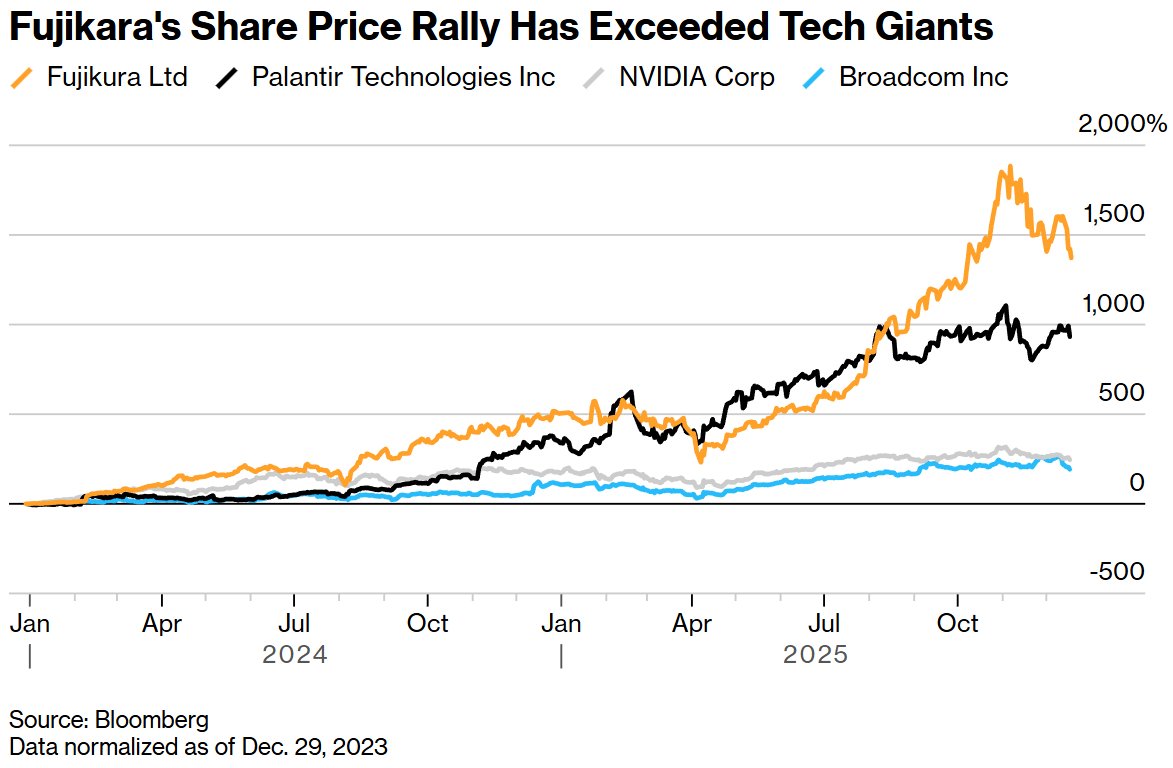
Fujikura's stock price rose more than Nvidia and other tech giants
He manages the CC Japan Income & Growth Trust Fund, and as of the end of November, Fujikura was one of its top ten holdings. Aston stated, “Supply capacity is a potential risk identified by the company, but in the current market conditions where demand expectations continue to be strong, their pricing power will help them manage production plans.”
Fujikura was founded in 1885. This push for new investment comes as the company strives to meet the needs of the US market. In October of this year, the White House selected Fujikura to provide up to $20 billion worth of fiber-optic cables for its AI infrastructure. Prior to any negotiations on US investment, Fujikura has announced plans to spend 45 billion yen (about $289 million) to build a new plant.
“It's clear that if we build these generative AI infrastructures, our current production capacity won't meet demand,” said Naoki Okada. He added that the company doesn't know the exact timeline for the investment, but even if spread over 10 years, this is a huge amount.
The CEO said that as further investment plans are discussed, Fujikura has locked in fiber supplies from several global companies and aims to increase the productivity of existing plants to fill the manufacturing gap before new production capacity is launched. The 61-year-old executive personally glued fiber bundles together at his desk nearly 20 years ago, helping develop Fujikura's “spider web ribbon fiber” for data centers today.
Okada said the company now collaborates with almost all hyperscale cloud computing giants. “I never imagined it would reach this point,” he said, adding that as demand for AI-driven data centers grew rapidly, the company “simply couldn't meet the needs of all customers.”
According to the data, Fujikura's customers include Apple and Toyota.
Morgan Stanley Mitsubishi UFJ Securities analyst Yu Shirakawa said in a December report that Fujikura is still expected to maintain strong growth by optimizing its product portfolio and connector sales. The agency raised Fujikura's target price from 14,000 yen to 21,500 yen at the time.
Last month, Fujikura raised its full-year revenue forecast to 179 billion yen, up 26% from the previous forecast. With around 75% of its sales coming from overseas, a weak yen could bring further upside to its earnings.