Nasdaq
 華爾街日報
華爾街日報Silicon Industry Branch: Polysilicon market transactions are light this week, new order prices are rising
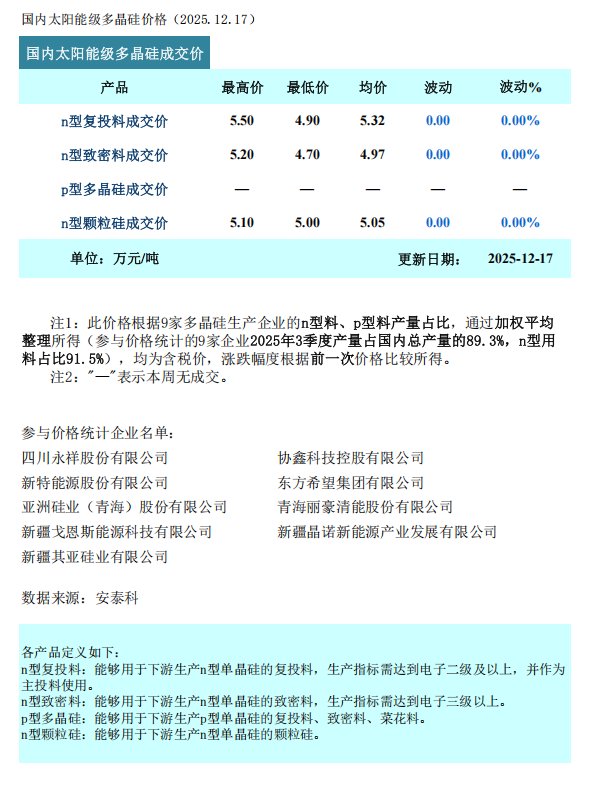
The Zhitong Finance App learned that on December 17, the Silicon Industry Branch released the Polysilicon Weekly Review. According to Antec statistics, the transaction price range for polysilicon n-type composite materials this week was 49,000 to 55,000 yuan/ton, and the average transaction price was 53,200 yuan/ton, which was flat from month to month. The transaction price range for n-type granular silicon was 50,000-51,000 yuan/ton, and the average transaction price was 50,500 yuan/ton, which remained flat from month to month. The Silicon Industry Branch said that this week, the domestic polysilicon market showed a situation of “light transactions and rising prices.” Market transactions were extremely light this week. The number of mainstream signing companies declined further, and new orders almost stopped, yet most polysilicon companies raised the price of new orders to about 65,000 yuan/ton or more.
The core driving force behind the increase in silicon prices is that the industry generally expects terminal demand to improve at the end of the first quarter of 2026, and January-February is a key transition period, so it is essential to maintain the stability of the price system and inventory in the industrial chain. The price increase at this time mainly sends a signal of firm price stability to the market, providing bottom support for the price stabilization of downstream silicon wafers and batteries.
The overall supply side remains stable: Currently, there are 11 polysilicon production companies. According to each company's production schedule, polysilicon production is expected to remain within 120,000 tons in December. Although the inspection and restoration of production by individual companies brought about a slight increase, factors such as production cuts during the dry water period in the southwest region and the fact that the overall operating rate of the industry remained low limited the increase in supply. Domestic polysilicon production is expected to be around 1.33 million tons in 2025, with the top five companies accounting for about 78% of production. Demand side continues to weaken: Downstream silicon wafers, cells and components have increased production cuts in response to problems such as high inventories and slow startup of terminal projects. The annual production of silicon wafers is estimated to be about 640 GW, corresponding to the demand for silicon materials of about 1.26 million tons. The current pattern of weak supply and demand will allow polysilicon social inventories to continue to accumulate in December, adding about 70,000 tons of silicon (including imports and exports) throughout the year.
Judging comprehensively, the fundamentals of high inventory and weak demand in the current market have not changed, but a stronger consensus on price stability is dominating the current market sentiment. It is expected that in the short term, with no improvement in downstream demand and prices, the actual volume of the polysilicon market will still be limited. However, the attitude of mainstream companies maintaining strong prices is very clear, and the price increase conveys their determination for a stable transition in the industrial chain. If the industrial chain can maintain a smooth transition in inventory and prices in January-February, and when terminal demand picks up, the market is expected to gradually break out of the trough.