
 Nasdaq
 華爾街日報
華爾街日報The “lockdown order” hits the fuel market! Trump ordered containment of Venezuelan oil tankers; crude oil prices rebounded from their lowest level in four years
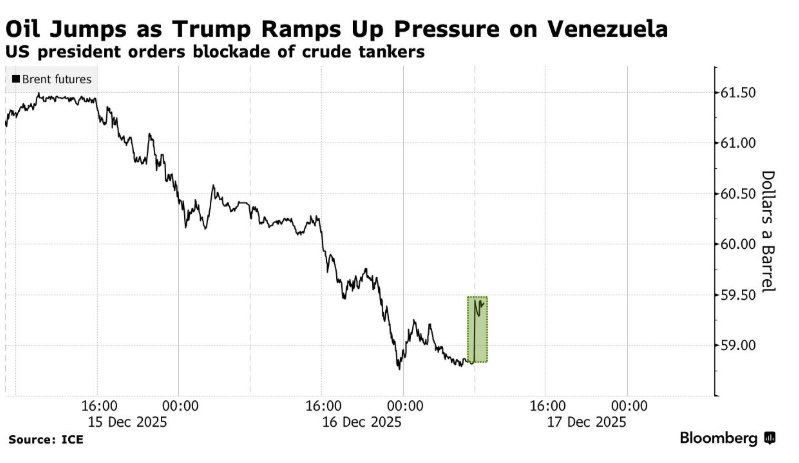
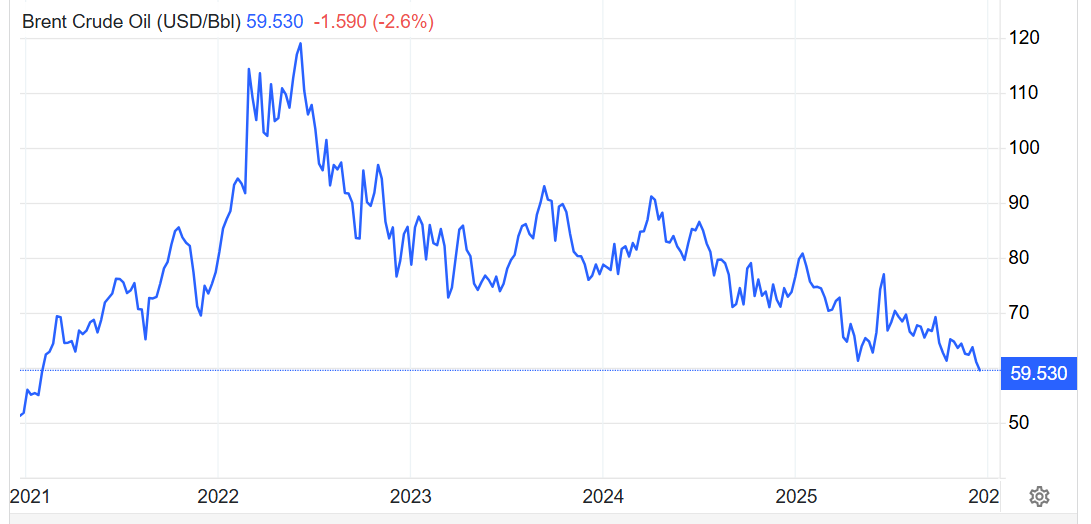
The Zhitong Finance App learned that after US President Trump ordered the blockade of sanctioned oil tankers off the coast of South American countries and increased military and economic pressure on Venezuela, the international crude oil pricing benchmark, the Brent crude oil futures price quickly rebounded from the lowest price level since 2021, but the rebound was relatively limited, hovering only around 1%.
The price of Brent crude oil has recently fallen to its lowest level in four years as traders' concerns about the expanding global crude oil oversupply sweep through the commodity trading market. As oil futures rebounded, the price of West Texas Intermediate crude oil (WTI crude oil futures) also rebounded. After a cumulative drop of nearly 6% in the previous four trading days, it quickly rebounded about 1.5% to close to $56 per barrel. Trump said in a social media post on Tuesday local time that he is ordering a complete blockade of crude oil carriers frequently entering and leaving Venezuela.
The move is a major escalation in recent military hostilities between the two countries, and comes after the US military seized an oil tanker off the coast of Venezuela last week. Trump also said he has designated the regime of Venezuela's supreme leader, President Nicolas Maduro, as a foreign terrorist organization.
“The Venezuelan Maduro regime has been identified as a foreign terrorist organization for stealing US assets and for many other reasons including terrorism, drug smuggling, and human trafficking,” Trump wrote on his social networking platform Truth Social. “As a result, I now order a complete and complete blockade of all sanctioned tankers entering and leaving Venezuela.”
Statistics show that Venezuela's own crude oil production has continued to rise since it hit a historically low region in 2020, but it is still far below the strong level of a few decades ago. Last month, some Venezuelan tankers loaded nearly 590,000 barrels of crude oil per day for export, while global crude oil consumption exceeded 100 million barrels per day. Most of the country's crude oil flows to China and India.
Energy consulting agency Rapidan Energy Group said that if the US continues to implement sanctions and blockades, about 30% of Venezuela's crude oil shipments will be at risk. The country's new oil reserves in oil tankers across Asia are expected to cushion any immediate impact on exports from China and other major Asian buyers, but any long-term export disruptions may force large refiners in Asia to seek more expensive alternatives from the Middle East and North America.
Warren Patterson, head of commodity strategy at ING Groep NV in the Singapore market, said: “The crude oil trading market has recently been generally exposed to supply-side risks, given the anticipated size of the oil oversupply expected to 2026.” “Currently, the price of Brent crude oil has rebounded, but the increase is hovering around 1%. Obviously, the market is not too worried.”
Brent crude oil futures prices and WTI crude oil futures prices are still expected to record significant annual declines as oversupply expectations continue to ferment. Oversupply is being driven by the rapid restoration of idle production capacity by the OPEC+ organization led by Saudi Arabia and Russia, as well as continued increases in production by other crude oil producers (especially the US and Canada), as well as weak global oil demand since this year. From the Middle East to the US, signs of weakening markets are showing; investors are preparing for the latest predictions from the International Energy Agency (IEA), which could become the biggest surplus since the pandemic.
Wall Street is generally pessimistic about the outlook for global crude oil demand in 2026, and it is expected that there will be a significant continuous oversupply of crude oil throughout the year. According to the average forecast of the five major Wall Street commercial banks, including Goldman Sachs, the global oil market will face an excess of about 2.2 million b/d next year, as actual global production will far exceed demand growth in 2026. Goldman Sachs (Goldman Sachs) expects the average price of Brent crude oil futures in 2026 to be around 56 US dollars/barrel, and WTI crude oil futures about 52 US dollars/barrel, which is significantly lower than the current trading price level.
Analysts at J.P. Morgan Chase recently said in a report that the average price of Brent crude oil is expected to be between $57 and $58 per barrel in 2026 and 2027, and unless OPEC+ OPEC starts implementing large-scale production cuts, oil prices may drop to around $30 per barrel. They expect that starting in June 2026, the global oil market will need to cut production by about 2 million barrels per day.
The surpluses predicted by these Wall Street financial giants are lower than the latest estimates of the International Energy Agency (IEA), an energy advisory body for the world's major economies. The IEA expects a record surplus of nearly 4 million b/d, but the IEA also believes that oil producer countries' adjustments may curb the scale of the excess.
Commodity traders are also actively weighing the probability that Ukraine and Russia may reach a peace agreement under the mediation of the US government. This may pave the way for drastic loosening of restrictions on Russian crude oil exports. At that time, market expectations of oversupply may further heat up, which may lead to another sharp drop in international crude oil prices.
In terms of the latest crude oil futures trading price, at 10:00 a.m. Singapore time, the price of WTI crude oil futures for January delivery rose 1% to $55.80 per barrel; the price of Brent crude oil futures for February delivery rose 0.8% to $59.42 per barrel.