
 Nasdaq
 華爾街日報
華爾街日報Does Nisshin Seifun Group (TSE:2002) Have A Healthy Balance Sheet?
David Iben put it well when he said, 'Volatility is not a risk we care about. What we care about is avoiding the permanent loss of capital.' When we think about how risky a company is, we always like to look at its use of debt, since debt overload can lead to ruin. As with many other companies Nisshin Seifun Group Inc. (TSE:2002) makes use of debt. But the more important question is: how much risk is that debt creating?
Why Does Debt Bring Risk?
Debt assists a business until the business has trouble paying it off, either with new capital or with free cash flow. If things get really bad, the lenders can take control of the business. However, a more common (but still painful) scenario is that it has to raise new equity capital at a low price, thus permanently diluting shareholders. Having said that, the most common situation is where a company manages its debt reasonably well - and to its own advantage. The first step when considering a company's debt levels is to consider its cash and debt together.
What Is Nisshin Seifun Group's Net Debt?
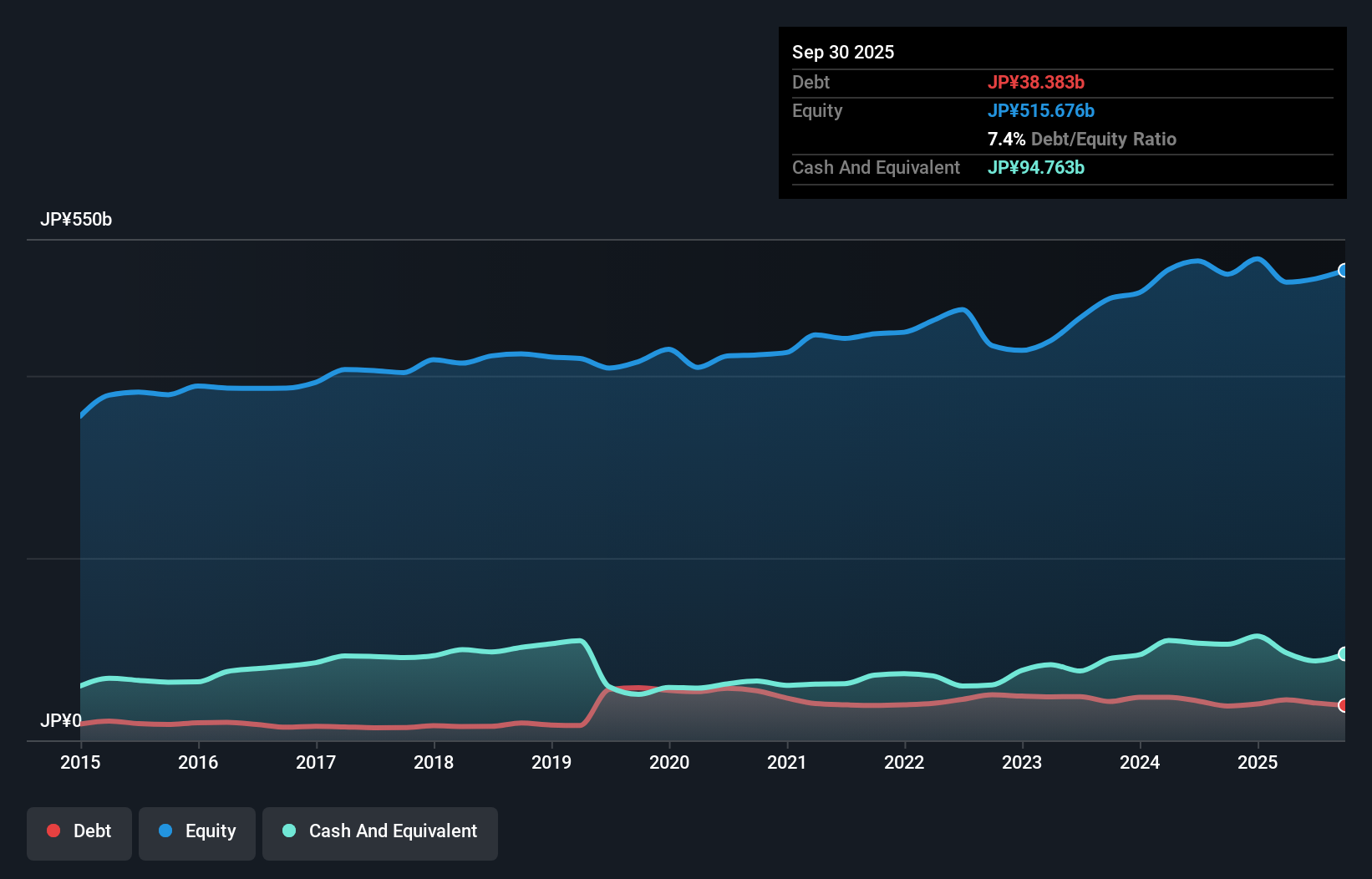
As you can see below, Nisshin Seifun Group had JP¥38.4b of debt, at September 2025, which is about the same as the year before. You can click the chart for greater detail. However, its balance sheet shows it holds JP¥94.8b in cash, so it actually has JP¥56.4b net cash.
A Look At Nisshin Seifun Group's Liabilities
The latest balance sheet data shows that Nisshin Seifun Group had liabilities of JP¥138.1b due within a year, and liabilities of JP¥144.5b falling due after that. Offsetting these obligations, it had cash of JP¥94.8b as well as receivables valued at JP¥109.3b due within 12 months. So its liabilities outweigh the sum of its cash and (near-term) receivables by JP¥78.6b.
Given Nisshin Seifun Group has a market capitalization of JP¥538.8b, it's hard to believe these liabilities pose much threat. Having said that, it's clear that we should continue to monitor its balance sheet, lest it change for the worse. Despite its noteworthy liabilities, Nisshin Seifun Group boasts net cash, so it's fair to say it does not have a heavy debt load!
View our latest analysis for Nisshin Seifun Group
But the bad news is that Nisshin Seifun Group has seen its EBIT plunge 11% in the last twelve months. We think hat kind of performance, if repeated frequently, could well lead to difficulties for the stock. There's no doubt that we learn most about debt from the balance sheet. But ultimately the future profitability of the business will decide if Nisshin Seifun Group can strengthen its balance sheet over time. So if you want to see what the professionals think, you might find this free report on analyst profit forecasts to be interesting.
Finally, a business needs free cash flow to pay off debt; accounting profits just don't cut it. Nisshin Seifun Group may have net cash on the balance sheet, but it is still interesting to look at how well the business converts its earnings before interest and tax (EBIT) to free cash flow, because that will influence both its need for, and its capacity to manage debt. Over the most recent three years, Nisshin Seifun Group recorded free cash flow worth 63% of its EBIT, which is around normal, given free cash flow excludes interest and tax. This cold hard cash means it can reduce its debt when it wants to.
Summing Up
Although Nisshin Seifun Group's balance sheet isn't particularly strong, due to the total liabilities, it is clearly positive to see that it has net cash of JP¥56.4b. So we are not troubled with Nisshin Seifun Group's debt use. The balance sheet is clearly the area to focus on when you are analysing debt. But ultimately, every company can contain risks that exist outside of the balance sheet. For example, we've discovered 1 warning sign for Nisshin Seifun Group that you should be aware of before investing here.
If, after all that, you're more interested in a fast growing company with a rock-solid balance sheet, then check out our list of net cash growth stocks without delay.
Have feedback on this article? Concerned about the content? Get in touch with us directly. Alternatively, email editorial-team (at) simplywallst.com.
This article by Simply Wall St is general in nature. We provide commentary based on historical data and analyst forecasts only using an unbiased methodology and our articles are not intended to be financial advice. It does not constitute a recommendation to buy or sell any stock, and does not take account of your objectives, or your financial situation. We aim to bring you long-term focused analysis driven by fundamental data. Note that our analysis may not factor in the latest price-sensitive company announcements or qualitative material. Simply Wall St has no position in any stocks mentioned.