
 Nasdaq
 華爾街日報
華爾街日報Oracle (ORCL.US) and Broadcom (AVGO.US) financial reports: The higher the market expectations, the harsher the market crashed
A fervent feast fueled by artificial intelligence (AI) faced a cruel “reality test” on Friday. When bad news broke from chip giant Broadcom (AVGO.US) and cloud service provider Oracle (ORCL.US), the market's overhyped expectations were instantly crushed.
On Friday, December 12, a wave of sell-offs swept AI-related stocks. Broadcom's stock price once fell sharply by 12%, dragging down both the S&P 500 index and the Nasdaq Composite Index by more than 1%, completely reversing the record highs set earlier this week due to expectations of interest rate cuts. Oracle, on the other hand, continued to drop by more than 4%.
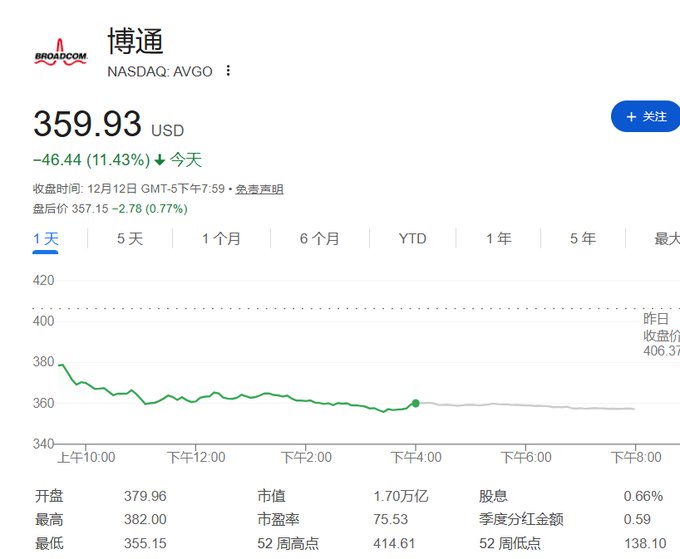
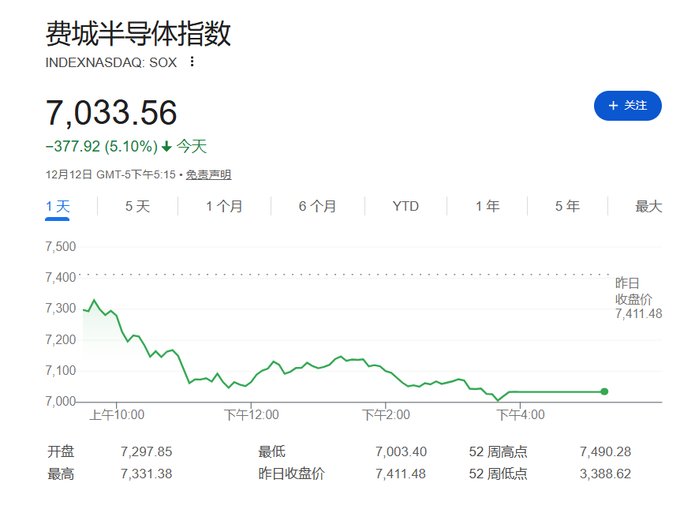
Meanwhile, the decline of Broadcom and Oracle quickly spread to the entire AI supply chain. The Philadelphia Semiconductor Index plummeted 5% and is on its way to the worst single-day performance in about two months. At the same time, it also hit the stock prices of a range of companies from Nvidia to cloud service provider CoreWeave.
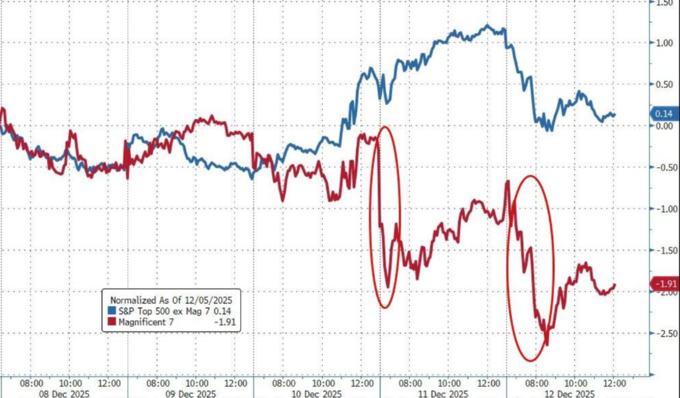
Panic spread rapidly in the market, and the performance of Mag7, the seven largest US stocks, was far inferior to the other 493 companies in the S&P 500 index. More importantly, the shock was not limited to the stock market; bond traders are also taking action to reduce their risk exposure to the industry. According to MarketAxess data, the yield premium required for investors to hold Oracle bonds jumped sharply.
The sell-off was sparked by two heavy punches. First, chip designer Broadcom announced earnings after the market on Thursday. Although sales reached a record high, its revenue forecast for the AI business failed to meet Wall Street's extremely high expectations.
Second, just after Oracle announced financial reports that fell short of expectations, it was part of the data center built by ChatGPT owner OpenAI, and it was revealed that the completion date may be postponed from 2027 to 2028. This directly raised questions from the market about the speed of AI infrastructure construction.
This series of chain reactions highlights the critical importance of AI narratives to the current market. It is enough to drag down the overall market and ask investors a core question: How much patience does the market have for promised AI returns?
Expectations fell short, and Broadcom's earnings report triggered a chain reaction
Friday's market dynamics provided investors with an excellent example of what happens when reality collides with high expectations. Broadcom reported record sales of $18 billion and strong profit growth on Thursday evening. The market reaction, however, deteriorated rapidly.
According to the Wall Street Journal analysis, investors focused their attention on several key issues: the profit margin of its custom AI chips, the timing of fulfilling promises from giants such as OpenAI, and the company's visibility into the business beyond 2027.
When the answers to these questions failed to satisfy the market, its stock price fell 11% in response, becoming one of the worst performing constituent stocks in the S&P 500 index, and quickly spread the chill to other AI concept companies.

Oracle made matters worse, with unanticipated earnings reports and rumours of data center delays shook confidence
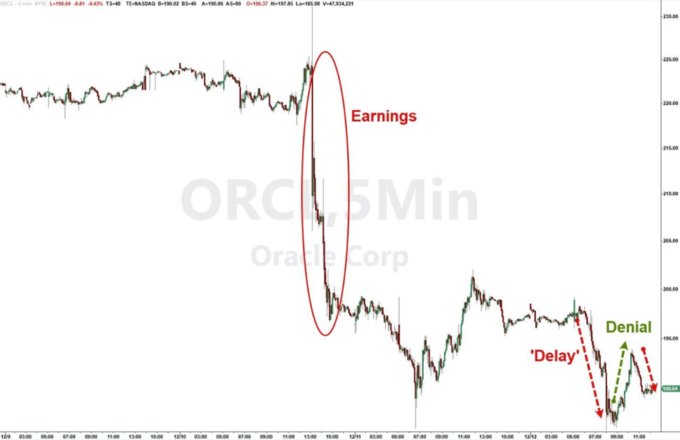
Prior to Broadcom's news, Oracle had already made the market uneasy. The database software giant's previously released earnings report showed that its revenue fell short of analysts' expectations, while capital expenditure exceeded expectations.
Subsequently, Bloomberg's report about possible delays in the data center it built for OpenAI became the last straw to crush the camel. Although an Oracle spokesperson came forward to deny that “all sites meeting contractual commitments have not been delayed and all milestones are on schedule,” this failed to stop investors from selling off.
Oracle's stock price fell 4.5% last Friday, with a cumulative decline of 13% for the week. Rishi Jaluria, an analyst at RBC Capital Markets, notes: “People are now looking at Oracle as a weather vane and thinking 'What does this mean for chips or electricity? ' This has significant downstream effects. ”
The wave of sell-offs is spreading, and no one from the chip to the bond market is spared
The impact of this sell-off extends far beyond Broadcom and Oracle. As the biggest beneficiary of the AI boom, the stock price of Nvidia, the world's highest company by market capitalization, fell 3.2%. Other chip-related companies such as Astera Labs and Coherent all declined by more than 10%. AI computing service provider Coreweave also fell 10%.
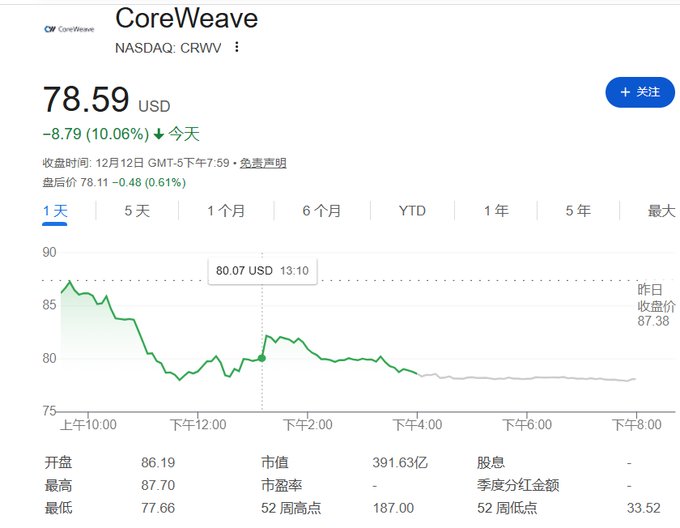
The sell-off has even spread beyond the technology industry, and power-related stocks, such as Constellation Energy Corp. and Vistra Corp., have also declined.
More importantly, the bond market also felt the chill. The volume of bond transactions issued by so-called “AI hyperscalers” (AI hyperscalers) such as Oracle, Microsoft, and Meta has increased abnormally. According to MarketAxess data, the yield premium required by investors to hold 5.95% of Oracle bonds due in 2055 jumped about 0.2 percentage points from US Treasury bonds to 2.07 percentage points.
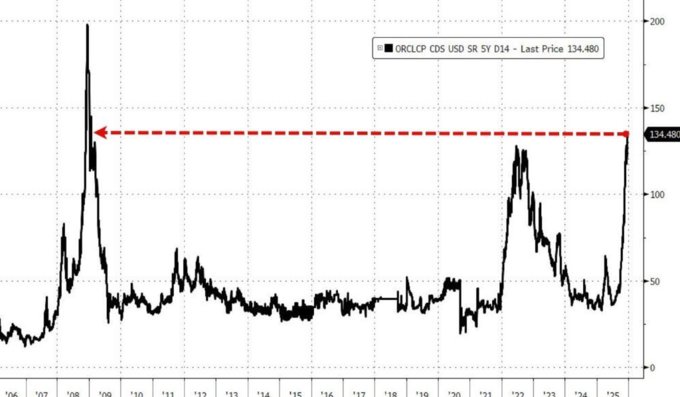
Market differences under the “AI reality test”
The AI field's “reality test” is in stark contrast to the optimism ignited by the Federal Reserve's dovish signals earlier this week. Previously, the bet that lower interest rates would revive the economy encouraged investors to pour into cyclical stocks such as banking, industry, and materials.
According to some analysts, this rapid reversal just proves the central position of AI trading in the market. Steve Wyett, chief investment strategist at BOK Financial, said, “The market will face a big question: how much patience do we have to wait for these companies to transition from a period of enthusiasm for AI construction to a period where we begin to expect returns?”
However, there are investors who have the opposite view. Robert Edwards, chief investment officer of Edwards Asset Management, believes that the current general anxiety caused by high AI valuations and huge expenses is actually a healthy sign of caution, suggesting that the market still has room to rise.
He pointed out that this “wall of concern” is an inverse indicator. As long as there are concerns in the market and a large amount of capital (such as 7.7 trillion US dollars in money market funds) is waiting outside the market, the stock market is likely to continue to rise.
This article is reprinted from the “Wall Street News” app, author: Long Yue, Zhitong Finance editor: Song Zhiyi.