
 Nasdaq
 華爾街日報
華爾街日報Investors Still Waiting For A Pull Back In Aviva plc (LON:AV.)
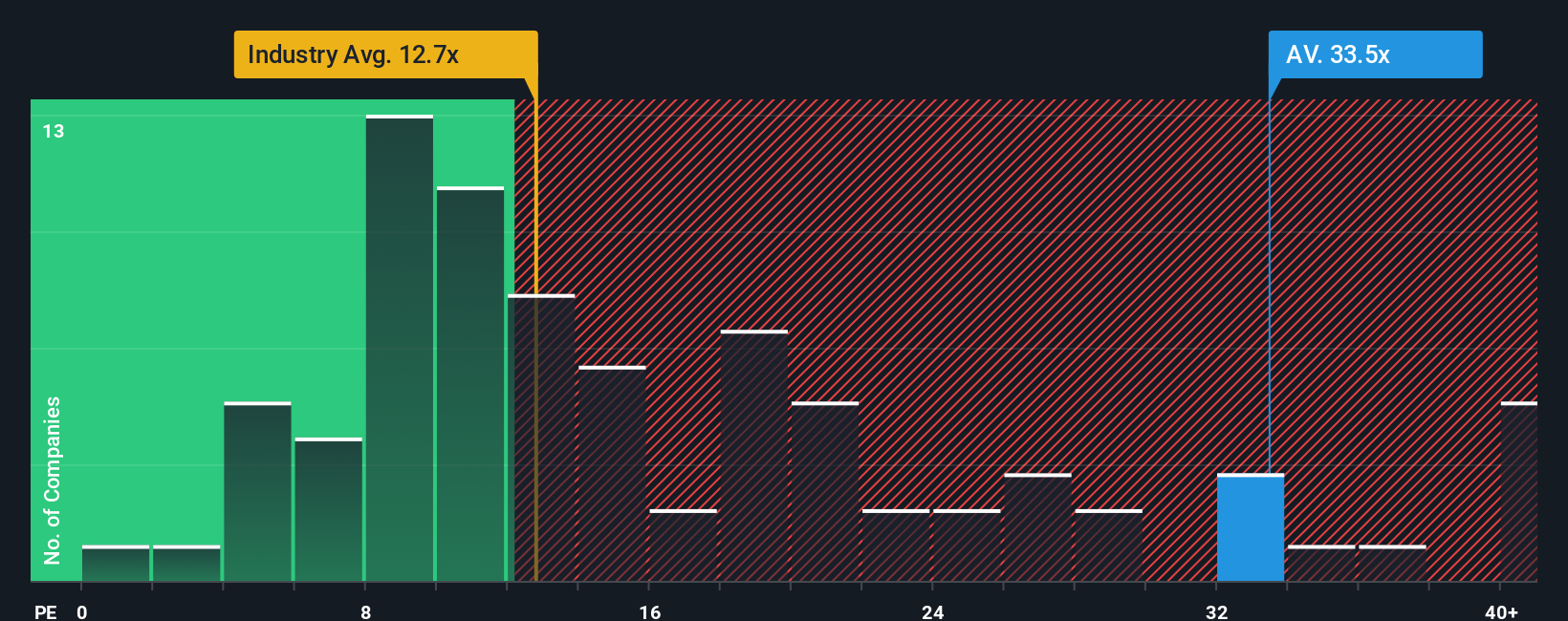
When close to half the companies in the United Kingdom have price-to-earnings ratios (or "P/E's") below 15x, you may consider Aviva plc (LON:AV.) as a stock to avoid entirely with its 33.5x P/E ratio. Although, it's not wise to just take the P/E at face value as there may be an explanation why it's so lofty.
While the market has experienced earnings growth lately, Aviva's earnings have gone into reverse gear, which is not great. It might be that many expect the dour earnings performance to recover substantially, which has kept the P/E from collapsing. You'd really hope so, otherwise you're paying a pretty hefty price for no particular reason.
View our latest analysis for Aviva
How Is Aviva's Growth Trending?
In order to justify its P/E ratio, Aviva would need to produce outstanding growth well in excess of the market.
Taking a look back first, the company's earnings per share growth last year wasn't something to get excited about as it posted a disappointing decline of 52%. At least EPS has managed not to go completely backwards from three years ago in aggregate, thanks to the earlier period of growth. So it appears to us that the company has had a mixed result in terms of growing earnings over that time.
Looking ahead now, EPS is anticipated to climb by 43% each year during the coming three years according to the seven analysts following the company. Meanwhile, the rest of the market is forecast to only expand by 16% each year, which is noticeably less attractive.
With this information, we can see why Aviva is trading at such a high P/E compared to the market. It seems most investors are expecting this strong future growth and are willing to pay more for the stock.
The Final Word
It's argued the price-to-earnings ratio is an inferior measure of value within certain industries, but it can be a powerful business sentiment indicator.
As we suspected, our examination of Aviva's analyst forecasts revealed that its superior earnings outlook is contributing to its high P/E. At this stage investors feel the potential for a deterioration in earnings isn't great enough to justify a lower P/E ratio. It's hard to see the share price falling strongly in the near future under these circumstances.
Having said that, be aware Aviva is showing 2 warning signs in our investment analysis, you should know about.
If P/E ratios interest you, you may wish to see this free collection of other companies with strong earnings growth and low P/E ratios.
Have feedback on this article? Concerned about the content? Get in touch with us directly. Alternatively, email editorial-team (at) simplywallst.com.
This article by Simply Wall St is general in nature. We provide commentary based on historical data and analyst forecasts only using an unbiased methodology and our articles are not intended to be financial advice. It does not constitute a recommendation to buy or sell any stock, and does not take account of your objectives, or your financial situation. We aim to bring you long-term focused analysis driven by fundamental data. Note that our analysis may not factor in the latest price-sensitive company announcements or qualitative material. Simply Wall St has no position in any stocks mentioned.