
 Nasdaq
 華爾街日報
華爾街日報The Fed's interest rate cut “added fuel” to the rise, and copper prices are approaching record highs
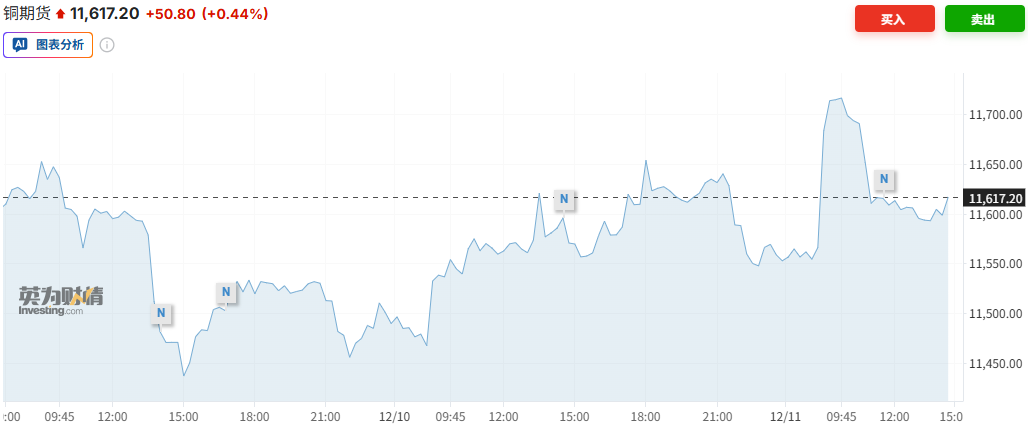
The Zhitong Finance App learned that after the Federal Reserve announced interest rate cuts and maintained expectations of cutting interest rates again next year, copper prices are approaching historic highs, and prices of other metals have risen accordingly. London metal futures rose 1.5% at one point, then regained more than half of the gains. The Federal Reserve previously cut interest rates for the third time in a row, but the wording changed slightly, suggesting that future interest rate cuts are more uncertain.
Meanwhile, senior Chinese officials said on Monday that the world's second-largest economy will continue to maintain a “moderately loose” monetary policy and take more active fiscal measures. China's trade data also provided support for copper prices. According to data, exports rebounded and exceeded expectations last month, driving China's annual trade surplus above 1 trillion US dollars for the first time.
In recent months, the price of this industrial metal has continued to rise, driven by loose monetary policies and tight supply. Copper prices have risen by more than 30% so far this year. In addition, a series of mine shutdowns and concerns about a shortage of copper supplies outside the US have also boosted copper prices, as traders are pouring into the US market to buy copper before tariffs may be imposed next year. Moreover, in the long run, the increase in demand in the renewable energy industry will support copper prices.
Analysts at CITIC Securities previously pointed out in a report that in 2026, there may be a gap of 450,000 tons in the global supply of refined copper, which is partly due to America's hoarding behavior. The CITIC analyst team stressed that next year, the average copper price will need to remain above 12,000 US dollars per ton in order to attract investment in new minerals and ensure adequate supply in the medium to long term.
According to ING's latest copper market report, in 2025, the global copper market is experiencing a “tight balance” game dominated by the supply side. The price bottom line has been raised above 11,000 US dollars per ton, but the key to continuing to break through upward still depends on Chinese demand. ING fixed the average price of copper at 11,500 US dollars/ton in 2026. The pace rose first and then declined: inventory spillover effects were strongest in the second quarter, and stocks were tight or pushed prices to a high of 12,000 US dollars; the tariff path in the second half of the year was clear. If exemptions were implemented and premiums returned, copper prices fell moderately.
Citigroup and J.P. Morgan also joined the bullish camp. Citigroup analysts pointed out in a report that according to their basic hypothetical scenario, copper inventories are being accumulated in the US, and there is a shortage in non-US regions. The average price of copper will reach 13,000 US dollars in the second quarter. Additionally, J.P. Morgan predicts that by the second quarter of 2026, the price of copper could reach $12,500 per ton, an average of around $12,075 for the whole year.
However, Goldman Sachs and others are more cautious, believing that the recent copper price break above $11,000 per ton may be short-lived, and that short-term price increases are mainly based on future expectations rather than current fundamentals. Goldman Sachs expects copper prices to fluctuate between $10,000 and $11,000/ton in 2026.
Macquarie Group analyst Peter Taylor also said that although copper prices are expected to remain “volatile” and may easily reach new highs, prices above $11,000 per ton are unsustainable because the global market is not tight at the physical level.