
 Nasdaq
 華爾街日報
華爾街日報China Medical System Holdings (HKG:867) Could Easily Take On More Debt
Howard Marks put it nicely when he said that, rather than worrying about share price volatility, 'The possibility of permanent loss is the risk I worry about... and every practical investor I know worries about.' So it seems the smart money knows that debt - which is usually involved in bankruptcies - is a very important factor, when you assess how risky a company is. As with many other companies China Medical System Holdings Limited (HKG:867) makes use of debt. But should shareholders be worried about its use of debt?
Why Does Debt Bring Risk?
Debt and other liabilities become risky for a business when it cannot easily fulfill those obligations, either with free cash flow or by raising capital at an attractive price. In the worst case scenario, a company can go bankrupt if it cannot pay its creditors. However, a more usual (but still expensive) situation is where a company must dilute shareholders at a cheap share price simply to get debt under control. Of course, the upside of debt is that it often represents cheap capital, especially when it replaces dilution in a company with the ability to reinvest at high rates of return. The first thing to do when considering how much debt a business uses is to look at its cash and debt together.
How Much Debt Does China Medical System Holdings Carry?
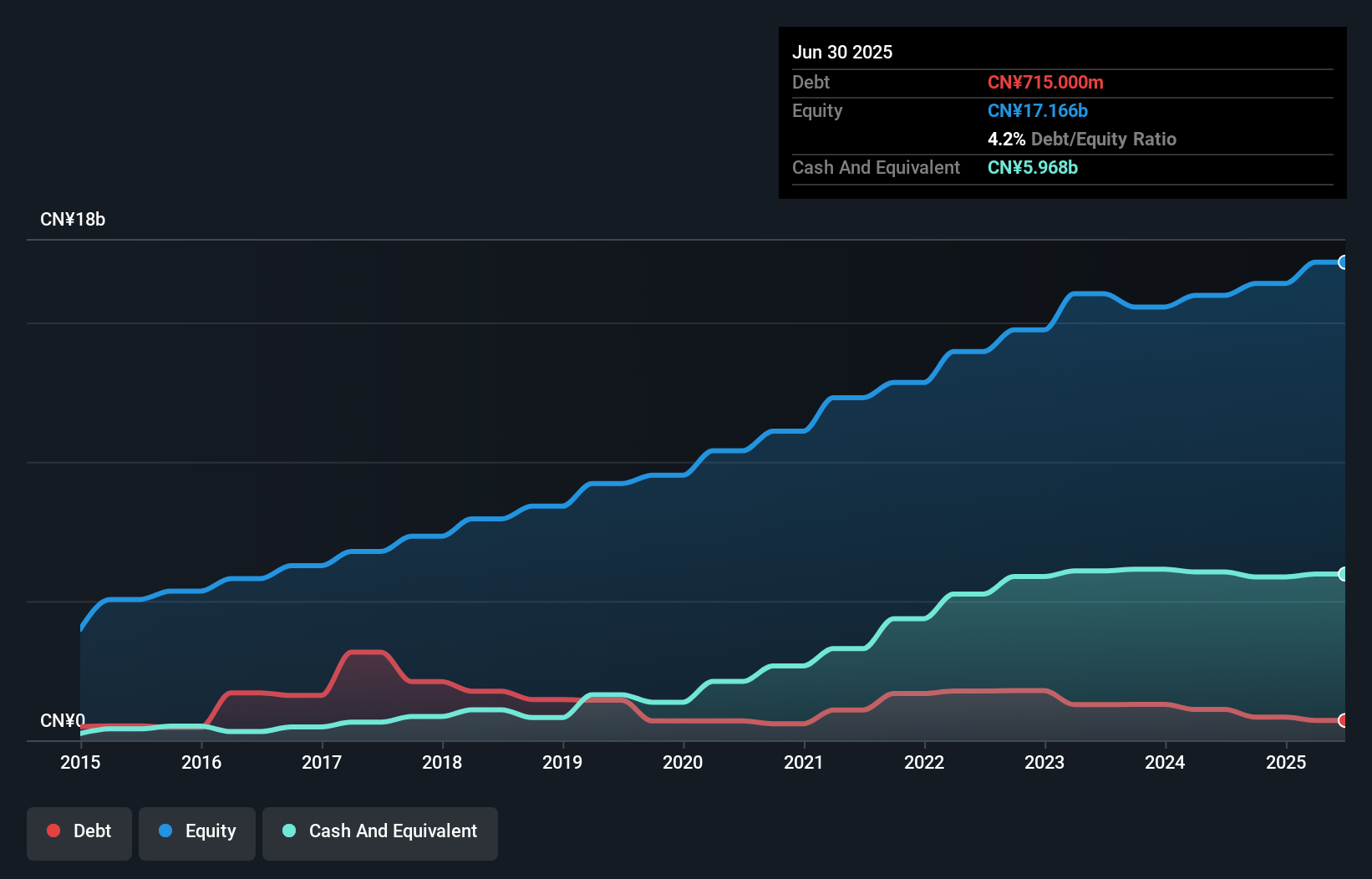
As you can see below, China Medical System Holdings had CN¥715.0m of debt at June 2025, down from CN¥1.11b a year prior. However, its balance sheet shows it holds CN¥5.97b in cash, so it actually has CN¥5.25b net cash.
A Look At China Medical System Holdings' Liabilities
The latest balance sheet data shows that China Medical System Holdings had liabilities of CN¥1.61b due within a year, and liabilities of CN¥163.1m falling due after that. Offsetting these obligations, it had cash of CN¥5.97b as well as receivables valued at CN¥2.27b due within 12 months. So it can boast CN¥6.47b more liquid assets than total liabilities.
It's good to see that China Medical System Holdings has plenty of liquidity on its balance sheet, suggesting conservative management of liabilities. Because it has plenty of assets, it is unlikely to have trouble with its lenders. Succinctly put, China Medical System Holdings boasts net cash, so it's fair to say it does not have a heavy debt load!
See our latest analysis for China Medical System Holdings
China Medical System Holdings's EBIT was pretty flat over the last year, but that shouldn't be an issue given the it doesn't have a lot of debt. The balance sheet is clearly the area to focus on when you are analysing debt. But ultimately the future profitability of the business will decide if China Medical System Holdings can strengthen its balance sheet over time. So if you're focused on the future you can check out this free report showing analyst profit forecasts.
But our final consideration is also important, because a company cannot pay debt with paper profits; it needs cold hard cash. China Medical System Holdings may have net cash on the balance sheet, but it is still interesting to look at how well the business converts its earnings before interest and tax (EBIT) to free cash flow, because that will influence both its need for, and its capacity to manage debt. During the last three years, China Medical System Holdings produced sturdy free cash flow equating to 72% of its EBIT, about what we'd expect. This free cash flow puts the company in a good position to pay down debt, when appropriate.
Summing Up
While we empathize with investors who find debt concerning, you should keep in mind that China Medical System Holdings has net cash of CN¥5.25b, as well as more liquid assets than liabilities. And it impressed us with free cash flow of CN¥725m, being 72% of its EBIT. So we don't think China Medical System Holdings's use of debt is risky. We'd be very excited to see if China Medical System Holdings insiders have been snapping up shares. If you are too, then click on this link right now to take a (free) peek at our list of reported insider transactions.
If, after all that, you're more interested in a fast growing company with a rock-solid balance sheet, then check out our list of net cash growth stocks without delay.
Have feedback on this article? Concerned about the content? Get in touch with us directly. Alternatively, email editorial-team (at) simplywallst.com.
This article by Simply Wall St is general in nature. We provide commentary based on historical data and analyst forecasts only using an unbiased methodology and our articles are not intended to be financial advice. It does not constitute a recommendation to buy or sell any stock, and does not take account of your objectives, or your financial situation. We aim to bring you long-term focused analysis driven by fundamental data. Note that our analysis may not factor in the latest price-sensitive company announcements or qualitative material. Simply Wall St has no position in any stocks mentioned.