
 Nasdaq
 華爾街日報
華爾街日報Is Jubilant Ingrevia Limited's (NSE:JUBLINGREA) Recent Price Movement Underpinned By Its Weak Fundamentals?
With its stock down 7.7% over the past three months, it is easy to disregard Jubilant Ingrevia (NSE:JUBLINGREA). It seems that the market might have completely ignored the positive aspects of the company's fundamentals and decided to weigh-in more on the negative aspects. Fundamentals usually dictate market outcomes so it makes sense to study the company's financials. Particularly, we will be paying attention to Jubilant Ingrevia's ROE today.
Return on equity or ROE is a key measure used to assess how efficiently a company's management is utilizing the company's capital. In other words, it is a profitability ratio which measures the rate of return on the capital provided by the company's shareholders.
How Is ROE Calculated?
ROE can be calculated by using the formula:
Return on Equity = Net Profit (from continuing operations) ÷ Shareholders' Equity
So, based on the above formula, the ROE for Jubilant Ingrevia is:
9.5% = ₹2.9b ÷ ₹30b (Based on the trailing twelve months to September 2025).
The 'return' is the amount earned after tax over the last twelve months. That means that for every ₹1 worth of shareholders' equity, the company generated ₹0.09 in profit.
Check out our latest analysis for Jubilant Ingrevia
What Has ROE Got To Do With Earnings Growth?
So far, we've learned that ROE is a measure of a company's profitability. We now need to evaluate how much profit the company reinvests or "retains" for future growth which then gives us an idea about the growth potential of the company. Assuming all else is equal, companies that have both a higher return on equity and higher profit retention are usually the ones that have a higher growth rate when compared to companies that don't have the same features.
Jubilant Ingrevia's Earnings Growth And 9.5% ROE
When you first look at it, Jubilant Ingrevia's ROE doesn't look that attractive. Yet, a closer study shows that the company's ROE is similar to the industry average of 9.9%. Having said that, Jubilant Ingrevia's five year net income decline rate was 5.4%. Remember, the company's ROE is a bit low to begin with. Therefore, the decline in earnings could also be the result of this.
So, as a next step, we compared Jubilant Ingrevia's performance against the industry and were disappointed to discover that while the company has been shrinking its earnings, the industry has been growing its earnings at a rate of 8.7% over the last few years.
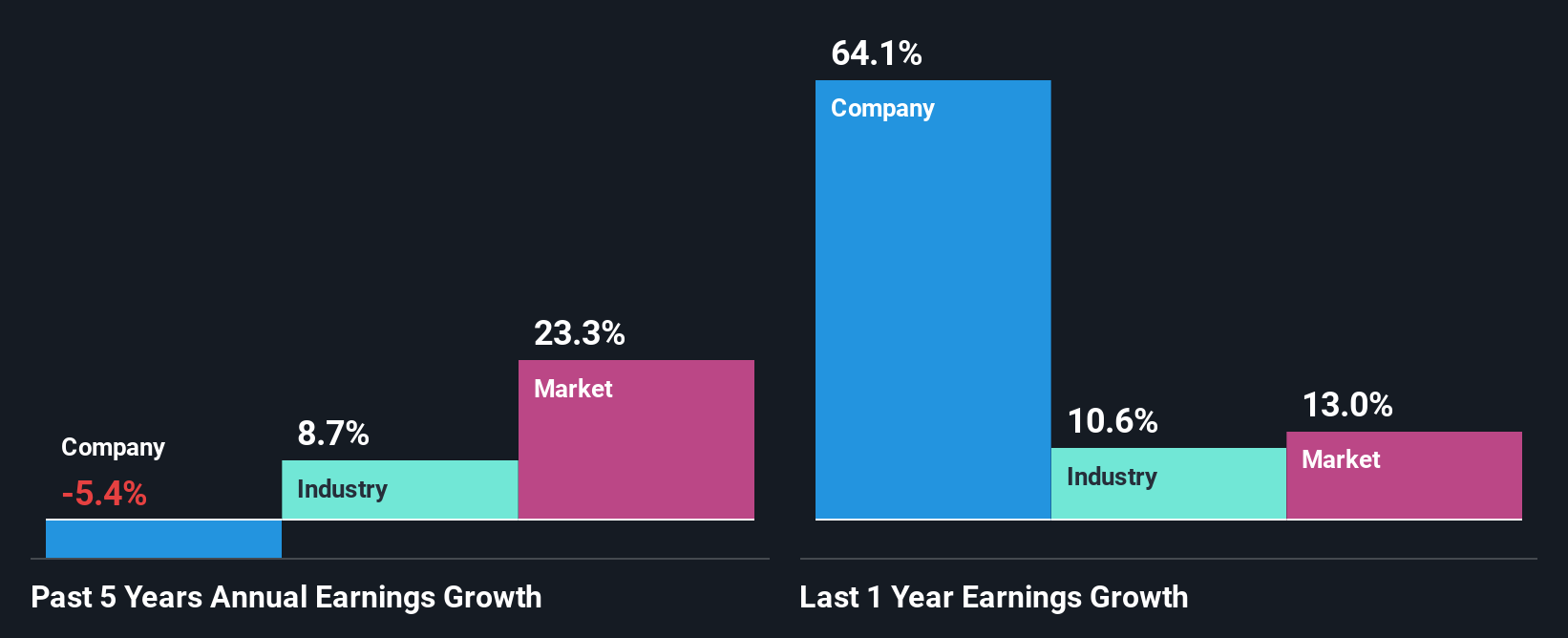
Earnings growth is a huge factor in stock valuation. It’s important for an investor to know whether the market has priced in the company's expected earnings growth (or decline). Doing so will help them establish if the stock's future looks promising or ominous. Is Jubilant Ingrevia fairly valued compared to other companies? These 3 valuation measures might help you decide.
Is Jubilant Ingrevia Efficiently Re-investing Its Profits?
Looking at its three-year median payout ratio of 35% (or a retention ratio of 65%) which is pretty normal, Jubilant Ingrevia's declining earnings is rather baffling as one would expect to see a fair bit of growth when a company is retaining a good portion of its profits. So there could be some other explanations in that regard. For instance, the company's business may be deteriorating.
Moreover, Jubilant Ingrevia has been paying dividends for five years, which is a considerable amount of time, suggesting that management must have perceived that the shareholders prefer consistent dividends even though earnings have been shrinking. Existing analyst estimates suggest that the company's future payout ratio is expected to drop to 17% over the next three years. Accordingly, the expected drop in the payout ratio explains the expected increase in the company's ROE to 13%, over the same period.
Conclusion
On the whole, we feel that the performance shown by Jubilant Ingrevia can be open to many interpretations. Even though it appears to be retaining most of its profits, given the low ROE, investors may not be benefitting from all that reinvestment after all. The low earnings growth suggests our theory correct. Having said that, looking at current analyst estimates, we found that the company's earnings growth rate is expected to see a huge improvement. Are these analysts expectations based on the broad expectations for the industry, or on the company's fundamentals? Click here to be taken to our analyst's forecasts page for the company.
Have feedback on this article? Concerned about the content? Get in touch with us directly. Alternatively, email editorial-team (at) simplywallst.com.
This article by Simply Wall St is general in nature. We provide commentary based on historical data and analyst forecasts only using an unbiased methodology and our articles are not intended to be financial advice. It does not constitute a recommendation to buy or sell any stock, and does not take account of your objectives, or your financial situation. We aim to bring you long-term focused analysis driven by fundamental data. Note that our analysis may not factor in the latest price-sensitive company announcements or qualitative material. Simply Wall St has no position in any stocks mentioned.