
 Nasdaq
 華爾街日報
華爾街日報Is Pulse Oil (CVE:PUL) Using Debt In A Risky Way?
Warren Buffett famously said, 'Volatility is far from synonymous with risk.' So it might be obvious that you need to consider debt, when you think about how risky any given stock is, because too much debt can sink a company. We note that Pulse Oil Corp. (CVE:PUL) does have debt on its balance sheet. But is this debt a concern to shareholders?
When Is Debt A Problem?
Debt and other liabilities become risky for a business when it cannot easily fulfill those obligations, either with free cash flow or by raising capital at an attractive price. In the worst case scenario, a company can go bankrupt if it cannot pay its creditors. However, a more usual (but still expensive) situation is where a company must dilute shareholders at a cheap share price simply to get debt under control. Having said that, the most common situation is where a company manages its debt reasonably well - and to its own advantage. The first step when considering a company's debt levels is to consider its cash and debt together.
How Much Debt Does Pulse Oil Carry?
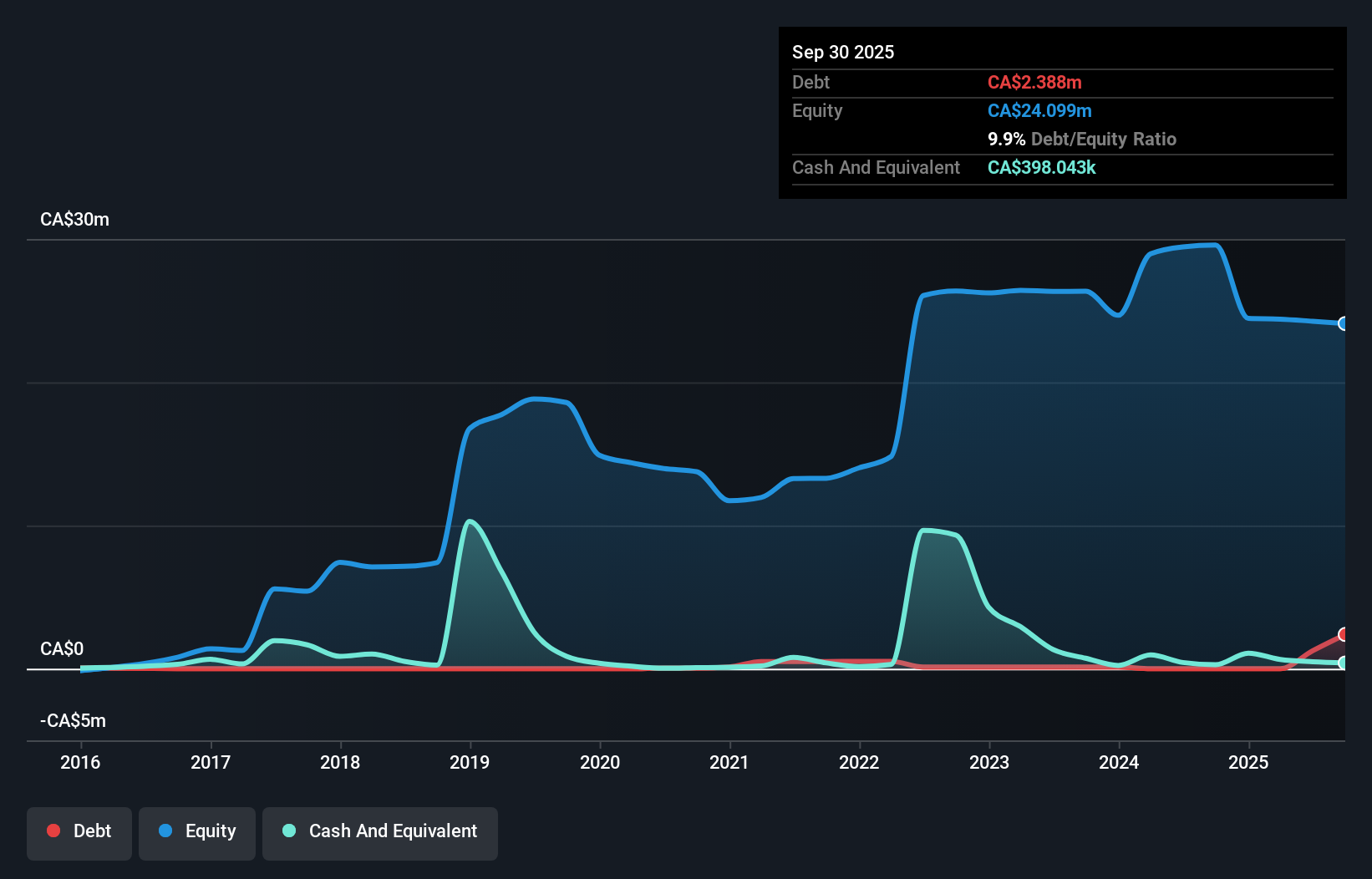
As you can see below, at the end of September 2025, Pulse Oil had CA$2.39m of debt, up from none a year ago. Click the image for more detail. However, it does have CA$398.0k in cash offsetting this, leading to net debt of about CA$1.99m.
A Look At Pulse Oil's Liabilities
According to the last reported balance sheet, Pulse Oil had liabilities of CA$1.38m due within 12 months, and liabilities of CA$5.49m due beyond 12 months. Offsetting this, it had CA$398.0k in cash and CA$167.7k in receivables that were due within 12 months. So its liabilities outweigh the sum of its cash and (near-term) receivables by CA$6.30m.
Given this deficit is actually higher than the company's market capitalization of CA$6.23m, we think shareholders really should watch Pulse Oil's debt levels, like a parent watching their child ride a bike for the first time. In the scenario where the company had to clean up its balance sheet quickly, it seems likely shareholders would suffer extensive dilution. When analysing debt levels, the balance sheet is the obvious place to start. But you can't view debt in total isolation; since Pulse Oil will need earnings to service that debt. So if you're keen to discover more about its earnings, it might be worth checking out this graph of its long term earnings trend.
See our latest analysis for Pulse Oil
In the last year Pulse Oil had a loss before interest and tax, and actually shrunk its revenue by 24%, to CA$3.3m. That makes us nervous, to say the least.
Caveat Emptor
While Pulse Oil's falling revenue is about as heartwarming as a wet blanket, arguably its earnings before interest and tax (EBIT) loss is even less appealing. Indeed, it lost a very considerable CA$5.4m at the EBIT level. Considering that alongside the liabilities mentioned above make us nervous about the company. It would need to improve its operations quickly for us to be interested in it. Not least because it had negative free cash flow of CA$1.4m over the last twelve months. So suffice it to say we consider the stock to be risky. There's no doubt that we learn most about debt from the balance sheet. But ultimately, every company can contain risks that exist outside of the balance sheet. Case in point: We've spotted 5 warning signs for Pulse Oil you should be aware of, and 4 of them are concerning.
Of course, if you're the type of investor who prefers buying stocks without the burden of debt, then don't hesitate to discover our exclusive list of net cash growth stocks, today.
Have feedback on this article? Concerned about the content? Get in touch with us directly. Alternatively, email editorial-team (at) simplywallst.com.
This article by Simply Wall St is general in nature. We provide commentary based on historical data and analyst forecasts only using an unbiased methodology and our articles are not intended to be financial advice. It does not constitute a recommendation to buy or sell any stock, and does not take account of your objectives, or your financial situation. We aim to bring you long-term focused analysis driven by fundamental data. Note that our analysis may not factor in the latest price-sensitive company announcements or qualitative material. Simply Wall St has no position in any stocks mentioned.