


Prediction: This Will Be Sandisk’s Stock Price by the End of 2027
Key Points
Concerns surrounding the state of the NAND flash market may be overblown.
Sandisk's long-term agreements with customers should ensure that it sustains healthy growth in 2027 and beyond.
Sandisk can surge by a big margin by the end of 2027, making it a no-brainer buy at its current valuation.
After an incredible rally in the first half of 2026, shares of Sandisk (NASDAQ:SNDK) have pulled back at an alarming pace in recent months.
The stock has retreated 60% since the beginning of July. Investors have been booking profits in Sandisk stock for various reasons. For instance, the broader semiconductor industry has been under pressure in recent months, as Wall Street is concerned about whether the incredible pace of spending on artificial intelligence (AI) infrastructure is sustainable amid rising inflation, which has led the Federal Reserve to increase interest rates.
Missed AI’s "Act 1"? Act 2 Could Be 15x Bigger. Most investors think they missed the AI boat because they didn't buy Nvidia in 2005. But according to our analysts, we’re only at the end of "Act 1"—the R&D phase. "Act 2" is the global rollout. Continue »
However, this isn't the only reason why Sandisk stock has taken a beating. Concerns about the state of the NAND flash industry that Sandisk serves have played a central role in the stock's decline. Let's look at the factors impacting Sandisk stock lately and check if it can step on the gas in 2027.

Image source: Getty Images.
Potential NAND flash oversupply has pulled down Sandisk stock
Sandisk manufactures NAND flash storage products, including enterprise solid-state drives (SSDs) that are used in AI data centers. The shortage of traditional hard-disk drives (HDDs) forced hyperscalers and AI companies to turn to SSDs to store huge data sets for training and inference workloads.
The demand for NAND flash storage significantly outpaced supply, creating a major shortage that led to a sharp price spike. Market research firm Gartner estimates that NAND flash prices will rise by 293% in 2026, as demand exceeds supply by 9%. The shortage is expected to persist into 2027, with demand exceeding supply by 5%. As a result, Gartner predicts a 30% increase in NAND flash prices next year.
This slower increase in prices has spooked investors, who now believe that Sandisk's days of hypergrowth could be coming to an end. Meanwhile, TrendForce reports that weak consumer demand for NAND has led to a 20% drop in spot prices in just two weeks. The shortage of data center graphics cards in China has led to a decline in enterprise SSD demand, thereby lowering prices.
These divergent views about the state of the NAND flash market in 2027 have weighed on Sandisk's shares recently. However, it is worth noting that lower spot prices don't necessarily mean that the NAND flash market will enter a downward spiral next year. That's because spot contracts usually involve small lot sizes and reportedly account for only 5% of NAND flash revenue.
Contract prices decide the market's direction, as NAND flash customers like to plan well in advance for their needs. This explains why Sandisk has already sold a large chunk of its NAND flash supply for the next two fiscal years under long-term agreements.
Sandisk management noted on the October earnings call that it has already sold 50% of its supply capacity for fiscal 2027 under long-term contracts. Even better, the company has demand commitments for two-thirds of its fiscal 2028 capacity. Management added that its long-term contract pipeline exceeds its supply capacity through the end of the decade.
So, Sandisk has demand visibility for the long run, which explains why its financial performance in fiscal 2027, which has just begun, is going to be solid.
A strong financial performance could send the stock higher in 2027
Sandisk's revenue in the first quarter of fiscal 2027 (which ended Oct. 2) increased by 378% year over year to $11 billion. The company's non-GAAP earnings per share jumped from just $1.22 in the year-ago period to $49.51 in the previous quarter.
Importantly, analysts have become bullish on Sandisk's earnings growth prospects for the next three years.
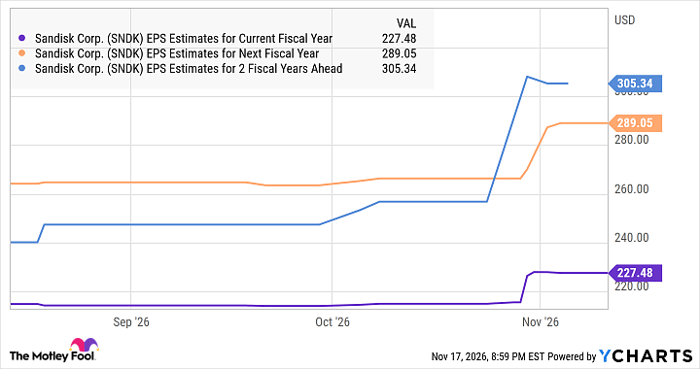
SNDK EPS Estimates for Current Fiscal Year data by YCharts
Additionally, the recent pullback in this semiconductor stock has brought its price-to-earnings (P/E) ratio to just 7. The forward earnings multiple is even more attractive at 3.5. Sandisk is a screaming buy at these multiples, considering the impressive earnings growth it is poised to clock.
Assuming Sandisk's earnings jump to $289.05 in fiscal 2028 (which will end in June 2028) and it continues to trade at 7 times earnings, its stock price could reach $2,023 in a year and a half. That implies potential gains of 145%. Meanwhile, the stock has a 12-month median price target of $2,100, suggesting that Wall Street is even more bullish about its prospects over the coming year.
So, Sandisk can deliver significant upside by the end of 2027, which is why it would make sense to buy this AI stock following its recent decline before it steps on the gas once again.
Harsh Chauhan has no position in any of the stocks mentioned. The Motley Fool recommends Gartner. The Motley Fool has a disclosure policy.